 Lynden
 Custer's Climate and What It Does to Exterior Siding
Custer sits close to the Strait of Georgia and Birch Bay, in the northwest corner of Whatcom County, which means homes here take on a different kind of weather stress than houses further inland. Salt-laden air moves in off the water and settles on exterior surfaces, wind-driven rain finds its way into every gap and seam a builder left behind, and the long gray stretch of fall through spring gives moss and algae months at a time to get established on north-facing walls and anything shaded by trees. None of this is dramatic on its own, but stacked up year after year, it's exactly the combination that wears out the wrong siding material faster than most homeowners expect.
Salt air is corrosive to metal fasteners and trim, and it accelerates the breakdown of paint films and caulking. Driving rain doesn't just wet a wall's surface — on a home with inadequate flashing or a siding product prone to swelling, it pushes moisture behind the cladding, where it can sit against sheathing and framing for weeks at a time in our wet season. And moss, once it takes hold, holds moisture against the wall surface continuously, which is a problem for any material that isn't dimensionally stable when saturated.
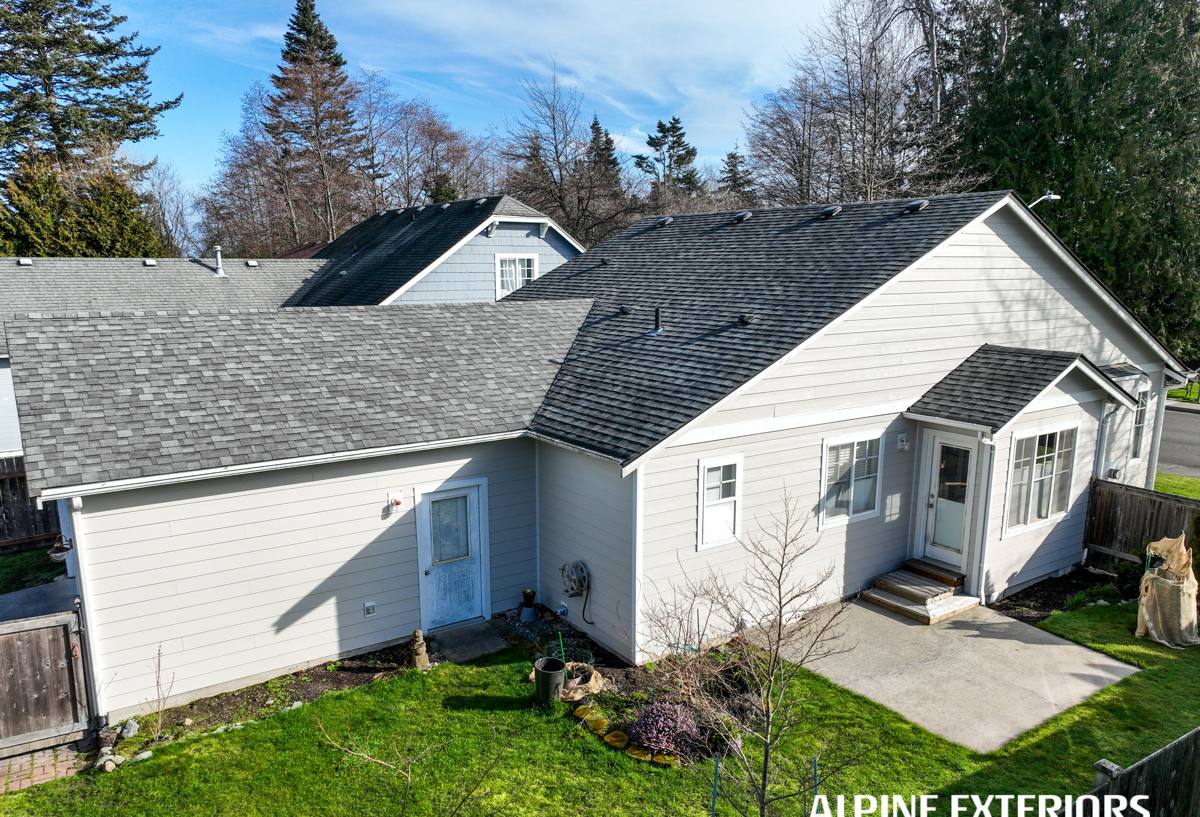
Why We Only Install James Hardie Fiber Cement
We made a deliberate decision as a company to install one siding system — James Hardie fiber cement — and to turn down jobs where a homeowner wants something else. That's not a marketing position; it's a practical one, built around what actually holds up in a climate like Custer's.
Fiber cement is made from cement, sand, and cellulose fibers, which makes it non-combustible and dimensionally stable in a way that wood-based and polymer-based sidings aren't. It doesn't swell when it gets wet and shrink when it dries out, which matters enormously in a place where the siding is wet more often than it's dry for half the year. It holds paint and factory finish far longer than wood products because it isn't expanding and contracting against that finish with every rain event.
James Hardie's ColorPlus factory-applied finish is baked on under controlled conditions, which gives it better UV and moisture resistance than field-applied paint, and it comes with its own finish warranty separate from the product warranty. Hardie also engineers regional product lines — including versions suited to the Pacific Northwest's damp, moderate climate — so the product arriving on a Custer job site isn't a generic one-size-fits-all board.
What We Don't Install, and Why
We don't install vinyl, LP SmartSide, Cemplank, Allura, primed spruce, or raw cedar, and we're upfront about why with every homeowner who asks.
- Vinyl is inexpensive and low-maintenance in mild weather, but it becomes brittle in cold snaps, can warp or buckle from heat and pressure-washing, and offers no real fire resistance — a factor an increasing number of Washington insurers and building departments are weighing more heavily.
- LP SmartSide and other engineered wood products use a wood-strand core with a resin binder. It performs reasonably well when installation and caulking are perfect and stay perfect, but any breach in that seal — a nail pop, a caulk joint that fails, a corner that wasn't sealed correctly — lets moisture into the wood core, and swelling follows. In a market with this much sustained wet weather, that's a maintenance burden we don't want to put on a homeowner.
- Cemplank and Allura are also fiber cement, and they're not bad products — but we've standardized our crews, our fastening specs, and our warranty relationships around one manufacturer so that every job we do gets the same trained installation, not a mix of systems our team touches occasionally.
- Primed spruce and raw cedar are traditional, attractive, and genuinely difficult to keep ahead of in this climate. They require a repainting and caulking cycle that most homeowners underestimate, and any lapse in that maintenance shows up as rot faster than people expect, especially on the shaded, moss-prone sides of a house.
None of these are failures of those products in every application — they're trade-offs we've decided aren't worth putting on a Custer roofline given the salt air, rain, and moss this area sees.
Full Exterior Services, Not Just Siding
Siding doesn't work in isolation. Water that gets past a roof edge, a window flashing detail, or a deck ledger board ends up in the same wall assembly siding is supposed to protect. That's why we handle siding, roofing, windows, and decks as one connected scope of work rather than farming pieces out to different trades who never talk to each other.
On a siding project, our crews are also looking at your roof edge and flashing details, window trim and sealant condition, and any deck ledger or attachment point where water tends to collect. Catching a bad flashing detail during a siding job is far cheaper than discovering it later as a rot repair.
What Correct Installation Involves
Fiber cement performs the way it's engineered to only when it's installed to manufacturer specification, and that's where a lot of siding jobs — regardless of brand — go wrong.
- Weather-resistive barrier and flashing first. The house wrap and flashing behind the siding does the real waterproofing work; siding is the second line of defense, not the first.
- Correct fastener pattern and type. James Hardie specifies fastener spacing, type, and embedment depth. Under-fastening or using the wrong fastener is one of the most common causes of siding failure we see when we're called to assess someone else's install.
- Proper clearances. Siding needs a gap from grade, roof lines, decks, and other transitions so it isn't holding standing water against its edge — a detail that matters even more with the rain volume Whatcom County sees.
- Caulking and joint treatment done to spec, not skipped or rushed, especially at butt joints and trim intersections where moss and algae tend to accumulate first.
- Factory-primed and factory-finished panels handled and cut correctly so cut edges get sealed, preserving the warranty and the moisture resistance of the finish.
Comparing Siding Materials for a Coastal Whatcom County Climate
| Material | Moisture Behavior | Maintenance | Fire Resistance | Typical Lifespan |
|---|---|---|---|---|
| James Hardie Fiber Cement | Dimensionally stable, low absorption | Low — occasional wash, no repainting for years | Non-combustible | 30+ years with correct install |
| Vinyl | Doesn't absorb water but can trap it behind panels | Low, but brittle over time | Combustible, can melt/warp | 15-25 years |
| LP SmartSide / Engineered Wood | Vulnerable at breached seams and cuts | Moderate — caulk and paint upkeep required | Combustible | 20-25 years if maintenance stays current |
| Primed Spruce / Cedar | Absorbs moisture readily, prone to swelling | High — regular repainting and sealing | Combustible | Variable, heavily maintenance-dependent |
Signs a Custer Home May Need New Siding
- Persistent moss or dark streaking on north- or shade-facing walls that comes back soon after cleaning
- Soft spots, bubbling, or visible swelling, especially near butt joints and corners
- Paint that's peeling or alligatoring faster than a normal repaint cycle would suggest
- Visible gaps, warping, or panels that have pulled away from the wall
- Rising energy bills that may point to compromised insulation behind failing siding
- Rot or soft wood discovered around window and door trim
What Affects the Cost of a Siding Project
| Factor | Why It Matters |
|---|---|
| Home size and wall complexity | More corners, gables, and dormers mean more cutting, flashing, and labor time |
| Siding profile (lap, shingle, panel) | Shingle and specialty profiles take longer to install than standard lap |
| Existing damage to sheathing or framing | Rot discovered during tear-off adds repair scope before new siding goes on |
| Trim and accessory work | Trim boards, soffit, and fascia often get addressed at the same time for a clean result |
| Access and site conditions | Trees, slopes, and setback distances affect scaffolding and staging |
We give every Custer homeowner a specific, written number after walking the property — broad ranges you'll see quoted online rarely account for the condition of what's underneath the old siding, which is often the biggest variable.
Why a Local Crew Matters
A crew based near Lynden and working regularly throughout Whatcom County has already seen how the salt air off Birch Bay and the Strait affects fastener corrosion, how moss establishes itself on shaded gables through our wet months, and how driving rain off the water finds weak flashing details that a drier-climate crew might never think to check. That local pattern recognition shows up in the details — where extra flashing gets added, which trim intersections get extra attention, how a home is oriented to prevailing wind and rain. It also means a real phone number and a crew that's still around the following year if a warranty question comes up.
Get an Estimate
If you're noticing moss buildup, peeling paint, or soft spots on your Custer home's siding, we're happy to take a look. We'll walk the exterior, point out anything roofing, window, or deck-related that's connected to the siding's performance, and give you a straightforward, no-pressure estimate for James Hardie fiber cement siding built for this climate.