 Lynden
 Everson's Climate and What It Does to Exterior Siding
Everson sits in the Nooksack River valley in Whatcom County, a few miles from our shop in Lynden. It's a river-bottom community, and that geography shapes what siding has to deal with here. Humidity sits high for much of the year, fog settles into the valley on cold mornings, and the ground stays saturated well into spring. Add driving rain off the marine air that moves up the lowlands from the Strait, and you've got an exterior environment that's tough on any building material that isn't built for sustained moisture exposure.
Moss and algae are the most visible symptom. On north- and west-facing walls, and anywhere siding sits close to landscaping or tree cover, organic growth shows up fast and keeps coming back through most of the year. Wood-based siding products absorb moisture, which feeds that growth and eventually leads to swelling, delamination, and rot at seams and butt joints. Paint film on wood siding also breaks down faster in this kind of sustained damp than it would in a drier climate, which means more frequent repainting just to keep water out.
None of this is unique to Everson — it's the reality across Whatcom County — but low-lying river valley properties tend to see it a little sooner and a little worse than homes up on higher, better-drained ground. That's the baseline we design every install around.
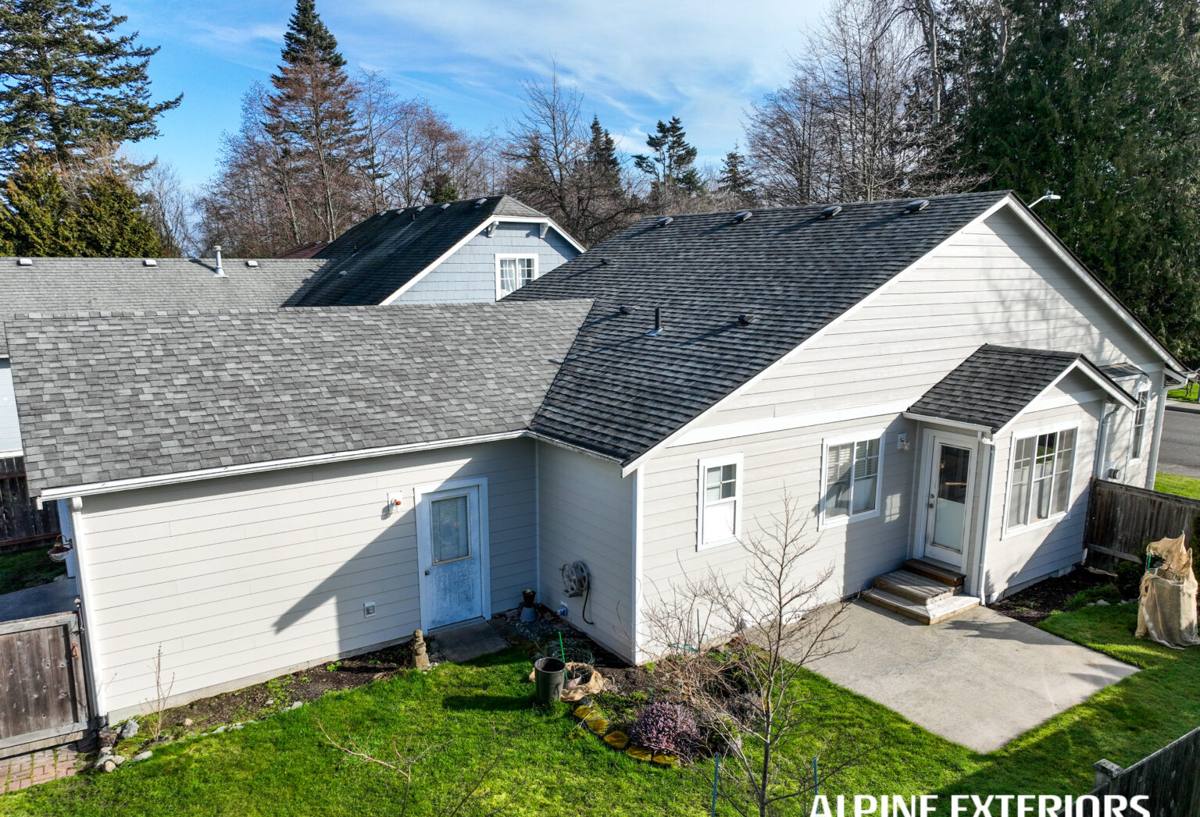
Why We Install Only James Hardie Fiber Cement
We made a decision a while back to standardize on James Hardie fiber cement siding and stop installing everything else — no LP SmartSide, no vinyl, no Cemplank or Allura, no primed spruce or cedar. That's not a marketing angle. It's because fiber cement is cement-based, not wood-based, so it doesn't absorb water the way wood products do and it doesn't feed rot the way an organic substrate can. In a climate like ours, that difference matters over a 20- or 30-year ownership horizon, not just in year one.
James Hardie's ColorPlus finish is baked on at the factory under controlled conditions, which gives a more consistent, longer-lasting bond than field-applied paint. It also holds up better against the kind of freeze-thaw and wet-dry cycling that happens through a Whatcom County winter. And because it's fiber cement, it's non-combustible — a genuine advantage during wildfire smoke seasons and simply a safer material to have on a home.
We're not going to tell you every alternative product is unusable. Vinyl is inexpensive and low-maintenance in mild climates. Cedar looks great when it's new and well cared for. Engineered wood products have improved a lot over the years. But each of them asks the homeowner to accept a trade-off — impact resistance, moisture tolerance, repainting cycles, warranty structure — that we don't think makes sense to sell in a market with this much sustained rain and humidity. Hardie is the one product line where we're comfortable standing behind the install for the long haul.
What We Give Up by Not Offering Alternatives
Being honest about this cuts both ways. Some homeowners want the lowest possible upfront cost, and vinyl will always beat fiber cement on that front. Others want a specific wood look that only real cedar delivers. We're not the right fit for every siding job in Everson, and we'd rather say that upfront than sell a product we don't believe holds up here.
Choosing the Right Hardie Product Line
James Hardie makes several distinct product lines, and the right one depends on the home's style and what look you're going for. We spec Hardie's HZ5 climate-engineered formulation for this region, which is built for areas that see freeze-thaw cycling and heavy moisture — a good match for the Nooksack valley.
- HardiePlank lap siding — the most common choice, available in several exposure widths and both smooth and cedar-textured finishes. Works on nearly any home style.
- HardiePanel vertical siding — often used for board-and-batten looks or as an accent on modern and farmhouse-style homes.
- HardieShingle — a staggered or straight-edge shingle profile for homes that want a traditional shingle look without the maintenance of real cedar shingles.
- HardieTrim — fiber cement trim boards that match the siding's moisture resistance, used around windows, corners, and fascia so the whole exterior envelope is consistent.
Color is a real decision too. ColorPlus comes in a fixed palette of factory finishes with a matching touch-up system, which means color consistency stays solid for years without a repaint. We walk homeowners through which colors read well against Whatcom County's typical grey-sky light, since colors that look punchy on a sunny sample board can read very differently under our normal overcast conditions.
What a James Hardie Install Actually Involves
Fiber cement siding is only as good as the install behind it, and this is where a lot of the long-term performance is won or lost. Correct installation in a wet climate means:
- Removing existing siding down to the sheathing and inspecting for hidden moisture damage or rot before anything new goes on.
- Installing a code-compliant weather-resistive barrier and correctly integrated flashing at every window, door, and penetration.
- Maintaining proper clearance at the bottom of the siding — off the ground, off decks and patios, off roof lines — so water has somewhere to go instead of wicking into the board.
- Following Hardie's fastening and joint-treatment specifications exactly, including gapping and caulking at butt joints, since improper fastening is the single most common cause of early failure in fiber cement installs.
- Field-priming any cut edges that aren't factory-finished, so the cement core isn't left exposed to moisture.
Skipping any of these steps is how you end up with a Hardie install that underperforms — and it's also exactly why James Hardie's warranty coverage depends on installation by a certified, qualified contractor. The product is engineered for this climate; the workmanship has to match it.
More Than Siding: Roofing, Windows, and Decks
Siding doesn't work in isolation. A house is one connected building envelope, and the roof, windows, and decks all interact with how water moves around a home. We handle all four because a siding job that ignores a failing roof edge or a leaking window flashing is only solving part of the problem.
- Roofing — a roof in poor condition sends water down behind siding at the eaves and rakes, undermining even a perfect siding install.
- Windows — window flashing integration is one of the most common failure points we find when we open up old siding, and it's addressed at the same time as a siding replacement whenever possible.
- Decks — deck ledger boards and siding termination points are a frequent source of trapped moisture if they aren't detailed correctly during a siding job.
Handling these trades together means fewer handoffs, fewer contractors pointing fingers at each other's work, and a building envelope that's been thought through as a whole rather than patched trade by trade.
Why a Lynden-Based Crew Matters in Everson
We're based in Lynden, a short drive from Everson, and that proximity is more than convenience. A crew that works this specific valley regularly knows which sides of a house take the worst weather, how the local moss and algae growth patterns behave through the seasons, and what the ground conditions look like on river-adjacent lots. That local knowledge shapes real decisions — where extra flashing attention matters most, which exposures need closer joint inspection down the road, and how to sequence a project around the wetter months instead of fighting them.
Being local also means we're not disappearing after the final walkthrough. Warranty service, follow-up questions, and future maintenance conversations are with a crew that's still working in Whatcom County, not a contractor that worked through the area once and moved on.
What Affects the Cost of a Siding Project
Every home is different, but a few factors consistently drive the price of a siding replacement in this area. We don't quote specifics without seeing the house, but here's what we're weighing:
| Factor | Why It Matters |
|---|---|
| Home size and wall complexity | More corners, dormers, and cutouts mean more material waste and labor time |
| Existing siding removal and disposal | Tear-off of old wood or vinyl adds labor beyond a straightforward install |
| Hidden sheathing or rot repair | Common on older homes once siding comes off; can't be priced until it's found |
| Product line and profile | Lap, panel, and shingle profiles carry different material and labor costs |
| Trim and detail work | Window and corner trim, especially on older or custom homes, adds time |
| Access and site conditions | Steep lots, tight setbacks, or landscaping close to the house slow the work |
Maintaining Hardie Siding in a Wet Climate
Fiber cement asks for less upkeep than wood, but "low-maintenance" doesn't mean "no-maintenance," especially in a place with this much sustained moisture and moss pressure. A simple annual routine goes a long way:
- Rinse siding down once a year, focusing on north- and west-facing walls where moss and algae collect fastest.
- Keep landscaping and tree branches trimmed back from siding to improve airflow and reduce shaded, damp surfaces.
- Check caulking at trim and joints every couple of years and re-caulk where it's cracked or pulled away.
- Watch gutters and downspouts — overflow onto siding during heavy Whatcom County rain events is a common cause of localized staining and moisture problems.
- Inspect the bottom edge of the siding near grade, decks, and patios periodically to confirm clearance hasn't been reduced by mulch, soil buildup, or new hardscaping.
If you're in Everson and thinking about what your siding is up against after another wet season, we're happy to take a look and talk through what we're seeing — no pressure, no obligation. Reach out for a free estimate using the form below.