 Lynden
 Birch Bay's Exterior Climate Is Different From Inland Lynden
Birch Bay sits right on the water, and that changes what a house's exterior has to deal with year-round. A few miles inland in Lynden, homes get the standard Pacific Northwest workload — steady rain, cool damp winters, shaded north walls that never quite dry out. Out at Birch Bay, you add a layer on top of that: salt-laden air coming off the water, wind-driven rain that hits siding at an angle instead of falling straight down, and stretches of the year where moss and algae get a real foothold on anything that stays wet too long.
None of that makes Birch Bay a bad place to own a home. It just means the exterior envelope — siding, trim, roofing, windows — has to be chosen and installed with that exposure in mind. A product or installation detail that's "good enough" on a sheltered inland lot in Lynden can fail faster a few miles away, closer to the water.
What Salt Air Actually Does to a Building Exterior
Salt air isn't just a coastal cliché. Airborne salt is hygroscopic — it pulls moisture out of the air and holds it against whatever surface it lands on. On metal fasteners, flashing, and hardware, that means accelerated corrosion if the wrong materials are used. On wood-based siding products, it means the surface stays damp longer between rain events, which speeds up rot, delamination, and paint failure. On any siding with exposed end-cuts or seams that aren't properly sealed, salt-laden moisture finds its way in and does its damage from the inside out, where you can't see it until the problem is advanced.
Driving Rain and Wind Exposure
Because Birch Bay is open to the water, storms don't just drop rain straight down — wind pushes it sideways into walls, under trim, and around window and door openings. That kind of driving rain finds every gap in flashing, every under-caulked joint, and every seam that wasn't lapped correctly. It's a much tougher test of installation quality than a sheltered inland lot, which is part of why we treat flashing and water management details as non-negotiable on every coastal job, not just an upsell.
Moss, Algae, and the Long Wet Season
Whatcom County's wet season runs long, and Birch Bay's proximity to the water keeps humidity up even between rain events. Shaded walls, north-facing elevations, and anywhere siding stays damp longer than it should are prime territory for moss and algae growth. Beyond looking bad, sustained moss growth holds moisture against the siding surface, which is exactly the condition that shortens the life of moisture-sensitive materials.
Why Material Choice Matters More at Birch Bay Than Inland
Every siding material has trade-offs. Those trade-offs get magnified the closer a house sits to salt water and open wind exposure. This is the honest version of how the common options hold up under Birch Bay conditions:
- Vinyl siding is inexpensive and low-maintenance in mild conditions, but it can become brittle and prone to cracking in cold snaps, and its seams and J-channels give wind-driven rain more opportunities to get behind the cladding.
- Primed wood or cedar looks great when new and can be a legitimate choice for the right owner, but it demands an ongoing repainting and caulking schedule that gets harder to keep up with in a salt-air, high-moisture environment — miss a cycle and rot can start before you notice.
- LP SmartSide and other engineered wood products perform reasonably well inland, but their wood-strand core is more sensitive to sustained moisture exposure at cut edges and seams than a true fiber cement product — exactly the kind of exposure Birch Bay's driving rain creates.
- Fiber cement (James Hardie) is non-combustible, dimensionally stable, and doesn't have a wood-strand core to swell or delaminate. It's the product we've standardized on for exactly this kind of exposure.
The James Hardie System We Install
We install James Hardie fiber cement exclusively — not as a sales preference, but because after years of working on homes across Whatcom County's range of exposures, from sheltered Lynden lots to open water frontage at Birch Bay, it's the product we trust to hold up without excessive upkeep.
HZ5 Engineering for This Climate
Hardie's HZ5 product line is engineered specifically for climates like ours — freeze-thaw cycling, sustained moisture, and coastal exposure. It's formulated and tested for the wetter, cooler conditions of the Pacific Northwest rather than a one-size-fits-all national spec.
ColorPlus Factory Finish
Hardie's ColorPlus finish is baked on at the factory under controlled conditions, which gives it more consistent coverage and better fade and moisture resistance than a field-applied paint job. For a Birch Bay home dealing with salt air and sun exposure off the water, that factory-cured finish holds its color and integrity longer than most site-applied coatings — and it comes with a stronger warranty backing than a repaint would.
A Non-Combustible, Stable Core
Fiber cement doesn't have a wood-strand core to absorb moisture and swell, and it's non-combustible — a genuine advantage during the dry season when wildfire smoke and regional fire risk are a real concern even here in the wetter northwest corner of the state.
Coastal-Exposure Siding at a Glance
| Factor | Vinyl | Wood / Cedar | Engineered Wood (LP) | James Hardie Fiber Cement |
|---|---|---|---|---|
| Salt air resistance | Fair | Poor without upkeep | Fair | Strong |
| Driving-rain seam risk | Higher (many seams) | Moderate | Moderate | Lower with correct install |
| Moisture-related core damage | Not applicable | High risk | Moderate risk | Not a wood core |
| Maintenance cycle | Low | Frequent repaint/caulk | Moderate | Low with ColorPlus |
| Fire rating | Combustible | Combustible | Combustible | Non-combustible |
It's Not Just Siding — the Whole Exterior Envelope Matters
A house is a system. Salt air and driving rain don't stop at the siding line, so we look at the whole exterior when we're out at a Birch Bay property.
Roofing
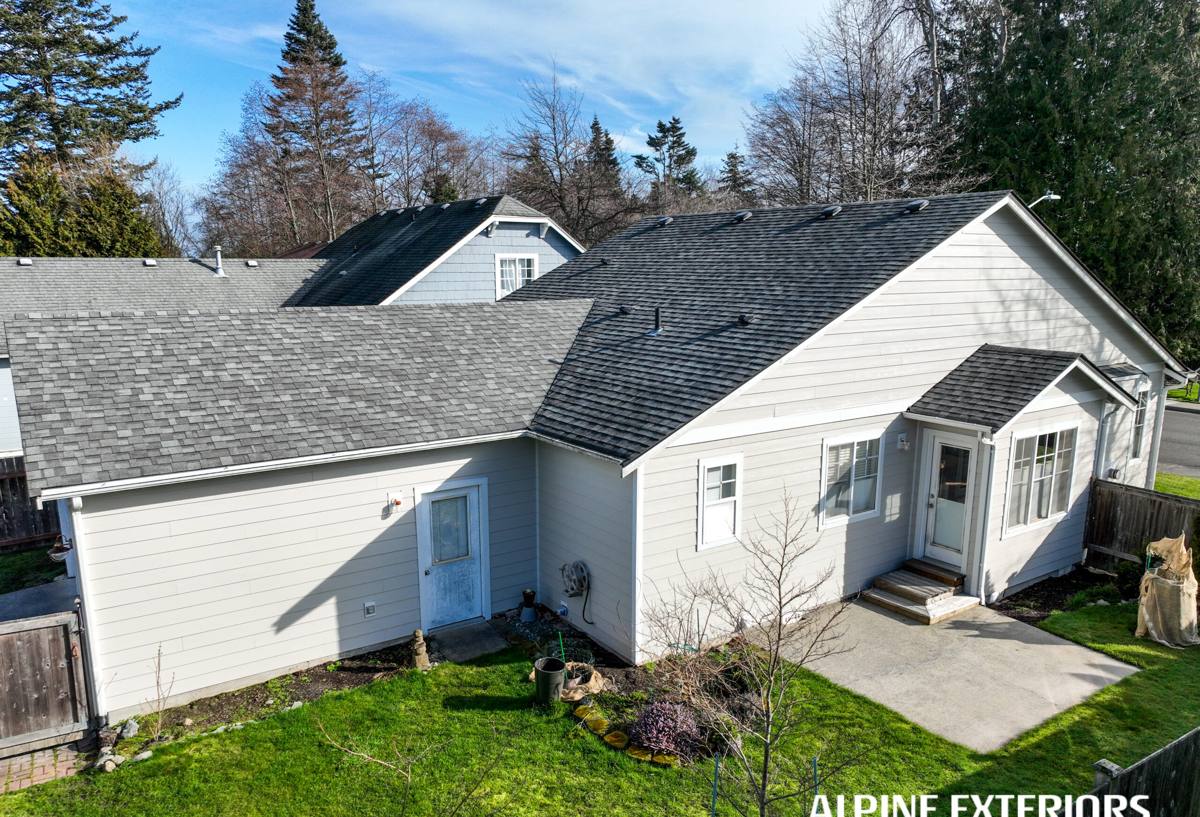
Roofing takes the brunt of wind-driven rain and salt deposition first. Flashing details at valleys, chimneys, and wall intersections matter even more here than inland, because a small leak at the roofline can travel down behind siding and show up as damage somewhere else entirely.
Windows
Window flashing and integration with the siding plane is one of the most common failure points we find on coastal homes — not because the windows themselves are bad, but because the water management around them wasn't detailed for this level of wind and rain exposure.
Decks
Decks facing the water take direct salt spray and sun exposure that inland decks don't. Fastener choice, board spacing for drainage, and ledger flashing all matter more here to avoid premature wear.
Why a Local Whatcom County Crew Matters
Coastal exposure isn't uniform even within a small area — a wall facing the water gets a very different beating than a wall tucked behind a windbreak of trees a hundred yards away. A crew that works across Whatcom County regularly, from inland Lynden out to the water at Birch Bay, has actually seen how these micro-exposures play out over time on real homes, not just in a manufacturer's spec sheet. That's the kind of judgment that goes into flashing details, fastener selection, and where to add extra water-management attention — decisions a crew unfamiliar with this specific coastline wouldn't necessarily think to make.
It also means someone local is available if a warranty question or a storm-related concern comes up later, rather than chasing down a contractor who did a one-off job and moved on.
What the Project Process Looks Like
Every home is different, but a typical re-siding project at Birch Bay follows the same general shape:
- On-site assessment of current siding condition, moisture damage (if any), and exposure on each elevation.
- Review of Hardie product lines, profiles, and ColorPlus color options suited to the home and its exposure.
- Removal of old siding and inspection of the sheathing and framing underneath for hidden moisture damage.
- Correction of any water-management issues found — flashing, house wrap, window and door integration — before new siding goes on.
- Installation to Hardie's specifications, including proper fastening, clearances, and joint treatment for this climate.
- Final walkthrough and warranty documentation.
Questions Worth Asking Before You Hire Anyone
- Will the crew inspect the sheathing underneath before installing new siding, or just cover what's there?
- What flashing and water-management details will be used around windows, doors, and roof intersections?
- Is the siding product rated for coastal or high-moisture exposure, or is it a general-purpose spec?
- What does the manufacturer's warranty actually cover, and is it transferable if you sell the home?
- Does the crew have experience with homes in this specific area, not just the region broadly?
What This Means for Your Home
If your Birch Bay home is showing early signs of moss buildup, paint failure, soft spots near trim, or siding that just never seems to fully dry out, those are worth addressing before they become structural. And if you're building new or planning a full exterior refresh, it's worth starting with a material built for this exposure rather than retrofitting problems later.
We're happy to take a look at your home, walk the exterior with you, and talk through what we're seeing — no pressure, no obligation. Reach out for a free estimate and we'll give you a straight answer about what your home needs.