 Lynden
 Siding Replacement for Birch Bay Homes, From a Crew That Works This Coastline
Birch Bay takes a different kind of weather than most of the towns we work in around Whatcom County. It sits right on the water, which means homes here get more direct salt exposure, more wind-driven rain, and a longer moss season than a house set back even a few miles inland. When siding fails in Birch Bay, it's rarely because the homeowner ignored it — it's because the original material or installation wasn't built for what this specific stretch of coastline throws at a wall year after year.
We're based in Lynden, a short drive inland, and we run crews on Birch Bay siding jobs regularly enough that this climate isn't a surprise to us. We install James Hardie fiber cement exclusively — no vinyl, no LP SmartSide, no Cemplank, no Allura, no primed spruce or cedar — because after years of tear-offs and repairs in exactly this kind of marine environment, that's the one system we're willing to fully stand behind. This page is specifically about full siding replacement for Birch Bay properties: what the climate demands, what a correct job actually involves, and how our process works from first look to final walkthrough.
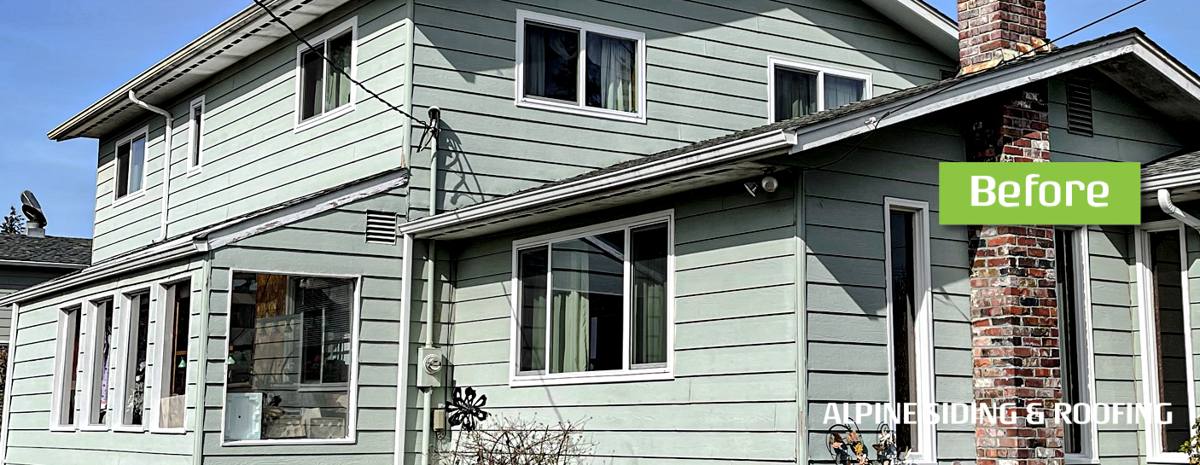
What Salt Air, Driving Rain, and Moss Actually Do to Birch Bay Siding
Salt-Laden Marine Air
Being directly on the bay means Birch Bay homes take on more airborne salt than almost anywhere else in the county. That salt works on metal continuously — fasteners, flashing, trim hardware — accelerating corrosion in ways that don't show up as dramatic failures at first, just a slow weakening that eventually shows up as rust streaking, loose trim, or a fastener that's lost its grip. Siding materials and hardware chosen without that exposure in mind tend to age faster here than the same products would a few miles inland.
Driving Rain That Hits Walls Sideways
Waterfront exposure also means more sustained wind, and wind-driven rain doesn't behave like a normal rainstorm. It gets pushed horizontally into wall assemblies, siding joints, and window and door flashing instead of falling straight down and running off. That's a heavier, more persistent moisture load than annual rainfall totals suggest, and it's the reason siding that performs fine in a sheltered inland yard can still let water in behind the cladding on a Birch Bay wall facing the water.
A Long Moss and Mildew Season
Mild temperatures, near-constant humidity, and shade from trees or neighboring structures combine to give Birch Bay a moss and mildew season that can run close to year-round on the wrong wall. North-facing and tree-sheltered siding is usually first to show it. Any siding that's even slightly porous, or that holds moisture against the substrate instead of shedding it, becomes a growth surface — and once moss and mildew take hold, they hold moisture against the wall even longer, which speeds up whatever damage is already happening underneath.
Signs Birch Bay Siding Has Reached Replacement, Not Repair
Not every siding problem means a full tear-off. But in a climate this demanding, a few signs consistently point to replacement rather than a patch-and-hope approach:
- Soft, spongy, or crumbling siding, especially near the bottom of walls or around window and door trim
- Moss or dark staining that returns within weeks of cleaning, particularly on shaded or water-facing walls
- Visible warping, cupping, or buckling across multiple panels or boards
- Rust streaking running down from fasteners, trim, or flashing
- Paint that won't hold — repeated peeling or bubbling within a year or two of repainting
- Musty odors or staining on interior walls that back up to exterior siding
- Siding older than 20-25 years with no documented replacement, regardless of its current appearance
Any one of these is worth a professional look. Several at once, especially on a water-facing wall, usually means the siding has been letting moisture in for a while and a repair would just be delaying a bigger problem.
Why We Replace Birch Bay Siding With James Hardie Only
We used to install a wider range of siding products. We stopped, and the decision came from what we kept finding on Birch Bay tear-offs specifically — swollen engineered wood at cut edges, vinyl that had cracked or bowed under sun and salt exposure, cedar and primed spruce that needed refinishing far more often than the original sales pitch implied. None of those products are junk; they're just not built for this level of sustained moisture and salt.
- Non-combustible core: Fiber cement doesn't feed a fire the way wood-based siding can, which matters for both safety and insurance underwriting.
- Factory-applied ColorPlus finish: The color is baked on in a controlled factory process instead of brushed on in the field, which holds up far longer against fading, chalking, and moisture intrusion than site-applied paint.
- Climate-engineered HZ product lines: Hardie's HZ5 formulation is built for regions with heavy moisture exposure and freeze-thaw cycling — a close match for waterfront Whatcom County.
- Dimensional stability: Fiber cement doesn't swell, warp, or cup the way engineered wood repeatedly can after a wet season on an exposed wall.
- Strong transferable warranty: Hardie backs the product with one of the more robust warranty structures in the industry, provided installation follows their published spec.
Each of the products we don't install has a legitimate place in the market, and plenty of homeowners elsewhere are satisfied with them. Our position is a professional one, not a claim that those products are defective: on a shoreline exposure like Birch Bay, we'd rather install and warranty one system we fully trust than offer a cheaper alternative that quietly shifts more long-term maintenance risk onto the homeowner.
What a Correct Siding Replacement Involves
Tear-Off and Sheathing Inspection
Once the old siding comes off, the sheathing underneath gets a real inspection, not a glance. Rot or soft spots at this stage are common on older Birch Bay homes, especially on water-facing or shaded walls, and covering damaged sheathing with brand-new siding just hides a problem that keeps getting worse behind the wall. We'd rather find it now and address it directly.
Weather Barrier and Flashing
Given how much siding failure on this coastline traces back to water getting behind the cladding rather than through it, the house wrap, window and door flashing, and every wall penetration get careful attention here. This step is easy to rush and nearly impossible to inspect once new siding is up, so we treat it as a non-negotiable part of the job, not an optional upgrade.
Fastener and Hardware Selection
Given the salt exposure directly off the bay, fastener and trim hardware corrosion resistance matters more in Birch Bay than in most of the towns we work in. We spec fasteners and flashing metal with that exposure in mind rather than defaulting to whatever's standard for a drier, inland job.
Installation to Manufacturer Spec
James Hardie's warranty depends on installation following their published specifications — correct fastener type and spacing, proper clearance above grade and roofline, and correctly sealed or factory-mitered joints. A Hardie product installed loosely will still develop moisture problems in a climate like this one; the material only performs as well as the installation behind it.
Final Walkthrough
We walk the finished job with the homeowner, cover realistic care and maintenance expectations for this climate, and confirm everything matches what was estimated before calling the project done.
What Drives the Cost of a Birch Bay Siding Replacement
| Factor | Why It Matters Here |
|---|---|
| Total square footage and number of stories | More wall area and height directly affect material and labor time |
| Sheathing condition after tear-off | Water-facing and shaded walls on older Birch Bay homes more often need sheathing repair before new siding goes up |
| Trim and detail complexity | Windows, corners, and rooflines all add flashing and cutting time, and correct flashing matters more in wind-driven rain |
| James Hardie product line and color | HZ5 panel, lap, and shingle-style options vary in material cost and finish |
| Access and site conditions | Waterfront lots, retaining walls, or tight setbacks can affect staging and labor time |
Every estimate is specific to the house. We walk through these factors directly during the on-site visit rather than handing over a number with no explanation behind it.
A Simple Checklist Before Hiring for Siding Replacement in Birch Bay
- Ask what siding material they install and why, and whether they back it with a written, transferable warranty
- Confirm current Washington contractor licensing and active liability insurance
- Ask specifically how they detail flashing at windows, doors, and roof-to-wall transitions for wind-driven rain off the water
- Ask what happens if rotted sheathing turns up during tear-off, and how that's priced
- Ask about fastener and hardware corrosion resistance given the salt exposure
- Get a clear, written scope of work before signing anything
Why It Matters That We're a Lynden Crew Who Actually Works Birch Bay
Lynden isn't on the water, but it's close enough that we're on Birch Bay job sites on a regular basis, not bidding a job from across the state and showing up once. That regular exposure to this specific coastline shapes real decisions on-site — which walls on a given lot stay wet longest, where extra flashing attention is worth the time, which fastener grade actually holds up out here. Those are the kinds of details that separate a siding job that lasts one or two wet seasons before problems show up from one that holds for decades. It also means that if a warranty question or maintenance issue comes up years down the road, it's a call to a crew still working this same area, not a company that's moved on.
If your Birch Bay home needs new siding, we're glad to come take a look and walk you through exactly what we're seeing and why. Reach out using the form below for a free, no-pressure estimate.