 Lynden
 Siding Built for Laurel's Weather, Not Against It
Laurel sits in the rural stretch of Whatcom County between Lynden and the Nooksack River bottomland, close enough to the Salish Sea that salt-tinged air, low-lying moisture, and long gray stretches of drizzle are just part of living here. Homes in Laurel tend to be spread out on larger lots, often with mature trees, open farmland exposure, or a mix of both — and that combination shapes how exterior materials hold up over the years. We've been doing siding, roofing, windows, and decks across Whatcom County long enough to know that what works on a tight suburban lot in Bellingham doesn't always perform the same way out here, where wind has more room to build speed and moisture has more time to sit.
This page is about siding specifically, and about being straight with you on what we install and why. We only install James Hardie fiber cement siding. We don't install vinyl, LP SmartSide, Cemplank, Allura, or bare cedar and primed spruce. That's not a marketing line — it's a standard we've held to because of what we've seen happen to the alternatives on homes exactly like the ones in and around Laurel.
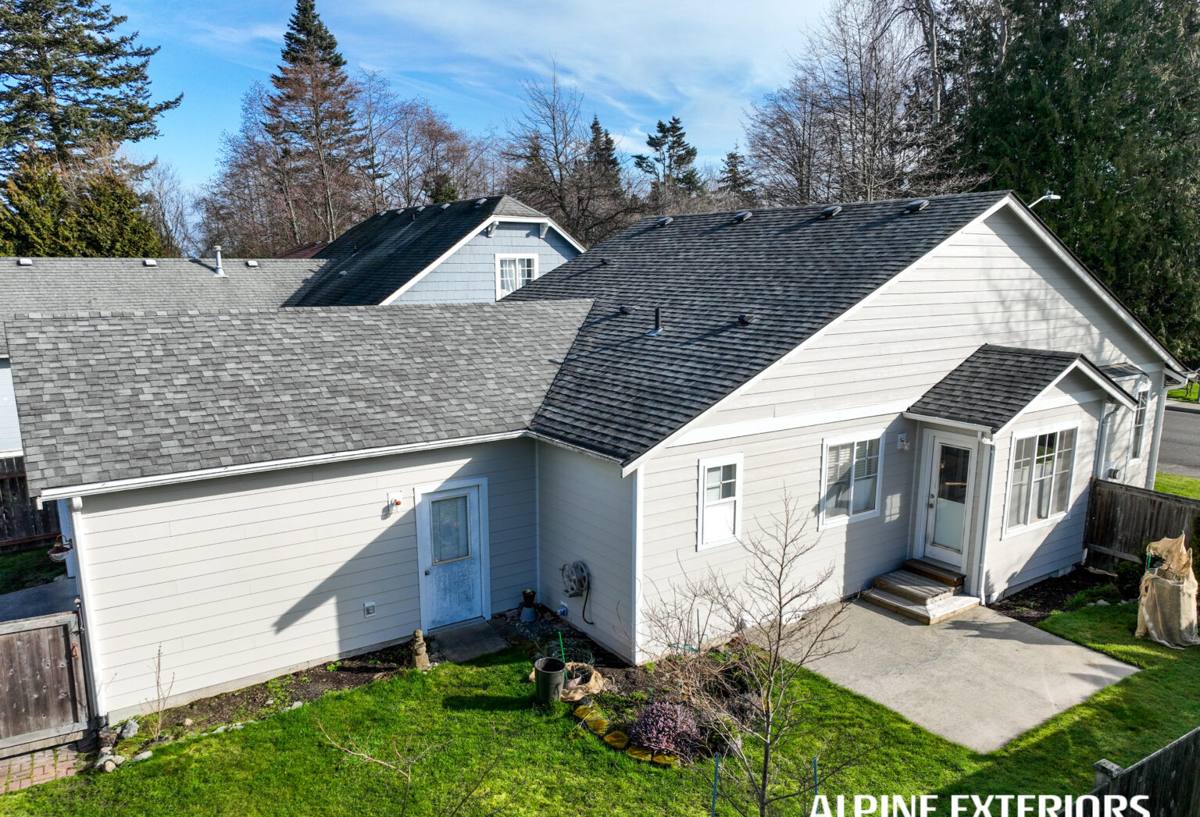
What Laurel's Climate Actually Does to Siding
Salt Air and Coastal Drift
Laurel isn't beachfront, but Whatcom County's proximity to Puget Sound and the Strait of Georgia means salt-laden air moves inland more than most homeowners realize, especially during winter storm systems. Salt air accelerates corrosion on fasteners and trim, and it works against paint films that aren't formulated to resist it. Over years, that shows up as chalking, fading, and eventually cracking on lower-grade siding materials.
Driving Rain
Wind-driven rain is the real test for any siding system, not just how much rain falls but how hard and at what angle it hits the wall. Laurel's open, rural exposure means wind can carry rain sideways into wall assemblies more aggressively than in a sheltered in-town lot. Any siding that relies on paint film alone to keep water out, rather than being dimensionally stable and moisture-resistant at the material level, is going to lose that fight eventually.
Moss and Prolonged Dampness
Whatcom County's moss season is long — realistically, most of the year outside of a dry summer stretch. Moss and algae need sustained moisture and shade to establish, and Laurel's tree cover and farmland humidity give them plenty of both. Moss holds water against the siding surface far longer than open air would, which is exactly the condition that causes swelling, delamination, and rot in wood-based products, and staining and pitting in cheaper composites.
What This Means for Material Choice
- Siding needs to shed water actively, not just resist it while the finish is new
- Fastener and trim corrosion resistance matters more here than in drier inland climates
- Anything that swells, wicks moisture, or delaminates when wet will show it faster under Laurel's tree cover and open exposure
- A factory-applied finish outperforms field-applied paint over the long run, especially where UV and moisture cycle repeatedly
Why We Standardized on James Hardie
James Hardie fiber cement is a cement-and-cellulose composite, not wood and not vinyl. It doesn't absorb water the way wood-based siding does, it doesn't expand and contract with humidity the way vinyl does, and it carries a factory-baked ColorPlus finish that's engineered to resist fading and hold up under UV and moisture exposure far longer than field-applied paint. It's also non-combustible, which matters increasingly to insurers and to homeowners thinking about wildfire smoke and ember exposure even in western Washington.
Hardie makes climate-specific product lines — including an HZ5 formulation engineered for regions with more freeze-thaw and moisture cycling — and Whatcom County falls into that category. That's not a coincidence; it's exactly the kind of engineering decision that matters on a property like the ones in Laurel, where the siding is going to face driving rain, tree-shaded dampness, and salt air all in the same year.
What Correct Installation Involves
Hardie siding is only as good as its installation. Manufacturer specs call for correct fastener placement and type (especially given salt-air corrosion risk), proper clearances from grade and roof lines, correctly lapped and flashed joints, and a compliant water-resistive barrier behind the panel. We install to those specs on every job — not as an upsell, but because a Hardie install that skips these details loses most of the durability advantage the product is built to offer.
Why We Don't Install the Alternatives
Vinyl Siding
Vinyl is inexpensive and easy to install, and for some budgets and some climates it's a reasonable choice. But it's a thin, flexible material that expands and contracts significantly with temperature swings, and in wind-exposed rural settings like Laurel, that flexing can loosen panels over time and let wind-driven rain work behind them. Its color is baked through the material rather than a true weather-engineered finish, which sounds like an advantage but means fading shows uniformly and there's no factory finish system designed specifically to resist coastal UV and moisture cycling.
LP SmartSide
LP SmartSide is an engineered wood product with real strengths — it's lighter than fiber cement and easier to handle. But it's still wood-based at its core, treated with a resin binder and coated to resist moisture, not immune to it. In a climate with Laurel's moss season and driving-rain exposure, any breach in that coating — a cut edge, a fastener hole, a caulk joint that fails — gives moisture a path into a material that can swell and deteriorate from the inside out.
Cemplank and Allura
Cemplank and Allura are also fiber cement, and fiber cement as a category is sound. Our decision not to install them comes down to consistency of finish quality, warranty structure, and product line depth for the specific conditions we build for here — not a claim that the base material is flawed. We'd rather install one system to spec, master its installation details, and back it with one warranty conversation than juggle several similar-but-different products across projects.
Primed Spruce and Bare Cedar
Cedar has real appeal and a long history in the Pacific Northwest, and we understand why homeowners like the look. But bare cedar and primed spruce depend entirely on ongoing maintenance — recoating, caulking, and monitoring — to keep moisture out. In a moss-prone, tree-shaded, rain-heavy environment like Laurel, that maintenance burden is significant and unforgiving of gaps. Miss a maintenance cycle and the material starts absorbing moisture immediately.
Comparing the Options
| Material | Moisture Behavior | Finish Durability | Maintenance Burden | Our Position |
|---|---|---|---|---|
| James Hardie Fiber Cement | Dimensionally stable, doesn't absorb and swell | Factory ColorPlus finish, long-rated fade resistance | Low — occasional wash | What we install |
| Vinyl | Doesn't absorb, but flexes and gaps under wind/temp cycling | Color molded through, but fades and chalks over time | Low, but panels can loosen or crack | Not installed |
| LP SmartSide | Wood-based core, vulnerable at cuts/fasteners if coating fails | Factory finish, but breach-dependent | Moderate — edge sealing critical | Not installed |
| Cedar / Primed Spruce | Absorbs moisture readily without upkeep | Field-applied, needs recoating | High — ongoing recoating/caulking | Not installed |
How We Approach a Siding Project in Laurel
Every job starts with an honest look at the house — how it's oriented, how much tree cover and shade it has, where wind and rain tend to hit hardest, and what the existing wall assembly looks like once old siding comes off. That assessment drives decisions about water-resistive barrier condition, flashing details around windows and doors, and where trim and fastener choices need extra attention for corrosion resistance given the salt-air factor.
Because we also handle roofing, windows, and decks, we're often looking at a property's full exterior picture rather than siding in isolation. Roofline flashing, window integration, and deck ledger connections all interact with siding at the points where water intrusion actually happens — those transitions matter as much as the field panels themselves.
What to Expect From a Local Crew
- An on-site walkaround before any estimate, not a phone-only quote
- Straight talk about what your home's exposure and condition actually call for
- Installation to James Hardie's published specifications, not shortcuts
- Attention to flashing, fastener corrosion resistance, and drainage details specific to this climate
- A crew that's worked on rural, tree-shaded, and open-exposure properties throughout Whatcom County, not just tract housing
Warranty and Long-Term Value
James Hardie backs its siding with a transferable limited warranty, and the ColorPlus finish carries its own separate finish warranty — both of which matter more, not less, in a climate that stresses exterior finishes as hard as Whatcom County's does. A transferable warranty also adds real value if you ever sell the home; buyers and their inspectors increasingly recognize Hardie siding and understand what it means for long-term maintenance costs.
None of that replaces correct installation. A warranty covers material defects, not damage from a poorly flashed joint or a fastener that was never rated for the application. That's why the installation details matter as much as the product choice itself.
Getting Started
If your home in Laurel has siding that's showing moss staining, soft spots, cracking, or fading that a wash won't fix, it's worth having someone take an honest look before deciding whether it's a repair, a partial replacement, or a full re-side. We're happy to walk the property with you, point out what we're actually seeing, and talk through options without any pressure to sign anything on the spot. Reach out for a free estimate using the form below.