 Lynden
 What Primed Spruce Siding Actually Is
Primed spruce siding is solid wood board siding — sometimes clear spruce, more often finger-jointed spruce — that arrives from the mill with a factory primer coat. It's installed as lap siding or panel siding, then field-painted on site. For decades it was a standard, affordable choice across the Pacific Northwest, and you'll still see it on plenty of homes around Lynden, Ferndale, and older neighborhoods throughout Whatcom County.
We get asked about it regularly, usually by homeowners comparing bids or trying to match an existing look. We don't install it. Not because it's a bad piece of wood, but because of how it performs once it's on a wall in this specific climate, year after year. Here's the honest breakdown.
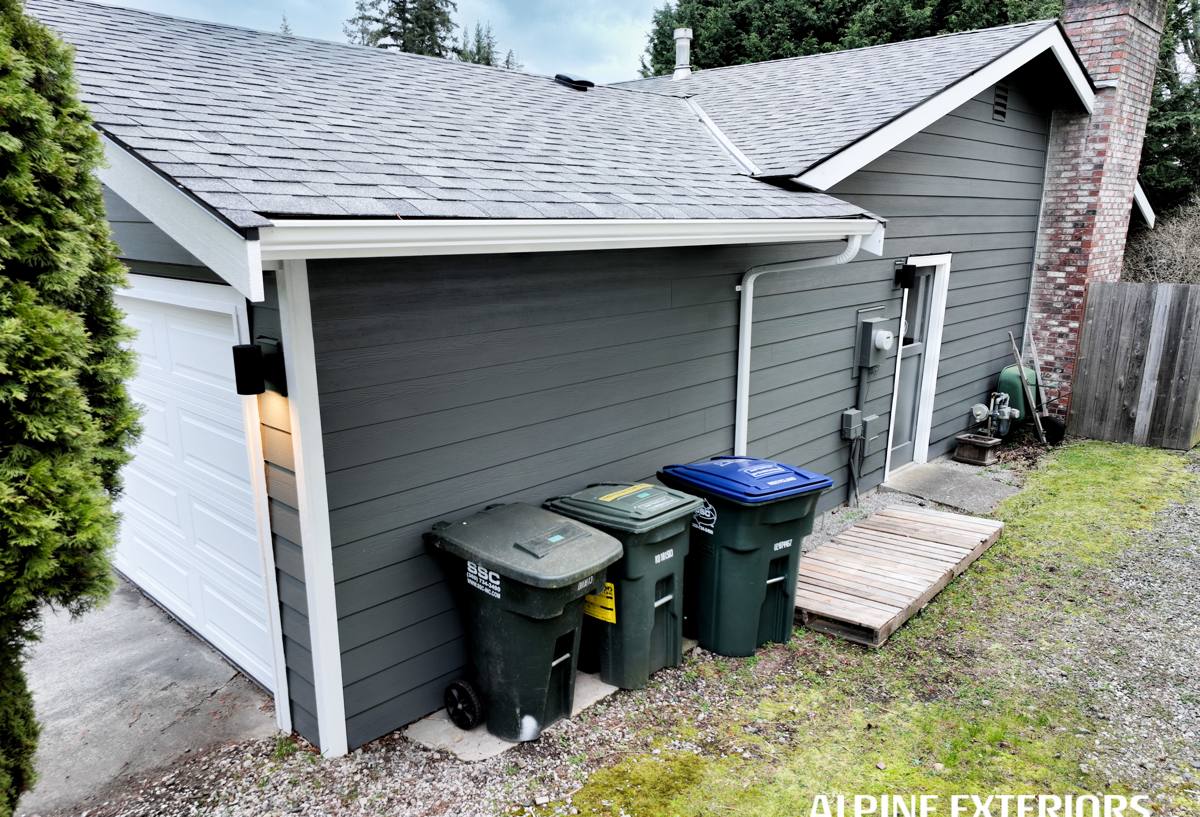
What Primed Spruce Gets Right
It's fair to start with the case for it, because there is one. Spruce is a workable, relatively lightweight softwood that takes paint well when it's properly sealed on all six sides before installation. It has a traditional, authentic wood-grain look that some homeowners specifically want, especially on historic or craftsman-style homes where fiber cement or vinyl profiles feel out of place. Material cost per board is also usually lower than fiber cement, which is part of why it was so common for so long.
If a homeowner is committed to a real-wood exterior and understands the maintenance commitment going in, primed spruce isn't a scam or a shortcut product. It's a legitimate material with a legitimate maintenance schedule attached to it.
Where Whatcom County's Climate Works Against It
The problem isn't the wood in a lab — it's the wood on a house in this specific corner of Washington. Lynden sits close enough to Puget Sound and Bellingham Bay that homes here deal with salt-laden air moving in off the water, on top of the driving rain that comes with fall and winter storms rolling off the Pacific. Add in a moss season that can stretch six months or more in shaded, north-facing exposures, and you've got a climate that specifically targets every weakness solid wood siding has.
Salt Air and Moisture Cycling
Salt air accelerates the breakdown of paint film and primer adhesion. Combined with wood's natural tendency to expand and contract with moisture, this creates a cycle: the paint film cracks at the wood's grain and joints first, moisture gets underneath, and the wood starts absorbing water where it's least protected.
Driving Rain and End Grain
Wood siding is most vulnerable at cut ends, butt joints, and anywhere end grain is exposed — even a hairline gap. End grain drinks water many times faster than the face of a board. Whatcom County's driving rain, which comes in sideways more often than straight down during winter storms, drives moisture directly into these joints instead of running off the surface the way it would in a drier climate.
Moss and Prolonged Dampness
Moss doesn't just grow on roofs. On shaded walls, under eaves, and on the north side of homes throughout this area, moss and algae colonize primed wood siding and hold moisture against the surface for weeks at a time. That prolonged dampness is exactly the condition that breaks down paint adhesion and invites rot, especially once the factory primer's protective qualities start to fade.
The Maintenance Reality Homeowners Take On
Every wood siding product needs a repaint cycle — that's not unique to spruce. What matters is how often, and how unforgiving the schedule is if you fall behind.
| Factor | Primed Spruce Siding |
|---|---|
| Typical repaint interval | 3-5 years in coastal/high-moisture exposures |
| Consequence of a missed cycle | Paint failure exposes bare wood, moisture intrusion begins quickly |
| Vulnerable points | Butt joints, cut ends, nail heads, bottom edges of lap boards |
| Moss/algae exposure | High on shaded and north-facing walls in this region |
| Insect vulnerability | Present once wood moisture content rises and finish is compromised |
The core issue is that primed spruce doesn't fail gracefully. A vinyl or fiber cement product with a fading finish is a cosmetic problem. Wood siding with a failing finish is a moisture-intrusion problem, and moisture intrusion behind siding can mean sheathing damage that's far more expensive than the siding itself.
Common Failure Points We See on Existing Homes
When we're called out to look at an older home's wood siding — often for a homeowner comparing repair versus replacement — the damage tends to show up in the same predictable places:
- Cupping or warping on boards exposed to direct weather with inconsistent shade
- Paint peeling first at butt joints and board ends, where end grain is exposed
- Soft or spongy wood at the bottom edge of lap boards near grade or under gutters
- Caulk joint failure at corners and trim, letting wind-driven rain track behind the siding
- Moss and algae staining on north- and west-facing elevations
- Nail head rust bleed-through once the factory primer thins with age
- Woodpecker or insect damage concentrated around areas already softened by moisture
None of these are defects unique to one manufacturer's spruce product — they're characteristic of how solid wood behaves under sustained coastal moisture exposure, which is the exposure every home in this area gets.
Primed Spruce vs. James Hardie Fiber Cement
| Comparison Point | Primed Spruce | James Hardie Fiber Cement |
|---|---|---|
| Base material | Solid softwood | Cement, sand, cellulose fiber |
| Moisture absorption | High, especially at end grain | Engineered for moisture resistance |
| Combustibility | Combustible | Non-combustible |
| Finish | Field-applied paint over factory primer | Factory-applied ColorPlus finish |
| Repaint cycle | 3-5 years typical in this climate | 15+ years before finish attention needed |
| Pest vulnerability | Present when moisture-compromised | Not a food source for insects |
| Warranty structure | Varies, often finish-only from paint manufacturer | Manufacturer-backed, transferable product warranty |
This isn't a case of one product being universally "better" — it's that fiber cement's engineered composition specifically addresses the failure points wood siding runs into here: moisture cycling, salt air, and prolonged damp exposure from moss season.
Why We Standardized on James Hardie
We made a decision a while back to install James Hardie fiber cement exclusively, and it comes down to matching the product to the climate instead of matching the product to the lowest bid. Hardie's HZ5 product line is specifically engineered for climates with sustained moisture exposure — which describes Whatcom County well. It's non-combustible, it holds its ColorPlus factory finish far longer than field-applied paint on wood, and it doesn't feed insects or absorb water through end grain the way solid wood does.
Just as important, Hardie backs the product with a real transferable warranty, which matters when a homeowner eventually sells. A siding product with a spotty maintenance history and a fading paint job is a harder sell than one backed by a manufacturer warranty that transfers with the house.
We're not saying every wood-sided home in this area is in trouble, or that homeowners who've maintained their spruce siding on schedule made a mistake. We're saying that when we're the ones installing new siding, we install what we believe holds up best against this specific climate with the least ongoing burden on the homeowner — and that's not primed spruce.
What Correct Installation Still Requires
Switching to fiber cement doesn't mean installation quality stops mattering. Hardie siding still needs correct fastening patterns, proper clearances at grade and roof lines, factory-mitered or properly caulked joints, and flashing detail that actually sheds water instead of trapping it. A poorly installed Hardie job can still develop moisture problems at the seams — the material is more forgiving than wood, not maintenance-free regardless of workmanship. That's why installation quality is something we talk about as much as material choice when we're on site with a homeowner.
Thinking Through Your Own Siding Decision
If your home currently has primed spruce siding and it's held up well, that's worth respecting — not every board on every wall fails on the same schedule, and shade, exposure, and past maintenance all play a role. But if you're seeing paint failure, soft spots, or recurring moss staining, it's worth having an honest look at whether you're maintaining a losing battle or making a sound long-term repair.
We're happy to walk your home's exterior, point out where wood siding is holding up and where it isn't, and talk through what a Hardie fiber cement replacement would actually involve for your specific house — no pressure, no scare tactics, just a straight assessment. If you'd like that conversation, request a free estimate below.