 Lynden
 Siding Built for Acme's Climate, Not Just the Showroom
Acme sits in the kind of Whatcom County terrain that puts real demands on a home's exterior — dense tree cover, valley shade, and long stretches of the year where surfaces simply don't dry out fast. Add in the marine-influenced weather that defines this whole corner of Washington, with its driving rain and salt-tinged air moving in off the Sound and Strait, and you get a climate that is hard on paint, hard on seams, and very hard on any siding material that isn't built to handle sustained moisture. Moss and mildew aren't an occasional nuisance out here — they're a season, and for a lot of homes, close to a year-round condition on the north and shaded sides.
We install exterior products for homes throughout this part of Whatcom County, and the pattern is consistent: siding failures in this area are almost always moisture failures. Not one dramatic storm, but years of damp shade, splash-back off soil and landscaping, and slow saturation at seams and butt joints. Whatever goes on an Acme home has to be chosen with that reality in mind, not just for how it looks the day it's installed.
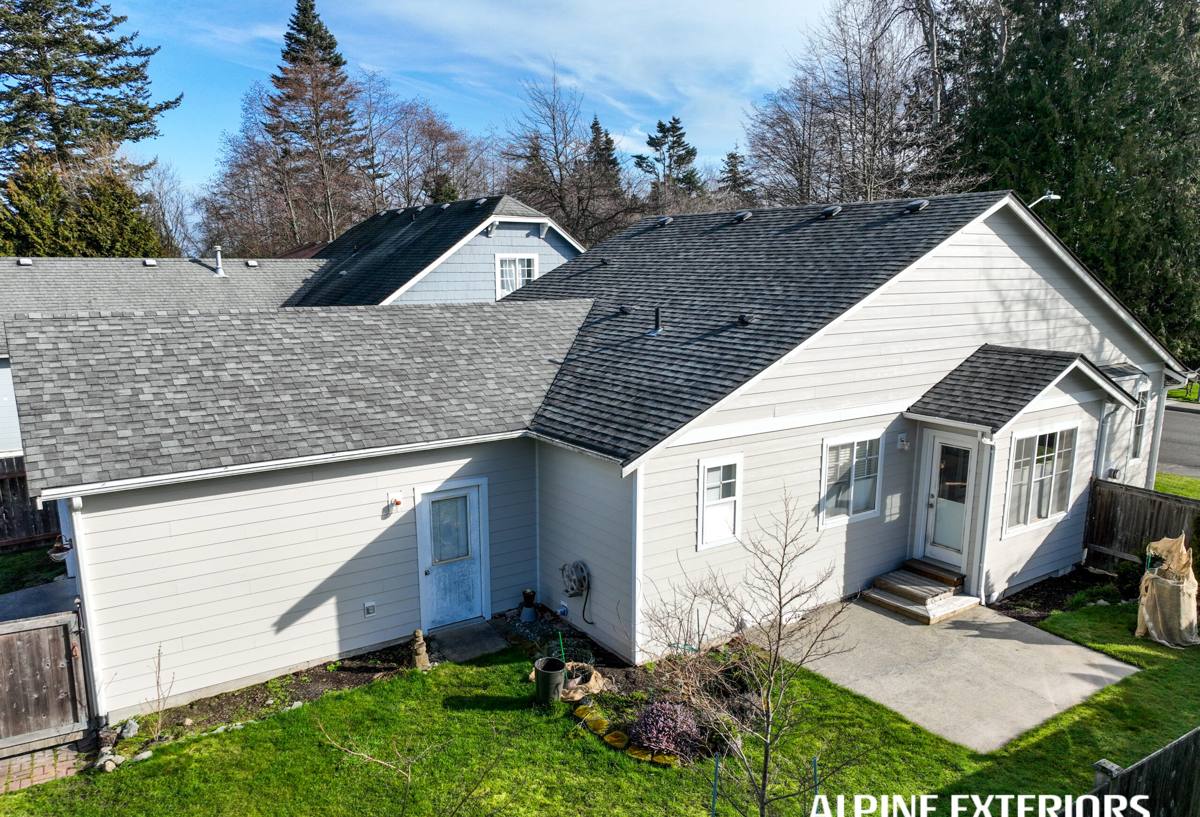
Why We Install Only James Hardie Fiber Cement Siding
We are a James Hardie-exclusive siding contractor. We don't carry vinyl, LP SmartSide, Cemplank, Allura, primed spruce, or cedar as installation options. That's a deliberate standard, not a lack of familiarity with the alternatives — we know those products well, and we'll talk through their trade-offs honestly with anyone who asks. But for the climate we work in, fiber cement from James Hardie is the material we're willing to put our name behind.
What Makes It the Right Fit Here
- Non-combustible core — fiber cement doesn't feed a fire the way wood-based products can, which matters increasingly in this region.
- Engineered for Pacific Northwest moisture — Hardie's HZ5 product line is specifically formulated for climates like ours, with resistance to moisture-related swelling, cracking, and rot.
- Factory-applied ColorPlus finish — baked-on color that resists fading and doesn't rely on a field-applied paint job to hold up against years of rain.
- Long track record — decades of real-world performance in wet climates, not a newer product still proving itself.
None of this means fiber cement is maintenance-free. It still needs proper caulking, correct flashing, and periodic attention. But it starts from a material that's dimensionally stable and doesn't absorb and swell the way wood-based or wood-derived products can when they stay damp for weeks at a time — which, in a shaded valley community like Acme, they often will.
Products We Don't Install, and Why
Homeowners sometimes ask why we won't quote vinyl or engineered wood siding, since both are common and less expensive up front. Here's the honest version:
Vinyl Siding
Vinyl is inexpensive and low-maintenance in the sense that it doesn't need painting, but it's a thin plastic product that can warp, crack in cold snaps, and fade unevenly over time. It also relies heavily on correct installation to manage expansion and contraction — a lot of the complaints we hear about vinyl trace back to that, not the product itself. In a climate with big seasonal humidity swings, we've simply decided it isn't the product we want representing our work.
LP SmartSide, Cemplank, Allura, and Wood Products
LP SmartSide is an engineered wood product — it performs reasonably well when detailed and maintained correctly, but it's still wood-based, meaning it's more sensitive to sustained moisture exposure than fiber cement, and any breach in the factory coating opens a path for water. Cemplank and Allura are other fiber cement brands; they're not a different category of product, but we've standardized on Hardie specifically for its warranty structure, ColorPlus finish consistency, and manufacturing track record in our region. Primed spruce and cedar are traditional, attractive options, but they demand real ongoing maintenance — painting, caulking, and vigilance — to hold up against a moss-prone, high-rainfall climate like Whatcom County's. For homeowners who love the look of wood, we're happy to talk through Hardie's wood-grain profiles as an alternative that gets close to that appearance without the same maintenance burden.
Why a Local Crew Matters for an Acme Job
Siding installation is unforgiving of shortcuts, and the details that matter most — flashing at windows, proper clearance at grade, ventilation behind the cladding, correct fastening patterns for Hardie's specifications — are exactly the details a crew unfamiliar with this climate is most likely to get wrong. A crew that works across Whatcom County regularly sees how homes in shaded, higher-rainfall settings actually perform over years, not just how a job looks at completion.
That local knowledge shows up in small decisions: where to add extra flashing even when it's not strictly required, how much clearance to leave between siding and soil or hardscaping, and which north- and west-facing details need the most attention given prevailing wind-driven rain. It also means someone is reachable if a question comes up two or five years after installation — not a call center, but a crew that knows the house.
How We Approach a Siding Installation
Assessment First
Every job starts with a look at the existing exterior — not just the siding, but what's underneath it. Moisture-damaged sheathing, failed flashing, or trapped water behind old cladding needs to be found and addressed before new siding goes up, or the new material is just covering the same problem.
Weather Barrier and Flashing
A correctly installed weather-resistant barrier and properly integrated flashing around every window, door, and penetration is what actually keeps water out — the siding is the visible layer, but the system behind it does the real work. This is where a lot of installation failures originate, regardless of what siding brand is used.
Installation to James Hardie Specification
Hardie's warranty is tied to installation being done to their published specifications — correct fastener spacing and type, proper clearances, correct joint treatment. We install to that standard as a matter of course, not as an upsell.
Finish Details
Trim, caulking at joints, and touch-up on any field-cut edges (which need sealing since factory ColorPlus coating doesn't extend to a fresh cut) round out the job so the finished exterior performs as a system, not just individual boards.
The Whole Exterior: Roofing, Windows, and Decks
Siding rarely fails in isolation. A roof that's shedding water onto a wall, windows that are letting moisture behind the trim, or a deck ledger board holding water against the house all put stress on the siding around them. Because we also handle roofing, windows, and decks, we can look at an Acme home's exterior as one connected system rather than quoting siding in a vacuum and hoping the rest holds up. If a roofline detail or window flashing issue is contributing to a siding problem, we'll flag it as part of the same conversation.
What Affects Siding Cost in Acme
Every home is different, so we don't publish flat pricing, but these are the main factors that move a project's cost up or down:
| Factor | Why It Matters |
|---|---|
| Amount of tear-off / existing siding removal | Old vinyl, wood, or damaged fiber cement adds labor and disposal cost |
| Sheathing or framing repair | Moisture damage found during tear-off has to be fixed before new siding goes on |
| Home size and wall complexity | Multiple stories, dormers, and cut-up wall lines take more material and labor than simple rectangular walls |
| Hardie product line chosen | Lap siding, panel systems, and shingle-style profiles carry different material costs |
| Trim and detail work | Custom trim, corner boards, and accent details add time beyond field siding installation |
| Access and site conditions | Steep lots, dense landscaping, or limited equipment access can affect labor time |
Signs It's Time to Replace Your Siding
Homes in shaded, higher-moisture settings often show warning signs earlier than homes in drier, more exposed locations. Worth checking for:
- Soft or spongy spots when you press on the siding, especially near the bottom courses
- Persistent moss or algae growth that returns quickly after cleaning
- Paint that's bubbling, peeling, or failing faster than a typical repaint cycle
- Visible warping, cupping, or gaps opening between boards
- Rising heating bills that suggest the wall assembly is no longer performing as insulation
- Water stains or discoloration on interior walls near exterior corners
Any one of these on its own might be a minor fix. Several together, especially on a home more than 15-20 years old, usually mean it's time to have the whole exterior assessed rather than patching individual spots.
Living with a Moss-Prone Climate
Even the best-installed fiber cement siding will see moss and algae growth in a climate like this, particularly on shaded north and west walls. That's normal, not a sign of product failure — it's a function of the trees and rainfall that make this part of Whatcom County what it is. Routine gentle washing, keeping vegetation trimmed back from walls, and making sure gutters are clear and directing water away from the foundation all go a long way toward keeping a Hardie exterior looking good for the long haul. What you're trying to avoid isn't growth on the surface — it's sustained moisture getting trapped behind the cladding, which is exactly what correct installation and detailing are designed to prevent.
If your Acme home's siding is showing its age, or you're planning ahead for a project, we're happy to take a look and talk through what we're seeing — no pressure, no obligation. Reach out for a free estimate using the form below.