 Lynden
 Serving Aldergrove, BC From Just Across the Line
Aldergrove sits close enough to Lynden, Washington that the two communities share more than a border crossing — they share the same weather, the same soil, and a lot of the same building styles. Homes in Aldergrove face the identical set of exterior challenges that we see every week on the Whatcom County side: damp Pacific air, long stretches of overcast and rain, and the kind of moss and mildew pressure that only lets up for a few dry months a year. When we work in Aldergrove, we're not learning a new climate. We're applying what we already know works in Lynden to homes just up the road.
That matters more than it might seem. Exterior work — siding, roofing, windows, decks — is only as good as the installer's understanding of how the local climate actually behaves on a wall, a roofline, or a deck board over ten or twenty years. A crew that's only ever worked in a dry interior climate, or one that treats every job the same regardless of region, will make different (and sometimes wrong) calls on flashing, ventilation, and material choice. A crew based minutes away, working this same weather pattern day in and day out, makes those calls correctly the first time.
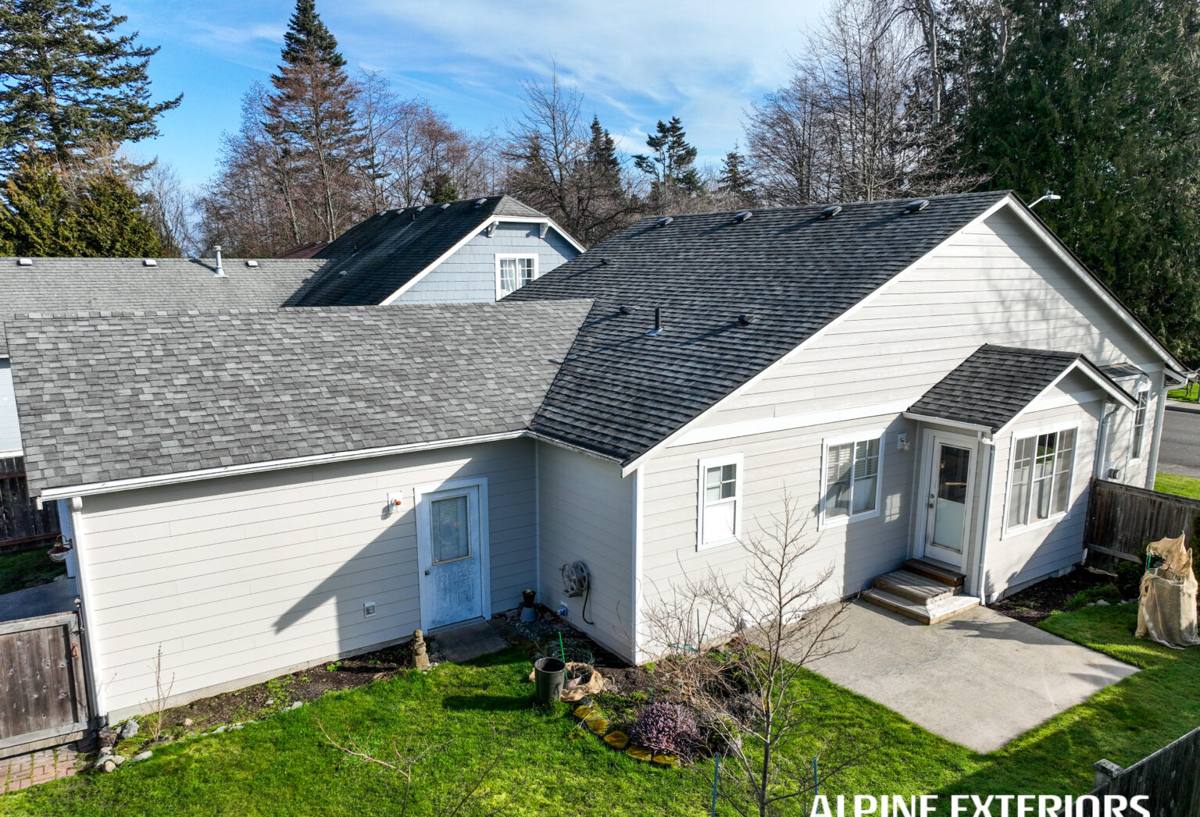
What the Local Climate Does to a Home's Exterior
The stretch of the Fraser Valley and Whatcom County lowlands around Aldergrove and Lynden deals with a specific combination of stressors:
- Persistent moisture: long rainy seasons keep exterior surfaces wet for extended periods, which is the single biggest driver of rot, mold, and coating failure.
- Driving rain: wind-driven rain doesn't just fall straight down — it gets pushed sideways into seams, laps, and trim joints, which is exactly where poor installation shows up first.
- A long moss and algae season: shaded north- and east-facing walls, roof valleys, and anything under tree cover stay damp long enough for moss, algae, and mildew to take hold and spread.
- Seasonal freeze-thaw cycling: it's not extreme cold here, but repeated freezing and thawing still works water into any crack or gap that wasn't sealed correctly.
- Salt-tinged marine air: proximity to Puget Sound and the Strait of Georgia means airborne moisture carries a mild salt content that accelerates corrosion on fasteners, flashing, and lower-quality trim.
None of this is exotic or unusual — it's just the Pacific Northwest doing what it does. But it means every material and every installation detail on an Aldergrove-area home has to be chosen with moisture management as the top priority, not an afterthought.
Why We Only Install James Hardie Fiber Cement Siding
Given that climate profile, we made a deliberate decision as a company: we install James Hardie fiber cement siding exclusively. We don't install vinyl, LP SmartSide, cedar, primed spruce, Cemplank, or Allura. That's not a marketing position — it's a practical one, built around what actually holds up here.
Fiber cement is non-combustible and dimensionally stable, meaning it doesn't expand and contract with moisture the way wood-based products do, and it doesn't soften or delaminate the way some engineered wood siding can when water gets behind it repeatedly. James Hardie's factory-applied ColorPlus finish is baked on under controlled conditions, which gives it far better resistance to the fading, chipping, and peeling that field-applied paint struggles with in a climate this wet. Hardie also engineers specific product lines (its HZ5 line, for the colder, wetter zones) for regions like ours, rather than selling one generic product everywhere.
We're not claiming other siding products can't work anywhere — they have real uses in drier climates or on the right budget. But for a home absorbing this much rain, this much shade-driven moss growth, and this much marine air, we've seen what holds up over a decade and what doesn't, and that experience is why Hardie is the only product we put our name behind.
Full Exterior Services — Not Just Siding
Siding is our specialty, but a home's exterior works as one system, so we handle the pieces that interact with it directly.
Roofing
A roof in poor condition undermines even the best siding job — water that gets past a failing roofline runs down behind the cladding regardless of what the walls are made of. We handle roof repair and replacement with the same moisture-first mindset, paying close attention to valleys, flashing, and the areas most prone to moss buildup under tree cover.
Windows
Window flashing and integration with the siding is one of the most common failure points on any home, old or new. When we replace siding, we check window flashing details as a matter of course, and we install and replace windows to work correctly with the wall assembly around them, not as an isolated add-on.
Decks
Decks in this region take a beating from the same rain and shade that affects siding, plus standing water and ground contact. We build and repair decks with drainage, ledger flashing, and material choices suited to a climate where wood stays damp for long stretches of the year.
How a Siding Project Works, Start to Finish
Homeowners in Aldergrove considering a siding replacement can generally expect the same process we run in Lynden and across Whatcom County:
- On-site assessment. We look at the existing siding, sheathing condition where accessible, trim, window flashing, and any visible moss, staining, or rot patterns that hint at what's happening underneath.
- Moisture and substrate check. Before anything gets ordered, we confirm the wall assembly underneath is sound — there's no point installing new siding over compromised sheathing.
- Product and color selection. We walk through the relevant James Hardie line and ColorPlus color options suited to the home's exposure and the owner's preference.
- Weather barrier and flashing detail. Correct house wrap, flashing at every penetration, and proper rain-screen gapping where called for — this is where most long-term failures actually originate, not in the siding material itself.
- Installation to manufacturer spec. Fastener pattern, clearances, and joint treatment following James Hardie's published installation requirements, which is also what keeps the manufacturer's warranty intact.
- Final walkthrough. We review the finished work with the homeowner before considering the job complete.
Comparing Siding Options for This Climate
| Factor | James Hardie Fiber Cement | Vinyl | Engineered Wood / Cedar |
|---|---|---|---|
| Moisture resistance | High — dimensionally stable, won't swell or rot | Doesn't absorb water, but seams and gaps can trap moisture behind it | Vulnerable to swelling, rot, and moss growth if moisture gets in |
| Finish durability | Factory-baked ColorPlus finish resists fading and chipping | Color molded in, but can fade and become brittle over time | Field-applied paint/stain needs recoating on a regular cycle |
| Fire resistance | Non-combustible | Combustible, can melt or warp near heat sources | Combustible |
| Typical lifespan (installed to spec) | Multiple decades | 15-25 years typical | Highly dependent on maintenance |
| Maintenance in this climate | Periodic washing to control moss/algae | Low, but cracks and seams are a weak point | Regular recoating, moss and rot monitoring |
This isn't a claim that vinyl or wood siding can never perform — it's a summary of the trade-offs that led us, as a company working in this specific climate, to standardize on fiber cement.
Moss, Mildew, and Long-Term Maintenance
Even the best-installed siding needs some seasonal attention in a climate like this. A few habits go a long way toward protecting the investment:
- Keep gutters clear so water isn't overflowing directly onto siding or trim below.
- Trim back vegetation and tree limbs that keep specific wall sections in permanent shade — that's where moss establishes first.
- Rinse siding periodically (a garden hose is often enough) to keep spores and algae from getting a foothold, especially on north-facing walls.
- Watch caulking and trim joints for cracking or gaps, and have them addressed before a rainy season sets in rather than after.
- Have flashing above windows and doors checked if you notice staining or discoloration streaking down from those points.
Signs Your Current Siding Needs a Closer Look
- Soft spots or visible sagging when you press on the siding surface
- Persistent moss or dark streaking that returns quickly after cleaning
- Peeling, bubbling, or chalky paint on wood-based siding
- Visible gaps at seams, corners, or around window and door trim
- Musty smell or interior staining on walls that share an exterior wall with problem areas
Why a Local Crew Matters for a Cross-Border Job
Aldergrove is close enough to Lynden that distance isn't the issue — familiarity is the advantage. A crew that already understands Whatcom County's rain patterns, the way moss builds up on shaded walls in this specific microclimate, and how homes in this immediate area tend to be built, brings that knowledge with them rather than guessing. We also plan logistics — scheduling, material delivery, and job sequencing — around the realities of working near the border, so there are no surprises mid-project.
Homeowners get the same standard of work, the same product line, and the same installation detail whether the job is in Lynden proper or just across the line in Aldergrove. We don't treat it as a different market with a different level of care.
Get a Straightforward Estimate
If your Aldergrove home is due for new siding, a roof repair, window replacement, or deck work, we're happy to take a look and give you an honest read on condition and options — no pressure, no inflated scare tactics. Fill out the form below to schedule a free estimate.