 Lynden
 Why Birch Bay Homes Are Harder on Windows Than You'd Think
Birch Bay sits close enough to the water that salt air is a daily fact of life, not an occasional nuisance. Add Whatcom County's long wet season, driving rain off the Strait, and months of low sun angle that keep moss and mildew going strong, and you've got a climate that finds every weak point in a window installation. Homes just a few miles inland in Lynden deal with plenty of rain too, but Birch Bay properties — especially anything within a mile or two of the shoreline — take a harder combined hit from salt-laden air, wind-driven moisture, and constant damp shade under the trees on the wooded lots back from the beach.
None of that means custom windows are a bad idea out here. It means the installation has to account for conditions that a lot of window crews never deal with, because they're used to drier inland work. Get the product and the install right, and a Birch Bay window can easily outlast the siding around it. Get it wrong, and you're looking at fogged glass, rotting jambs, and stained siding within a few years.
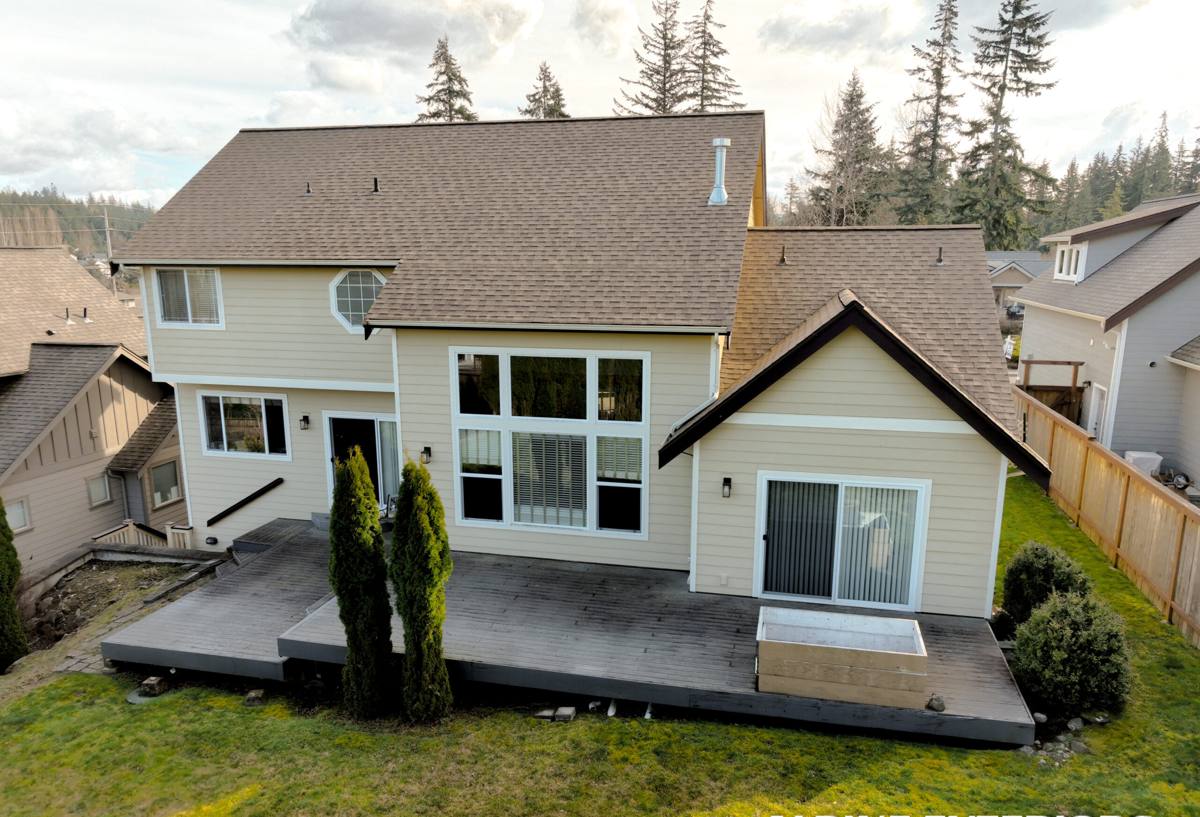
What "Custom" Actually Means Here
Custom windows aren't just non-standard sizes, though that's often part of it — older Birch Bay homes and cabins built decades ago rarely match today's stock window dimensions. Custom also covers:
- Matching a specific opening exactly, rather than resizing the rough opening to fit a stock unit
- Choosing glass packages suited to salt air and coastal glare — not the same spec you'd default to inland
- Picking frame materials that actually hold up to the moisture and salt exposure at your specific lot, whether that's oceanfront or a shaded lot back from the water
- Matching sightlines and trim profiles across additions or mismatched window generations on the same house
- Configuring operable styles (casement, single-hung, sliders) based on how exposed a wall is to wind-driven rain
A good custom window job starts with a real assessment of where the house sits relative to the water and tree cover, not a catalog order.
Frame Materials: What Holds Up in Birch Bay Conditions
Vinyl
Quality vinyl frames are a solid, low-maintenance choice for most Birch Bay homes. They don't corrode, they don't need repainting, and modern multi-chambered vinyl handles temperature swings well. The trade-off is that cheaper vinyl can become brittle over many years of UV and salt exposure, so frame quality matters more here than it would on a dry, inland lot.
Fiberglass
Fiberglass frames expand and contract at nearly the same rate as glass, which reduces seal stress over time — a real advantage where humidity swings are constant. It also resists salt air corrosion well. The cost is higher than vinyl, and it's a product we recommend selectively, not as a blanket upsell.
Wood and Wood-Clad
Wood interiors with an aluminum or vinyl exterior cladding give you a traditional look with better weather protection on the outside face. In a high-salt, high-moisture environment like Birch Bay's waterfront, we're careful about recommending bare wood exteriors — the maintenance burden (repainting, sealing exposed end grain) is real, and any gap in that upkeep lets rot start fast. If you want a wood look, clad exteriors are usually the more honest long-term choice for this location.
Aluminum
Aluminum frames are strong and slim-profile, but bare aluminum conducts cold and can corrode faster in salt air unless it's properly finished and maintained. We use it selectively for specific architectural needs, not as a default here.
| Frame Type | Salt Air Resistance | Maintenance | Typical Cost Position |
|---|---|---|---|
| Vinyl (quality-grade) | Good | Low | Lower |
| Fiberglass | Very good | Low | Higher |
| Wood-clad | Good (clad side) | Moderate | Higher |
| Bare aluminum | Fair, finish-dependent | Higher | Mid |
Glass Packages Worth Discussing
Double-pane, low-E glass is the baseline we'd suggest for any Birch Bay home simply for energy performance through a long, damp winter. Beyond that, a few things are worth a real conversation rather than an automatic upsell:
- Argon or krypton gas fill — improves insulation, more relevant on north- and west-facing walls that take the brunt of winter wind
- Tinted or coated glass — cuts glare off open water views without darkening the room as much as people expect
- Impact-resistant or laminated glass — worth discussing for exposed waterfront walls that take direct wind-driven debris in winter storms
- Triple-pane — better insulation value, but heavier sashes and higher cost; we'll tell you honestly when it's worth it and when double-pane low-E is the better dollar-for-dollar choice
The Installation Details That Actually Prevent Failures
Most window problems we get called out to fix in this area aren't product failures — they're installation shortcuts. In a climate that throws driving rain at a wall for months at a time, these details separate a window that lasts decades from one that fails in five years:
Flashing and Water Management
Every window opening needs a flashing sequence that sheds water downward and outward — sill pan flashing, properly lapped side flashing, and head flashing integrated with the house wrap, in that order, shingle-style. Skip the sill pan or get the lap order backward, and water gets trapped at the sill where it will eventually rot the framing, invisible from outside until the damage is already done.
Sealant Selection and Placement
Not every gap should be sealed. Weep paths and drainage planes need to stay open so any water that does get behind the cladding can escape — sealing them shut traps moisture instead of managing it. We use sealant where it belongs and leave drainage paths alone.
Insulation Around the Frame
Gaps between the window frame and the rough opening need to be filled with a compatible low-expansion foam or backer rod, not stuffed with fiberglass that can hold moisture against the frame.
Fastening and Shimming
Windows need to be shimmed level, plumb, and square before fastening, or the sashes bind and seals stress unevenly over time — a slow failure mode that shows up as premature seal loss, not an immediate problem.
Our Process for a Birch Bay Custom Window Job
- On-site assessment — we look at exposure (waterfront vs. tree-shaded), existing frame condition, and any signs of past water intrusion before recommending anything
- Measuring and product selection — exact opening measurements, honest frame and glass recommendations based on that specific wall's exposure, not a one-size answer for the whole house
- Old window removal — careful removal that lets us inspect the rough opening and framing for hidden rot before a new unit goes in
- Framing repair if needed — any soft or water-damaged framing gets addressed before the new window goes in, not covered up
- Flashing and installation — full flashing sequence, proper shimming, correct fastening
- Sealing and trim — interior and exterior trim work, sealant only where it belongs
- Final check — operation, seal, and squareness checked before we call the job done
Signs Your Current Windows Are Already Losing the Fight
- Fogging or moisture between panes — a failed seal, not fixable, only replaceable
- Soft or discolored trim and siding around the frame — often a sign water has been getting behind the window for a while
- Drafts you can feel even with the window latched shut
- Difficulty opening, closing, or locking — frames can shift as underlying wood swells or rots
- Visible gaps between the frame and siding
- Persistent moss or dark staining directly below a window — often a signal that water is shedding off the window into that spot, not just general moss season buildup
Any one of these on its own might be minor. Two or three together on the same window usually means it's past patching and into replacement territory.
Cost Factors Worth Understanding Before You Get a Quote
| Factor | Why It Moves the Price |
|---|---|
| Standard vs. custom size | Custom sizing requires made-to-order units, not stock inventory pricing |
| Frame material | Vinyl, fiberglass, and clad wood sit at different price points as noted above |
| Glass package | Gas fills, coatings, and impact-resistant glass add cost but target specific problems |
| Number of openings | Whole-house jobs typically bring a better per-window rate than one-offs |
| Existing damage | Rot repair at the rough opening adds labor beyond the window itself |
| Access and height | Second-story or hard-to-reach openings take more time and equipment |
We'd rather walk you through these factors on-site than quote a number sight unseen — a per-window "starting at" price rarely tells you what your actual house needs.
Why Local Experience in Birch Bay Matters
A crew that mostly works dry, inland jobs can install a window that looks fine and fails in a few years out here, simply because they didn't account for how much water and salt this stretch of Whatcom County actually deals with. We work throughout the Lynden area and understand the difference between a standard inland install and what a Birch Bay wall actually needs — the flashing sequence, the frame choice, the glass package suited to salt exposure. That's not a sales pitch, it's just what holds up in this specific environment over the long haul.
If you're dealing with drafty, foggy, or failing windows in Birch Bay, or planning ahead for a remodel, we're happy to come take a look and give you a straightforward, no-pressure estimate — no obligation, just an honest read on what your home actually needs.