 Lynden
 Roofing in Everson: What the Climate Actually Demands
Everson sits in a part of Whatcom County that gets more moisture, more wind-driven rain, and more shade-grown moss than most homeowners realize until they're the ones climbing a ladder to look at it. The weather off Puget Sound and Bellingham Bay pushes damp, salt-tinged air inland during storms, and that moisture settles into roofs that don't get enough sun or airflow to dry out between rain events. Add in tall fir and cedar cover common around Everson properties, and you get the conditions moss and algae love: shade, standing moisture, and organic debris in the valleys and behind the ridge caps.
None of this means asphalt shingles are a bad choice here — they're still the most practical, cost-effective roofing material for the vast majority of homes in this area. It means the installation has to account for the climate instead of ignoring it. A shingle roof installed the same way you'd install one in a dry inland climate will underperform in Everson. One installed correctly, with the right underlayment, ventilation, and flashing details, will hold up for decades.
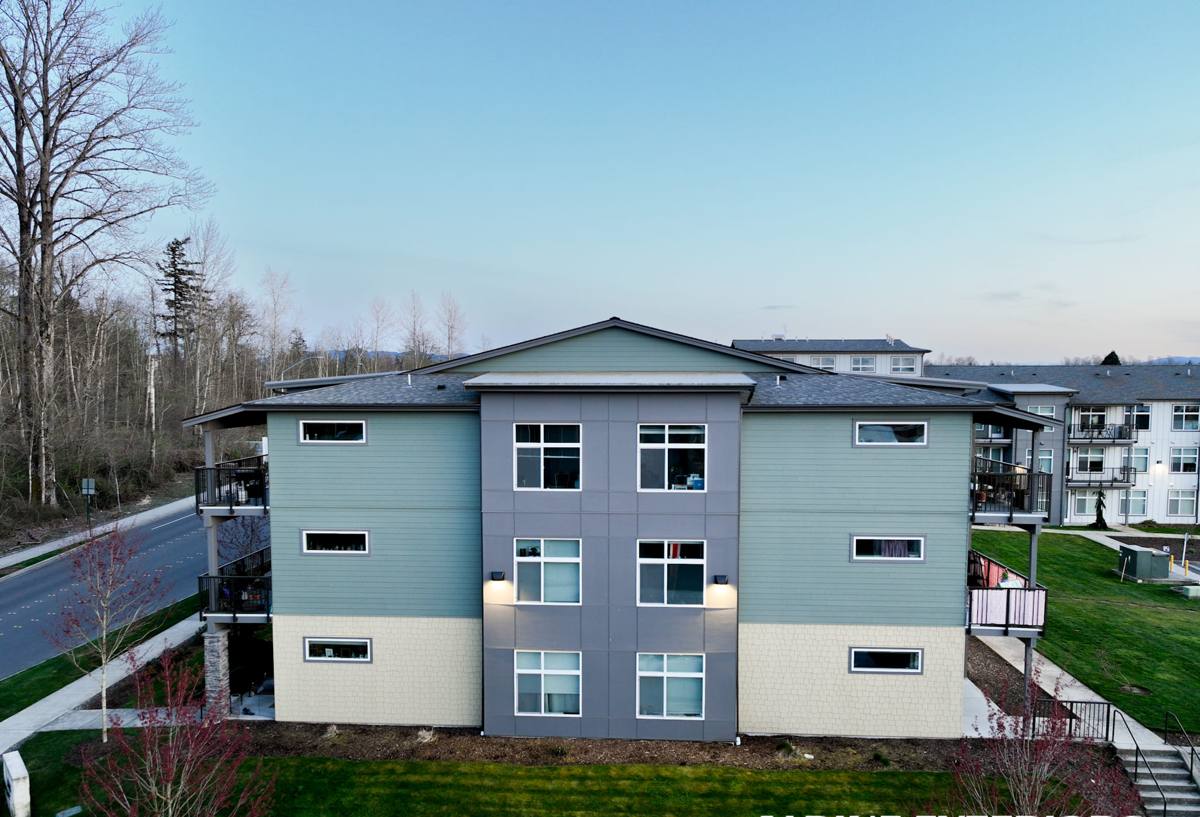
Why Asphalt Shingles Still Make Sense in This Climate
Asphalt shingles remain the default roofing material for most Whatcom County homes for good reason: they're affordable relative to metal or cedar, they're straightforward to repair in sections rather than replacing an entire roof, and modern algae-resistant formulations have closed much of the gap that used to exist between asphalt and pricier alternatives in wet climates. The trade-off is that asphalt shingles are more sensitive to installation quality than some other materials — get the underlayment, flashing, or ventilation wrong, and moisture problems show up faster on a shingle roof than they would on some other systems.
That sensitivity is exactly why the installation details below matter more here than they would in a drier climate. A shingle roof in Everson isn't a lower-maintenance version of a roof anywhere else — it's a system that needs to be built specifically to handle sustained moisture and shade.
Where Asphalt Still Falls Short
We'll say plainly where asphalt has real limits: on steep, heavily shaded north-facing slopes with little sun exposure, moss and algae staining will still occur over time even with algae-resistant shingles, because no shingle coating fully stops biological growth in constant shade and moisture. For those specific conditions, some homeowners choose metal for the shaded sections only, or accept that periodic soft washing will be part of ownership. We'll tell you honestly during an estimate if your roof has one of these problem areas, rather than pretending any shingle will solve it.
What a Correct Asphalt Shingle Roof Job Involves
A roof that's going to hold up to years of coastal-influenced Whatcom County weather needs several layers working together, not just shingles nailed to plywood. Here's what we consider non-negotiable on every Everson roof we install:
- Ice and water shield at vulnerable points — valleys, eaves, around chimneys, skylights, and any roof-to-wall transition, where wind-driven rain is most likely to work its way under standard felt.
- Synthetic underlayment across the full deck — more tear-resistant and more consistently waterproof than old-style felt, and it holds up better if weather moves in mid-project.
- Balanced intake and exhaust ventilation — soffit vents pulling air in, ridge vents letting it out, so the attic doesn't trap the moisture that drives premature shingle aging and deck rot from underneath.
- Properly lapped step and counter-flashing — at every wall intersection, chimney, and dormer, so water is directed onto the shingle surface and off the roof, not channeled into a seam.
- Correct nailing pattern and fastener count — per the shingle manufacturer's wind rating, not a generic pattern. Under-nailing is one of the most common causes of premature shingle blow-off in wind events.
- Starter strip and drip edge at all eaves and rakes — often skipped or shortcut on lower-cost jobs, and one of the first places a corner-cut roof fails.
Skip any one of these and the roof might look fine for a year or two. The problems that show up from a shortcut installation in this climate tend to surface as leaks, granule loss, or soft decking — not immediately, but on a timeline of a few wet seasons, which is often long enough that the original installer is no longer easy to reach.
Moss, Moisture, and Algae: The Long-Term Maintenance Reality
Every roof in this part of Whatcom County will deal with moss and algae pressure eventually — it's a function of the climate, not a sign of a bad roof. What matters is how the roof is built and maintained to manage it rather than let it shorten the roof's life.
Algae-resistant shingles (most manufacturers embed copper or zinc granules for this purpose) slow down the black streaking that's common on north-facing and shaded slopes. Proper attic ventilation reduces the moisture the roof sheds from underneath, which is half the battle. And keeping valleys, gutters, and roof-to-wall junctions clear of needle and leaf debris prevents the standing moisture that lets moss take hold in the first place. Moss that's allowed to mat over shingles holds water against the surface constantly, which accelerates granule loss and can lift shingle edges enough for wind-driven rain to get underneath.
We recommend a yearly look at the roof — not necessarily a professional inspection every year, but at minimum clearing debris from valleys and gutters before the wet season sets in. We're happy to do that inspection as part of routine service if a homeowner would rather not get on the roof themselves.
Our Process, Start to Finish
We keep the process simple and try not to make it more complicated than it needs to be:
- On-site estimate. We walk the roof (or get on it, weather permitting), check the current condition of the decking, flashing, and ventilation, and give you a written scope and price — not a vague range.
- Material selection. We go over shingle tiers, color, and any accessory upgrades (ice and water shield extent, ventilation changes) so you know what you're paying for and why.
- Tear-off and deck inspection. Old roofing comes off down to the deck, and we check for soft or rotted sheathing before anything new goes down — this is the point where hidden moisture damage from a prior roof gets caught.
- Installation. Underlayment, flashing, ventilation, and shingles go in per the layers described above, with attention to the wind and moisture points specific to this area.
- Cleanup and walkthrough. Magnetic sweep for nails, debris hauled off, and a final walkthrough so you can see the finished work and ask questions before we consider the job done.
Choosing the Right Shingle for This Climate
Not every shingle tier is worth the upgrade for every roof, but the differences matter more here than in a dry climate. Here's how the common tiers compare for a Whatcom County home:
| Shingle Type | Wind/Moisture Performance | Typical Lifespan Here | Best Fit |
|---|---|---|---|
| 3-tab (standard) | Lower wind rating, less algae resistance available | Shorter end of the range in wet, shaded conditions | Budget-driven projects, low-slope simple roofs |
| Architectural (laminated) | Higher wind rating, algae-resistant granules standard | Solid mid-to-long range with correct install | Most Everson-area homes — the practical default |
| Premium/impact-resistant | Highest wind rating, best algae resistance, thicker profile | Longest range, best resistance to moss matting damage | Exposed sites, steep shaded slopes, homeowners planning to stay long-term |
For most homes in this area, architectural shingles are the right balance of cost and performance. We'll point out the specific cases — heavy shade, exposed ridgelines, a roof you plan to keep for 25-plus years — where the premium tier earns its extra cost.
What Drives the Cost of a Shingle Roof Here
| Factor | Why It Matters in This Area |
|---|---|
| Roof pitch and complexity | Steeper roofs and multiple valleys/dormers take longer and need more flashing detail |
| Deck condition | Rotted sheathing found at tear-off has to be replaced before shingles go on — common on older roofs with past moisture issues |
| Shingle tier | Architectural and premium shingles cost more per square but hold up better to moss and wind |
| Ventilation upgrades | Adding proper intake/exhaust venting where it's missing adds cost but prevents underside moisture damage |
| Ice and water shield extent | More coverage at valleys and eaves costs more upfront and pays off in fewer leak calls |
We don't quote a flat per-square number over the phone because these factors genuinely change the price from one Everson roof to the next. A firm number only comes after we've actually looked at your roof.
Why a Crew That Already Works Everson and Lynden Matters
Roofing crews that mainly work drier parts of the state sometimes under-spec ventilation or skip the extra ice and water shield that this climate calls for, simply because it isn't standard practice where they usually work. A crew based in and around Lynden and Everson makes those calls automatically, because we're dealing with the same rain, wind, and moss pressure on every roof we touch in this area. We also know how our own work holds up over time here, because we're not driving in from out of the area for one job and leaving — if a detail needs adjusting after a hard winter, we're close enough to come back and make it right.
A Simple Maintenance Checklist for Homeowners
- Clear leaves and needles from valleys and gutters before the fall rains set in.
- Look for moss buildup on shaded slopes each spring, and have it gently treated or removed before it mats.
- Check attic ventilation isn't blocked by insulation stuffed into soffit vents — a common and easy-to-miss issue.
- After any major windstorm, do a visual check from the ground for lifted or missing shingles.
- Address small leaks immediately — a stain on an interior ceiling almost always means the problem has existed longer than it's been visible.
- Have flashing around chimneys and skylights checked every few years, since these are the most common failure points on an otherwise sound roof.
If your roof is showing granule loss, moss buildup, or you're just not sure how much life it has left, we're happy to take a look and give you a straightforward, no-pressure estimate — use the form below to get started.