 Lynden
 Siding Installation in Acme, From a Crew That Already Works This Part of Whatcom County
Acme sits east of Lynden in the wooded foothill country of Whatcom County, where farmland gives way to timber, creek drainages, and homes built into or right up against tree cover. That setting is beautiful, and it's also demanding on a house. Shade, moisture, and tree debris don't treat exterior siding the same way an open, sun-exposed lot does, and a siding job specified without that difference in mind tends to show problems within a few wet seasons rather than a few decades.
We install siding across Whatcom County, and Acme's rural, canopy-heavy properties are a regular part of that work — not an occasional out-of-the-way trip we bid reluctantly. On siding specifically, we install James Hardie fiber cement exclusively. That's a professional standard, not a sales pitch, and this page walks through why it holds up for a foothill home like the ones around Acme, what a correct installation actually involves, and how the project runs from first call to finished wall.
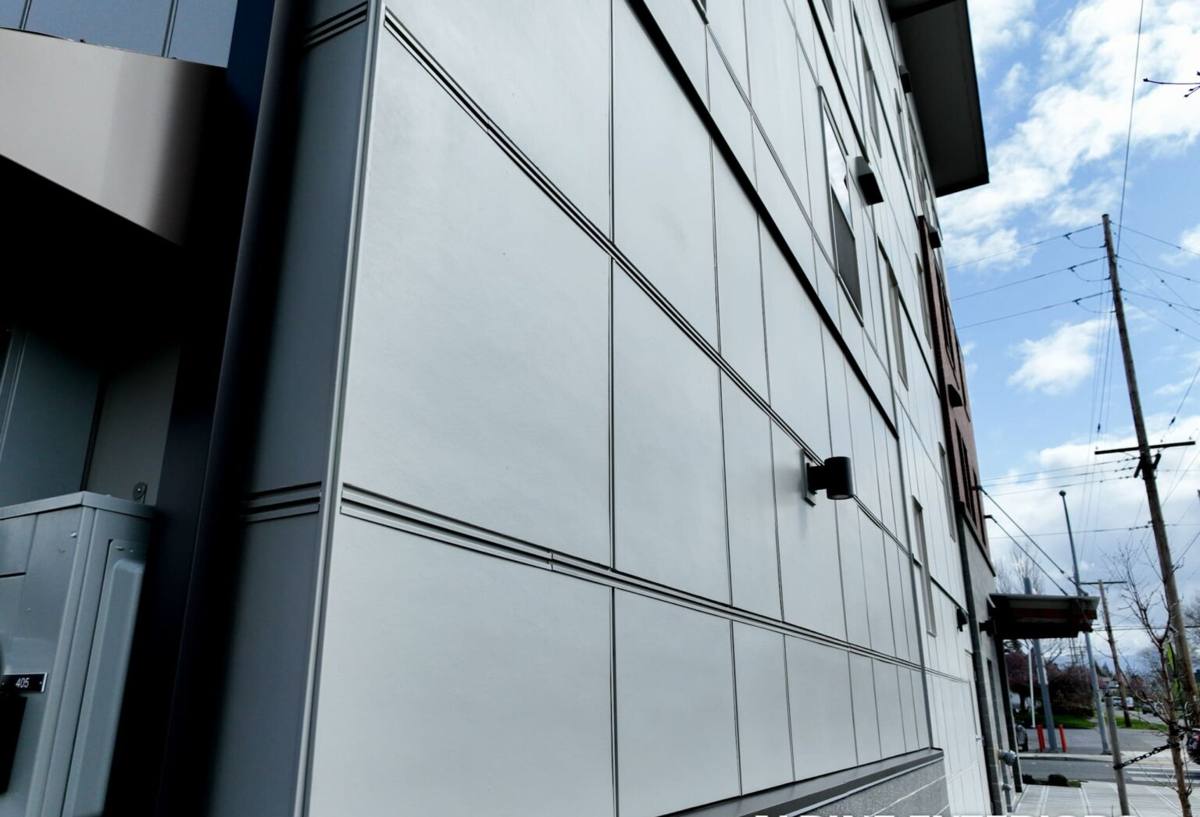
What an Acme Property Puts a Siding System Through
Salt Air Still Reaches This Far Inland
Acme is well inland from the coastline, but the marine air that moves through this whole part of Whatcom County doesn't stop at the water's edge. Over years, it accelerates corrosion on fasteners, flashing, and lower-grade trim hardware. It's a slower process out here than at the shoreline, but it's still real, and it's still a reason to choose materials and hardware that don't assume a dry inland climate.
Driving Rain Against Tree-Sheltered Walls
Fall and winter rain in this region rarely falls straight down — wind pushes it sideways into wall assemblies, trim joints, and anywhere a roof meets a wall. On a lot of Acme properties, tree cover also means walls stay wet longer after a storm passes, since less direct sun and wind reach the siding to dry it back out. That combination of driving rain and slow drying is exactly the condition that separates a siding system installed correctly from one that starts letting water in behind the cladding after a few wet winters.
A Moss Season That Can Run Most of the Year
Shade, tree debris, and near-constant moisture add up to a moss and mildew season on Acme homes that can run close to year-round on north-facing or heavily shaded walls. Any siding material that's even slightly porous, or that holds moisture against the substrate instead of shedding it, becomes a growth surface over time. On a property backed up against timber, that's not a hypothetical — it's the normal condition the siding has to perform in every day.
What Correct Siding Installation Actually Involves
Siding is a system, not just a finished surface. Get the layers underneath wrong, and the best material on the market won't save the wall. A correct installation covers a few things every time, regardless of what's happening on the surface:
Water-Resistive Barrier and Flashing First
Before any siding goes up, the wall needs a continuous water-resistive barrier and properly lapped flashing at every window, door, and penetration. On a shaded, slow-drying property like a lot of Acme's, this layer is what actually keeps incidental moisture from reaching the sheathing — the siding itself is the second line of defense, not the first.
Fastening and Clearances to Spec
Fiber cement has to be fastened at the manufacturer's specified pattern and depth, with the right clearance at the bottom edge above grade, decks, and roof lines. Too tight a clearance traps moisture and debris against the bottom course — a common issue on properties where landscaping or ground cover has crept up over the years.
Trim, Corners, and Penetrations Sealed Correctly
Most siding failures don't start in the field of the wall — they start at trim boards, corners, and places where pipes, vents, or fixtures pass through the cladding. Getting caulking, flashing, and gaps right at these details matters more in a wet, tree-shaded climate than it would in a drier one, because any small gap stays wet longer before it can dry.
Why We Install Only James Hardie Fiber Cement
We used to install a wider range of siding products. We narrowed to one system after seeing repeatedly what actually holds up on homes in this climate versus what looks good on a spec sheet and struggles a few winters into real exposure.
- Non-combustible core: Fiber cement doesn't feed a fire the way wood-based siding products can, which matters for both safety and insurance underwriting on a wooded, tree-adjacent property.
- Factory-applied ColorPlus finish: The color coat is baked on in a controlled factory process instead of applied in the field, holding adhesion and color far longer under sustained shade, moisture, and moss exposure.
- Climate-engineered HZ product lines: Hardie's HZ5 formulation is built for regions with significant moisture exposure and freeze-thaw cycling, which describes this part of Whatcom County well.
- Dimensional stability: Fiber cement doesn't swell, cup, or warp the way engineered wood siding can after repeated wetting cycles through a long, shaded wet season.
- A strong transferable warranty: Hardie backs the product with one of the more robust warranty structures in the industry, provided installation follows their published specs.
We don't install LP SmartSide, vinyl siding, Cemplank, Allura, primed spruce, or cedar. Each has a place in the market, and plenty of homeowners are satisfied with them elsewhere. Our call is a professional one: on properties that sit in this much sustained shade and moisture, we'd rather stand fully behind one system than offer a cheaper option that quietly shifts maintenance risk onto the homeowner down the line.
Where Other Products Fall Short on a Shaded, Wet Property
| Product | Common trade-off in this setting |
|---|---|
| Vinyl siding | Panel seams and gaps give wind-driven rain an entry point, and warping under temperature swings is more noticeable on long, unbroken wall runs |
| LP SmartSide / engineered wood | Wood-strand core is more moisture-sensitive at cut edges and fastener points, a real concern where walls stay damp longer under tree cover |
| Primed spruce or cedar | Needs ongoing paint and moisture maintenance to avoid rot; shaded, slow-drying walls shorten the interval between repaints |
| Other fiber cement brands | May lack a climate-specific HZ-style formulation or the same factory-finish warranty depth as James Hardie |
How a Siding Project Runs on an Acme Home
Inspection and Estimate
Every job starts with an honest look at the house — current siding condition, any signs of trapped moisture or soft sheathing, and how sun, shade, and tree cover vary across each wall. On a wooded lot, we're also checking for branches or vegetation contact against the siding, since that's a common contributor to trapped moisture and moss on these properties. That inspection drives the estimate, not a flat per-square-foot guess.
Tear-Off Versus Installing Over Existing Siding
Whether old siding comes off or new siding can go over it depends on what's underneath. If there's already hidden moisture damage to the sheathing — more common on shaded, tree-adjacent walls that have stayed wet for years — that has to be addressed before new siding goes up, not covered over. We'll tell you plainly if we find that, and what it means for scope and cost before work starts.
Installation and Finish Details
Installation follows Hardie's published fastening, clearance, and flashing specs, with particular attention to the ground-level and lower-wall clearances that matter most where landscaping, ground cover, or debris can build up against the bottom courses over time. We also plan color and finish choices with this property type in mind — flat, matte ColorPlus finishes tend to show less contrast against moss and lichen growth on shaded elevations than high-gloss options.
Signs Your Acme Home's Siding Needs Attention
A few warning signs show up consistently on shaded, tree-adjacent properties before a full siding failure does. Worth checking for, especially on north-facing or heavily shaded walls:
- Persistent moss or dark streaking that returns quickly after cleaning
- Soft spots or visible warping, especially near the bottom courses or trim
- Peeling or bubbling paint, which often signals moisture trapped underneath rather than just a finish problem
- Gaps or separation at trim boards, corners, and window or door casings
- Branches or vegetation making direct contact with the siding surface
- Visible fastener corrosion or staining running down from nail heads
Any one of these on its own might be minor. Several together, especially on a shaded wall, usually means it's worth having someone look before the next wet season.
Why Hiring a Crew That Already Works in Acme Matters
Acme isn't a dense subdivision with identical lots — properties out here vary a lot in tree cover, grading, and how exposed or sheltered each wall is. A crew that treats every job the same, regardless of setting, tends to miss the details that matter on a shaded, rural lot: clearance at overgrown grade lines, extra attention at trim details that stay wet longer, or color choices that hold up visually against moss growth. Working this area regularly means those details aren't guesswork — they're the normal starting point for how we scope and install the job.
It also means straightforward logistics: a crew based in this part of Whatcom County isn't treating an Acme property as a special trip, which keeps scheduling, follow-up, and any warranty service simpler than working with a company that only passes through occasionally.
If your Acme home's siding is showing wear, or you're planning ahead for a replacement, we're glad to come take a look. Estimates are free, there's no pressure, and you'll get a straight answer about what your home actually needs — just fill out the form below to get started.