 Lynden
 Building New in Maple Falls: Get the Windows Right Before the Siding Goes On
New construction gives you one real shot at getting window installation right. Once the siding, trim, and interior finish are in place, the flashing details behind them are hidden for the life of the house. That's a different job than swapping out an old window in an existing wall — there's no rough opening to fix, no old flashing to tear out and guess about. You're setting the standard the house will live with for the next 30-plus years.
We're a Lynden-based crew and Maple Falls is part of our regular working territory, not a place we pass through once. That matters on new builds because the framing schedule, the inspection timing, and the site conditions up in the foothills are all a little different than a lot job in town, and we've worked around all of it before.
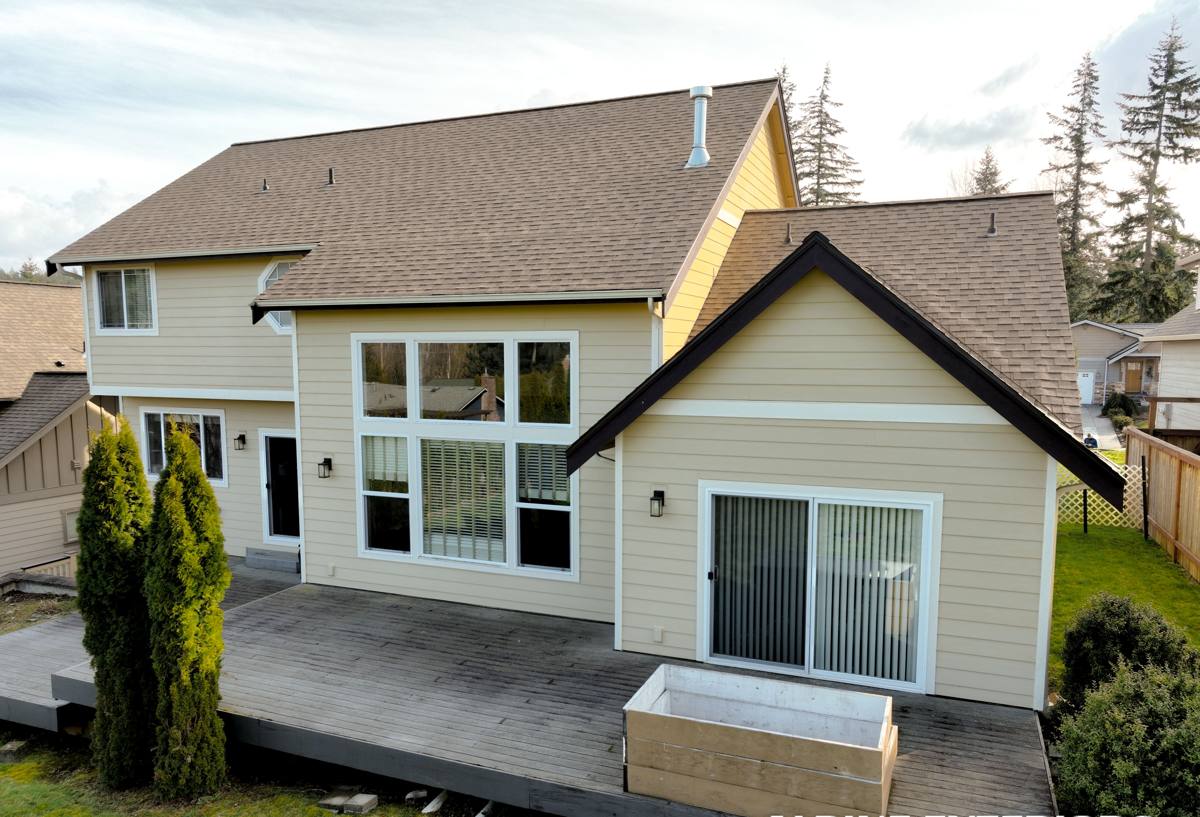
What the Maple Falls Climate Asks of a New Window
Rain that doesn't fall straight down
Whatcom County gets driving, wind-pushed rain, and up toward Maple Falls the terrain and tree cover push wind around in ways that send water sideways into wall assemblies rather than straight down off the roof. A window that relies on caulk alone to keep that out will eventually let water in — it's a matter of when, not if. Correct flashing is what actually keeps a wall dry, not the bead of sealant around the trim.
A long moss season
Heavy tree cover and shorter winter daylight hours mean surfaces around Maple Falls homes stay damp longer than they would in an open, sunnier setting. That doesn't damage the glass or frame directly, but it's a sign of how much ambient moisture the building envelope is dealing with for a good chunk of the year — which is exactly why the water management details behind the trim matter more here than they would in a drier climate.
Elevation and forest cover
Lots up near Maple Falls often sit higher and further into tree cover than in-town Lynden properties, which means more shade, more standing moisture in the air, and in some spots more temperature swing overnight. None of that is exotic, but it's the reason a window built for a suburban tract-home climate isn't automatically the right call for a foothill build.
What Correct New-Construction Window Installation Actually Involves
On a new build, the window itself is often the easy part. The install sequence is where jobs succeed or fail.
Flashing comes before the window, not after
The weather-resistive barrier (WRB) on the wall, the sill pan, and the flashing tape all need to be layered in the correct shingle-lap order — each piece overlapping the one below it — so water is always directed outward and down, never trapped behind the window. This has to happen before the window goes in, not patched around it afterward.
Sill pans and back dams
Every rough opening should get a sloped sill pan with a back dam, so any water that does get past the exterior cladding drains back out instead of pooling against the bottom of the frame. This is a small detail that's cheap to do right during framing and expensive to fix once the wall is closed up.
Matching the fastening method to the wall assembly
Nailing-fin windows and block-frame (masonry-style) windows attach differently, and the flashing details around each are different too. We confirm which type the plans call for and install to that assembly's correct method rather than a one-size-fits-all approach.
Shimming and squaring
A window that's slightly out of square will bind, won't seal evenly, and puts stress on the corners of the frame over time. Proper shimming at the right points, checked with a level on both axes, is what keeps the unit operating smoothly for years, not just on install day.
Choosing a Window Line for a Foothill Build
There's no single "best" window material — the right call depends on the home's exposure, budget, and how much upkeep the owner wants to take on. Here's how the common options stack up for a Maple Falls-type site:
| Material | Moisture handling | Maintenance | General cost position |
|---|---|---|---|
| Vinyl | Good — won't rot, but seals and hardware matter more over time | Low | Most affordable |
| Fiberglass | Very good — dimensionally stable in temperature and moisture swings | Low to moderate | Mid to upper |
| Wood-clad (exterior clad, wood interior) | Good on the exterior face if flashing and finish are maintained; interior wood needs some care | Moderate | Upper |
For a shaded, damp foothill lot, we lean toward materials and hardware that don't depend on the homeowner staying on top of yearly upkeep to perform well — the environment does enough of that work on its own. Whatever line an owner or builder prefers, our standard is the same: correct flashing and installation matter more to long-term performance than which material is in the frame.
How We Work With Builders and Owners on a Maple Falls Job
- Plan review and rough-opening check — we confirm window sizes and rough openings match the approved plans before framing locks them in.
- Site visit — we walk the lot to look at exposure, drainage, and any grading or access issues specific to the property.
- Scheduling with the framing crew — windows go in at the right point in the build sequence, coordinated so we're not waiting on other trades or holding them up.
- Installation — flashing, sill pans, and the window unit itself, installed to the sequence above and to the manufacturer's instructions.
- Walkthrough — every opening gets checked for square, operation, and weatherproofing before we call it done.
We coordinate directly with general contractors when there is one, or with the owner directly on owner-built projects. Either way, the goal is the same: windows that are ready for inspection and ready for siding, with no rework needed later.
Mistakes We Catch Most Often in New Construction
- Flashing tape applied in the wrong order, sending water behind the barrier instead of over it
- No sill pan, or a flat sill pan with no back dam or slope to drain water out
- Rough openings cut slightly undersized or oversized compared to the window's actual dimensions
- Windows shimmed only at the corners, leaving the middle of long units to sag or bow
- Insulation packed too tightly around the frame, which can bow vinyl frames and affect operation
- Trim and siding installed before the window's own flashing and sealing is confirmed complete
- Wrong fastening method used for the window type (treating a block-frame unit like a nailing-fin unit, or vice versa)
Energy Code and Comfort Considerations
New construction in Washington has to meet the state energy code's requirements for window U-factor, which measures how much heat the window loses. We select and install to meet code minimums as a baseline, and can talk through upgraded glass packages where an owner wants better performance than the minimum. On shaded, tree-covered lots like a lot of Maple Falls properties, solar heat gain (SHGC) is often less of a concern than it would be on an open, south-facing valley lot — but any large window facing open sky or a clearing still benefits from the right glass coating to manage glare and heat.
Condensation resistance is also worth a conversation for foothill builds, since indoor humidity combined with cooler overnight temperatures at elevation can show up as condensation on interior glass if the window's performance doesn't match the home's heating and ventilation setup. This is a design conversation worth having before the windows are ordered, not after they're installed.
Why a Crew That Already Works Maple Falls Matters
A foothill lot near Maple Falls isn't the same job as a flat in-town lot in Lynden. Driveways can be steep and narrow, staging space for materials is often tighter, and weather windows for exterior work can close faster at elevation than they do down in the valley. We've built enough jobs in this area to plan around those realities instead of discovering them mid-install.
We also know the local building department's expectations and the inspection process new construction goes through in Whatcom County, so window installation is documented and ready when the inspector shows up — no surprises, no re-scheduling a trip up the mountain because something wasn't ready.
Get a Straight Answer on Your Maple Falls Build
If you're framing a new home in Maple Falls, or working with a builder who is, we're glad to walk the plans with you before windows are ever ordered. Reach out for a free, no-pressure estimate — the form below gets it started.