 Lynden
 Nooksack's Climate Is Harder on Siding Than Most Homeowners Realize
Nooksack sits inland from the Salish Sea, but Whatcom County's lowlands still carry salt-laden air up through the valley, especially on the wind patterns that move in off the water during fall and winter storms. Combine that with the driving rain typical of a Pacific Northwest winter and the long, shaded moss season that runs from roughly October through April, and you have a climate that is genuinely tough on exterior building materials. Siding here isn't just a cosmetic choice — it's the first line of defense against moisture intrusion, and the wrong product or the wrong installation shows it within a few years, not a few decades.
We install siding across Lynden and the surrounding communities, including Nooksack, and the failure patterns we see are consistent: caulk joints that fail early, moss and algae staking a claim on north-facing and shaded walls, and water finding its way behind panels through bad flashing or missing drainage gaps. None of that is inevitable. It's a function of material choice and installation quality, both of which are things a homeowner can actually control.
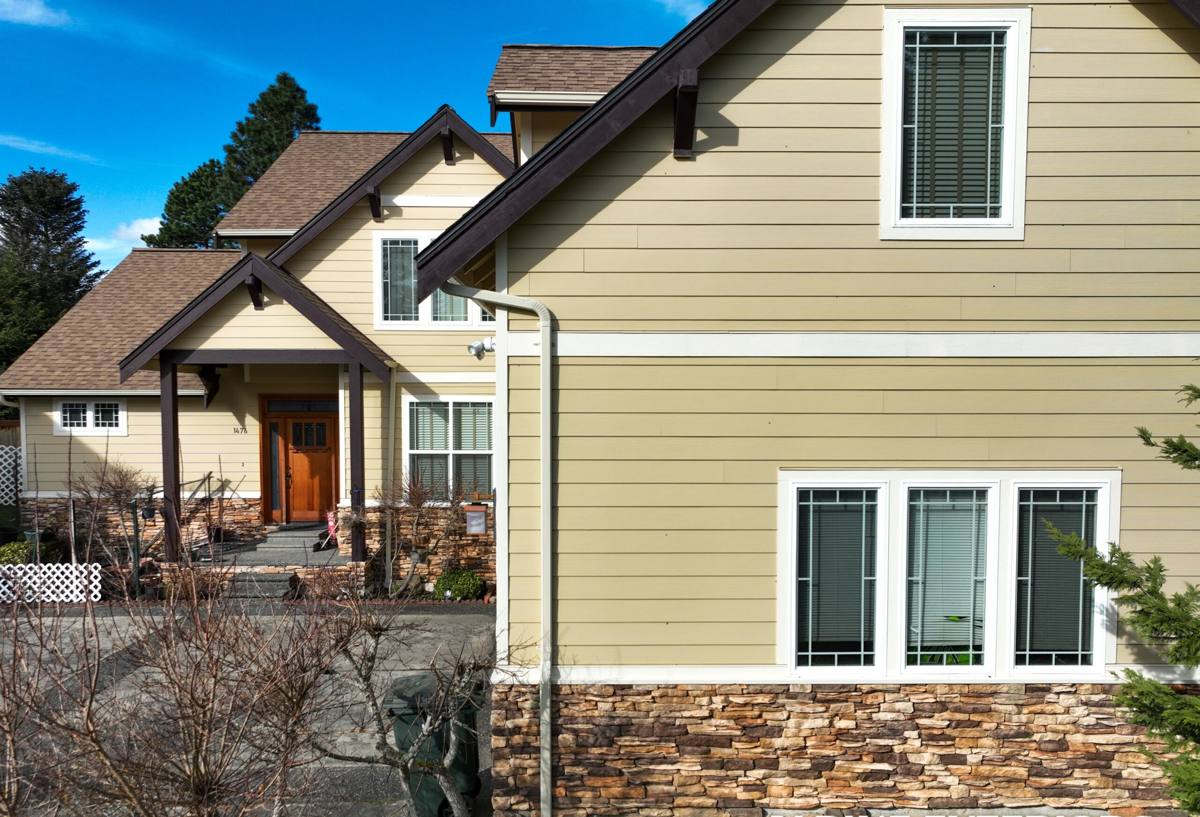
What James Hardie Siding Is Built to Handle
Moisture Behavior
Fiber cement is a blend of cement, sand, and cellulose fiber, engineered to resist the swelling, warping, and rot that plague wood-based products when they take on repeated moisture. In a climate where siding can stay damp for days at a stretch during a wet stretch of weather, that dimensional stability matters more than most homeowners expect. Hardie's HZ5 product line is specifically formulated for climates like ours — the Pacific Northwest's freeze-thaw cycles and sustained moisture exposure — rather than a one-size-fits-all formulation.
Non-Combustible Composition
Fiber cement doesn't support flame spread the way wood-based sidings can. That's not the primary concern for most Whatcom County homeowners, but it's a real difference in what you're putting on your home, and it factors into some insurance conversations.
ColorPlus Factory Finish
Hardie's ColorPlus finish is baked on in a factory-controlled process rather than field-applied paint. It holds color longer and gives you a denser, more consistent surface than site-painted siding — which matters in a moss-prone climate, because a rougher, more porous surface gives spores and algae more to grab onto. It's not moss-proof; nothing is. But it's a meaningfully better starting point than raw or primed wood.
What a Correct Installation Involves Here
The product is only half the equation. We've seen Hardie siding installed poorly, and it fails the same way any siding fails when the assembly behind it is wrong. In this climate, a few details are non-negotiable:
A Drainage Gap Behind the Panels
Water gets behind siding eventually — through a nail hole, a seam, wind-driven rain forced past a joint. A proper rainscreen gap lets that moisture drain and dry out instead of sitting against the wall sheathing. Face-nailing panels directly against a flat wall with no gap is a shortcut that causes problems years later, right about the time nobody remembers who installed it.
Flashing at Every Transition
Windows, doors, trim boards, and roof-to-wall intersections are where water intrusion actually starts. Flashing has to be installed and lapped correctly at every one of these points — caulk is a backup, not a strategy.
Fastening to Hardie's Published Schedule
Hardie specifies fastener type, spacing, and placement for a reason, and those specs shift depending on wind exposure and panel size. Skipping or guessing at this is one of the more common ways installations go wrong without it being visible from the ground.
Caulk Used Sparingly and Correctly
Caulk should seal specific joints, not paper over gaps that shouldn't exist in the first place. Over-reliance on sealant is often a sign the underlying detailing wasn't done right.
How Siding Materials Compare in This Kind of Climate
This is a general comparison based on how these materials behave under sustained moisture and shaded, moss-prone conditions — not a claim about any specific product failing, just an honest look at trade-offs.
| Material | Moisture Behavior | Moss/Algae Susceptibility | Ongoing Maintenance |
|---|---|---|---|
| James Hardie fiber cement | Dimensionally stable; doesn't swell or rot from moisture exposure | Lower on the dense factory finish, though periodic washing still matters on shaded walls | Occasional washing, caulk checks; no repainting on a fixed schedule |
| Primed wood or cedar | Absorbs moisture; prone to swelling, cupping, and rot at joints over time | Higher, especially on porous or weathered surfaces | Repainting/staining on a recurring cycle, more frequent spot repairs |
| Vinyl | Doesn't rot, but can warp or buckle with heat and doesn't manage trapped moisture behind it | Moderate; smooth surface but seams and laps still collect debris | Low, but panels are hard to color-match if damaged and replacement look often shows |
| Engineered wood (LP-type) | Treated to resist moisture, but edge and cut-end exposure remains a known vulnerability | Moderate to higher if edges aren't sealed and maintained | Requires diligent edge sealing and caulk maintenance to avoid swelling |
This is exactly why we standardized on James Hardie rather than carrying multiple product lines. We'd rather install one system correctly and stand behind it than sell whatever's cheapest for a given budget.
Our Process for a Nooksack Job, Start to Finish
- On-site assessment. We walk the exterior and identify which walls take the worst weather — typically the north and west-facing sides that stay shaded and catch driving rain — and check the condition of the existing wall assembly before quoting anything.
- Moisture and substrate check. If there's evidence of past water intrusion, we address it before new siding goes up. Covering a wet problem with new material doesn't solve it.
- Product and color selection. We walk you through Hardie's plank, shingle, and panel options and the ColorPlus palette so the choice fits the home and the neighborhood.
- Installation to spec. Rainscreen gap, correct flashing, and Hardie's fastening schedule — every time, not just when it's convenient.
- Final walkthrough. We go over the finished work with you and cover what maintenance, if any, to expect going forward.
Why Hiring a Crew That Already Works This Area Matters
Nooksack isn't a market we're guessing at — it's part of the territory we work regularly out of Lynden. That matters in a few concrete ways. We already know which orientations on homes in this part of Whatcom County tend to take the worst of the rain and hold onto moss the longest, so we're not learning that on your dime. We're a short drive away if a warranty question comes up years down the road, not a crew that did one job in the area and moved on. And because we only install one product system, our crews aren't switching between installation methods from one job to the next — the fastening pattern, flashing approach, and drainage detailing on your home is the same one we've done many times before.
Questions to Ask Before You Hire Anyone for This Job
- Are the installers factory-trained or certified specifically on James Hardie products, not just "experienced with siding" in general?
- Will they confirm in writing that a drainage gap and proper flashing details are part of the installation, not an upsell?
- Do they follow Hardie's published fastening schedule, and can they explain why it matters for wind and moisture exposure here?
- Is the manufacturer's warranty registered on your behalf, and do you understand what it covers versus workmanship coverage?
- Can they speak specifically to how homes in this part of Whatcom County hold up over time — or are they reciting generic answers?
Living With Hardie Siding in Nooksack: Maintenance That Actually Matters
Fiber cement done right is low-maintenance, not no-maintenance. In this climate, that means an occasional gentle washing of shaded or moss-prone walls — a garden hose and soft brush is usually enough, no pressure washer aimed directly at seams. It means glancing at caulked joints around windows and trim every year or two and having anything that's cracked or pulled away resealed before it becomes a moisture path. And it means keeping gutters and downspouts clear, since splash-back off a clogged gutter is one of the more common ways otherwise well-installed siding takes on chronic moisture at the lower courses. None of this is a heavy lift, but skipping it entirely does shorten how well the siding performs over the decades it's meant to last.
Get a Straight Answer on What Your Home Needs
If you're weighing a siding project on a home in Nooksack, we're glad to come take a look, walk the exterior with you, and give you a straightforward read on condition and options — no pressure, no upsell to a product we don't stand behind. Fill out the form below for a free estimate.