 Lynden
 Maple Falls Is a Different Kind of Siding Job
Maple Falls sits up in the wooded foothill country of Whatcom County, in the shadow of the Mt. Baker corridor, and that setting changes what a house needs from its exterior. Heavy tree canopy means long stretches of shade on north and east walls. Shade plus rain plus still air is exactly the recipe that grows moss, mildew, and algae on siding — and once that biological growth gets a foothold, it holds moisture against the wall long after the rain has stopped. Add in the marine-influenced weather that moves through this part of the Pacific Northwest, carrying salt-tinged air even into inland valleys, and you have a climate that is genuinely harder on exterior materials than a dry-side house ever sees.
We work throughout the Lynden area, and Maple Falls comes up often precisely because of this combination: dense trees, persistent dampness, and a long moss season that can run most of the year on the shaded sides of a house. A siding system that would hold up fine in a sunny, open subdivision can struggle here. That's the lens we use on every Maple Falls estimate — not "what siding looks good," but "what siding actually survives this specific microclimate."
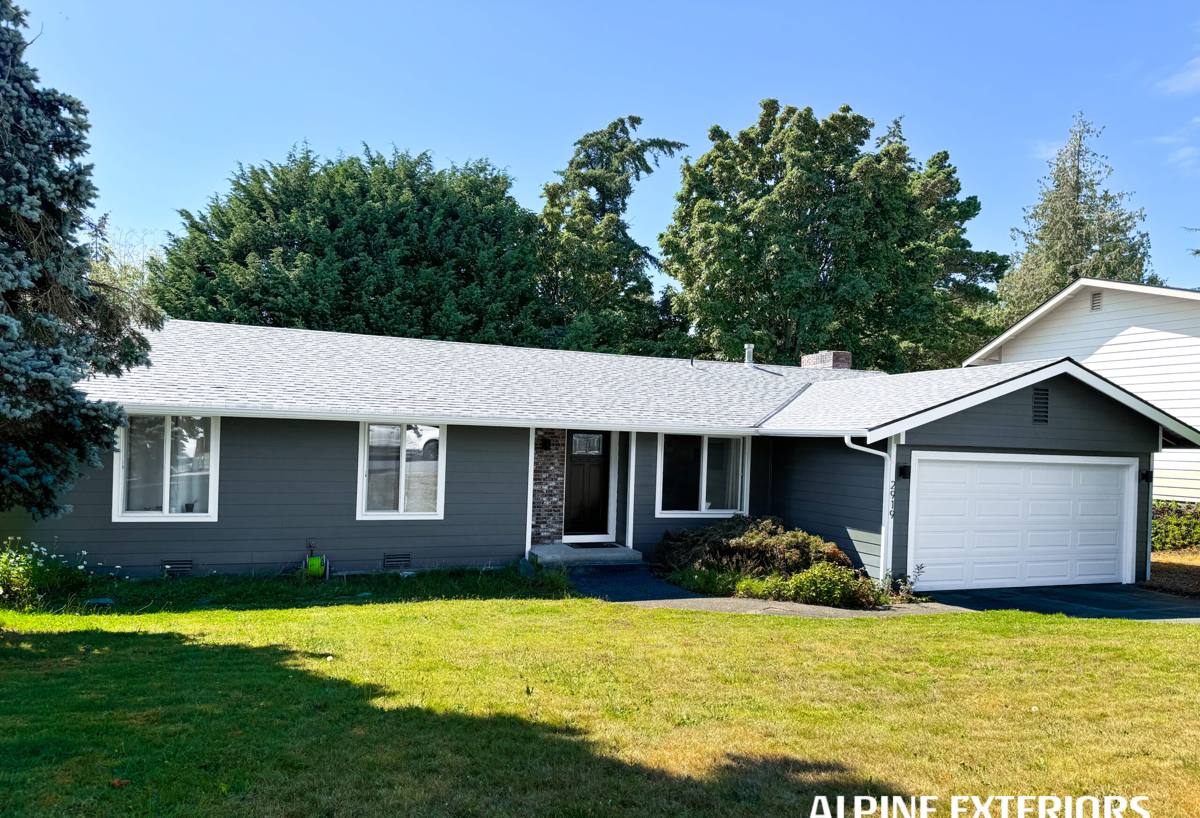
What This Climate Does to the Wrong Siding
Wood and wood-composite sidings (cedar, primed spruce, LP SmartSide) are wood at their core, and wood's weakness has always been moisture cycling — swelling when wet, shrinking when it dries, and rotting at any point where water gets trapped instead of shedding. In a shaded, damp environment like Maple Falls, those wet cycles are longer and more frequent. Moss holding water against a wall accelerates whatever moisture damage the material is already prone to.
Vinyl siding doesn't rot, but it has its own problems in this setting. It expands and contracts significantly with temperature swings, which stresses fastening over time, and it doesn't hold up to sustained moisture and organic growth the way a mineral-based product does — algae and moss cling to its surface just as readily, and it can't be pressure-washed as aggressively without damage or seam failure. It also has no fire resistance, which matters more in a heavily wooded area than it would in an open lot.
This is why we standardized on James Hardie fiber cement and don't install vinyl, LP SmartSide, cedar, primed spruce, or other composite panel products. It's not that those products can't be installed correctly — it's that in a climate like this one, we don't think they're the right long-term bet for a homeowner's money, and we'd rather be honest about that up front than sell something we don't stand behind.
Why Fiber Cement Fits Maple Falls Specifically
It's Not Wood, So It Doesn't Rot Like Wood
James Hardie siding is made from cement, sand, and cellulose fiber. It has no wood grain to trap water, swell, or rot. In a shaded, moisture-heavy environment, that single property removes the failure mode that causes the most siding replacement calls in this region.
It Holds Up to the Moss Fight
Moss and algae still land on fiber cement — no siding is immune to spores in the air — but the material itself doesn't degrade from the growth or from the cleaning needed to remove it. Homeowners can wash it down without worrying about warping panels or voiding a warranty, which matters on a home that will need that cleaning more than once a year on its shaded elevations.
It's Non-Combustible
Fiber cement doesn't burn. In a forested, semi-rural community like Maple Falls, where properties often back up to trees and brush, that's a real, practical advantage — not a marketing line. It's one less thing to worry about during dry summer stretches.
It's Engineered for This Exact Climate
James Hardie builds region-specific product lines rather than one generic board for the whole country. Their HZ5 and HZ10 systems are engineered around moisture exposure, freeze-thaw behavior, and humidity patterns by climate zone, and the Pacific Northwest falls into the wetter end of that spectrum. That's the version of the product we spec for Whatcom County installs.
Fiber Cement vs. the Alternatives, in This Climate
| Factor | James Hardie Fiber Cement | Vinyl | Wood / LP SmartSide |
|---|---|---|---|
| Moisture / rot risk | Very low — not wood-based | Low rot risk, but seams and fasteners stress under moisture cycling | Highest — wood core is vulnerable to sustained damp shade |
| Moss/algae cleanup | Can be washed without material damage | Can crack or discolor with aggressive cleaning | Cleaning can drive moisture into the substrate |
| Fire resistance | Non-combustible | Melts/burns, no fire rating | Combustible |
| Factory finish | ColorPlus baked-on finish, long repaint interval | Color molded in, fades over time, can't be repainted easily | Field-painted, needs repainting on a shorter cycle |
| Typical lifespan when installed to spec | Multi-decade, backed by transferable warranty | Long but variable, seam and fastener issues over decades | Shorter in wet, shaded conditions |
What a Correct Installation Involves
Fiber cement's reputation depends entirely on installation quality, especially in a climate like this. A poorly installed Hardie job in a wet, shaded lot will show problems fast — a well-installed one will genuinely outlast the mortgage. The details that matter most on a Maple Falls house include:
- Proper clearance between the bottom of the siding and the ground, roofline, deck, or grade — trapped moisture at these gaps is the most common cause of early failure
- Correct flashing and water-resistive barrier behind every seam, window, and door so bulk water is directed out, not into the wall assembly
- Fastener placement and spacing per manufacturer spec, not "close enough" — under-fastened panels move, crack caulking, and open gaps for moisture
- Rain-screen or drainage gap detailing where the wall assembly calls for it, which matters more in a high-moisture microclimate than in a dry one
- Factory-mitered or properly caulked joints, since raw cut edges left unsealed are a common weak point for water intake
- Ventilation planning around shaded, low-airflow wall sections so the assembly can actually dry out between rain events
None of this is exotic. It's just detail work that takes longer to do right, and it's the difference between a Hardie installation that lives up to its reputation and one that gives fiber cement a bad name it didn't earn.
Our Process for a Maple Falls Project
- Walk the property — we look specifically at shade patterns, existing moss or moisture staining, roofline and grade clearances, and any trouble spots the current siding is already showing
- Assess the wall assembly — check what's behind the existing siding, sheathing condition, and whether drainage detailing needs upgrading as part of the tear-off
- Spec the right Hardie system — plank or panel profile, ColorPlus color, and the HZ product line suited to this climate zone
- Written estimate — a clear scope covering removal, any sheathing repair, flashing and moisture-barrier work, and the installation itself, with no vague allowances
- Installation to manufacturer spec — clearances, fastening, flashing, and joint treatment done the way Hardie's install guide actually requires, not shortcuts
- Final walkthrough — we go over the finished work with the homeowner before calling the job done
Cost Factors on a Maple Falls Home
| Factor | Why It Moves the Price |
|---|---|
| Existing siding removal | Tear-off complexity and disposal add labor, especially with wood siding that's absorbed moisture and gotten heavy |
| Sheathing condition | Hidden rot found under old siding needs repair before new siding goes on — common on shaded walls with a history of moisture |
| Wall complexity | Dormers, multiple gables, and cut-in windows all add trim and cutting time |
| Access and site conditions | Wooded lots, slopes, and limited driveway access can affect staging and equipment setup |
| Drainage/moisture upgrades | Adding or improving rain-screen detailing in high-moisture zones is worth the added cost long-term |
| Trim and accessory choices | Hardie trim boards, soffit, and color-matched accessories versus mixed materials |
What to Ask Before You Hire Anyone
- Are you a James Hardie certified or preferred installer, and can you explain why you use the product lines you do?
- Will you show me the manufacturer's clearance and fastening specs and confirm the crew follows them?
- What's your plan for flashing and moisture barrier detailing on a shaded, wet wall section?
- Do you carry current liability insurance and worker's comp, and can I see proof?
- Is the estimate written with a specific scope, or is it a vague lump-sum number?
- Can you speak specifically to how this house's shade and drainage will affect the install?
Why Local Experience in Maple Falls Matters
A crew that's worked in Maple Falls and the surrounding Lynden area already knows how differently these wooded, shaded lots behave compared to an open, sunny property across town. They know which walls are going to fight moss no matter what siding goes up, where drainage details need extra attention, and how the local moisture pattern plays out over a full year rather than just during a single site visit. That local pattern-recognition is worth more than it sounds like — it's the difference between a generic install and one that's actually built for this specific piece of Whatcom County.
If you're weighing a siding replacement or new build in Maple Falls, we're happy to walk the property, look at what your current siding is telling you, and put together a straightforward, no-pressure estimate using the form below.