 Lynden
 Siding That Actually Holds Up Around Wiser Lake
Homes near Wiser Lake sit in a pocket of Whatcom County that gets more moisture exposure than a lot of homeowners realize until they're dealing with it firsthand. Between the lake's humidity, salt-tinged air moving inland off the Strait of Georgia, driving rain that comes sideways in winter storms, and a moss season that can stretch from October through May, exterior siding here works harder than it does almost anywhere else in the state. We install James Hardie fiber cement siding exclusively, and on lakefront and near-lake properties in this part of Lynden, that decision isn't about brand preference — it's about what actually survives this microclimate without turning into a maintenance project.
This page covers what Wiser Lake homes specifically need from their siding, what a correct Hardie installation looks like in this environment, and why working with a crew that already knows this neighborhood's conditions matters more here than in drier parts of the county.
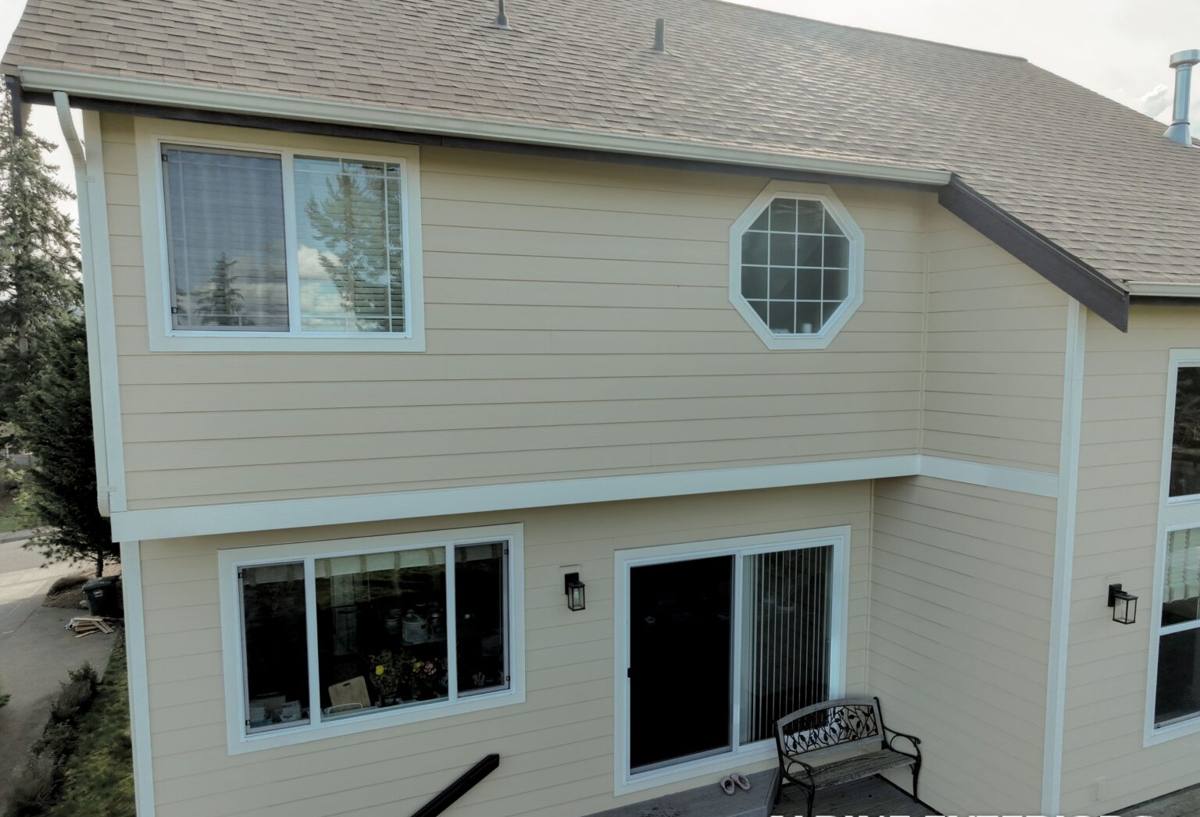
Why Wiser Lake's Climate Is Harder on Siding Than People Expect
Moisture That Doesn't Let Up
Standing water nearby means higher ambient humidity around the home year-round, not just during storms. Siding materials that can absorb or wick moisture — even a little, even slowly — stay damp longer here than they would on a dry inland lot. That extended damp period is exactly what feeds the next problem.
A Long, Aggressive Moss Season
Whatcom County's mild, wet winters are ideal moss-growing conditions, and lakefront humidity extends the window even further. Moss doesn't just look bad — it holds moisture directly against the siding surface, and on materials that aren't dimensionally stable or that have weak factory finishes, that constant damp contact accelerates paint failure, swelling, and rot.
Salt-Influenced Air
Wiser Lake isn't coastal saltwater, but this part of Whatcom County still sees salt-influenced air moving in from Puget Sound and the Strait, especially on windier days. Combined with lake humidity, that's a corrosive one-two punch for fasteners, trim, and any siding product with a finish that isn't built to resist it.
Driving Rain and Wind-Driven Water
Storms here don't just rain straight down — wind pushes water sideways into wall assemblies, testing every seam, joint, and piece of flashing. A siding system is only as good as its weakest connection point, which is why installation detailing matters as much as the material itself.
Why We Standardized on James Hardie for Homes Like These
We don't install LP SmartSide, vinyl, Cemplank, Allura, primed spruce, or cedar. That's a deliberate standard, not a limitation on what we're capable of installing. Around Wiser Lake specifically, here's what tips the decision:
- Fiber cement composition: Hardie board is engineered from cement, sand, and cellulose fiber — it doesn't swell, rot, or delaminate the way wood-based or wood-adjacent products can when exposed to sustained moisture.
- Non-combustible: An added layer of protection that has nothing to do with moss or moisture, but matters for long-term home value and insurance considerations.
- ColorPlus factory finish: A baked-on, multi-coat finish applied under controlled factory conditions holds up to moss, mildew staining, and salt-influenced air far better than field-applied paint, and it's backed by its own finish warranty.
- Climate-engineered HZ10 formulation: Hardie's HZ10 product line is engineered specifically for the Pacific Northwest's wet, moderate climate — this isn't a generic siding product adapted to our region, it was built for it.
- Dimensional stability: Fiber cement doesn't expand and contract with moisture the way wood-based composites can, which means fewer stressed seams and less caulk failure over time — a real factor when driving rain is testing every joint multiple times a year.
We're not going to tell you every alternative product is worthless — some have real strengths in the right application. But for a lakefront-adjacent Whatcom County property that deals with sustained humidity, moss, and wind-driven rain every single year, the trade-offs on cheaper or wood-based alternatives (recoating cycles, moisture sensitivity, seam maintenance) aren't ones we're willing to put our name behind anymore.
What a Correct Installation Involves Here
Material choice only solves half the problem. The other half is installation detail, and it's where a lot of siding jobs — even with good materials — quietly fail over the following 5 to 10 years. On a Wiser Lake property, we pay particular attention to:
Water Management Behind the Siding
A drainage plane and rainscreen gap let any moisture that does get past the siding surface drain and dry out instead of sitting against the wall sheathing. This matters more here than on a dry inland lot because the margin for error on trapped moisture is smaller.
Flashing and Butt Joint Detailing
Every horizontal joint, window head, and trim intersection is a potential entry point for wind-driven rain. Correct flashing at these points — not just caulk — is what actually keeps water out during a real Whatcom County storm.
Fastener Placement and Corrosion Resistance
With salt-influenced air in the mix, fastener choice and placement isn't a minor detail. Hardie's own installation specifications call for corrosion-resistant fasteners set at the correct depth and spacing — over-driven or under-driven nails are one of the most common causes of premature siding problems, and they're avoidable with a crew that installs Hardie every day.
Clearance from Grade and Hardscape
Near a lake, ground moisture and splash-back are bigger factors than on a typical inland lot. Hardie specifies minimum clearance from grade, decks, and patios for a reason — get that wrong and you're inviting the exact moisture exposure the product is designed to resist.
Caulking and Joint Sealing Standards
Manufacturer-approved sealants at the right joints, applied correctly, are part of what keeps the whole assembly watertight. This is a small line item that gets skipped or rushed on lower-bid jobs — and it's one of the first things that fails under sustained wind-driven rain.
Our Process for Wiser Lake Projects
- On-site assessment: We look at your home's specific exposure — how close you are to the water, prevailing wind direction, existing moss or moisture damage, and current siding condition.
- Product and color selection: We walk through Hardie's HZ10 lines, textures, and ColorPlus color options suited to the property and to Lynden's architectural styles.
- Detailed written estimate: Scope, product specification, and timeline in writing — no vague verbal quotes.
- Tear-off and inspection: Removing old siding lets us check sheathing and framing for hidden moisture damage before anything new goes up — critical on a lake-adjacent property.
- Water management install: Drainage plane, flashing, and rainscreen detailing installed to spec before a single piece of Hardie goes on.
- Hardie installation: Installed to manufacturer specification for fastener type, spacing, clearance, and joint treatment.
- Final walkthrough: We review the finished work with you directly before considering the job done.
Why a Crew That Already Works Wiser Lake Matters
Whatcom County covers a lot of different microclimates — a crew that mostly works drier inland neighborhoods isn't necessarily thinking about moss pressure, lake humidity, or salt-influenced air the same way a crew that regularly works Wiser Lake and the surrounding Lynden area does. That familiarity shows up in small decisions: how much rainscreen gap to leave, which trim details to prioritize, where moss tends to establish first on a given elevation. None of that is exotic knowledge, but it's the kind of thing that only comes from doing this work repeatedly in this specific environment, not from a general siding crew treating every job the same way regardless of where the house sits.
Cost Factors for a Wiser Lake Hardie Project
Every home is different, but these are the main variables that move the price on a project like this:
| Factor | Why It Matters |
|---|---|
| Home size and elevation count | More square footage and more complex rooflines mean more material and labor |
| Current siding condition | Hidden moisture or rot damage found during tear-off can add scope |
| Hardie product line and texture | HZ10 lap, panel, and shingle products vary in material cost |
| Trim and detail work | Corner boards, window trim, and fascia detailing add labor time |
| Site access | Lakefront lots with limited access or steep grades can affect setup and staging |
| Water management upgrades | Adding or upgrading a rainscreen system is worth the investment here |
We don't quote broad numbers without seeing the property — every estimate is based on an actual on-site assessment, not a rough guess over the phone.
Signs Your Current Siding Isn't Keeping Up
- Persistent moss or algae staining that returns shortly after cleaning
- Soft spots, bubbling, or visible swelling, especially near the bottom courses or ground-level trim
- Paint that's peeling, chalking, or needs recoating more often than every few years
- Visible gaps or separation at seams and joints
- A musty smell near exterior walls, which can indicate moisture getting behind the siding
- Fastener staining or rust streaks running down the siding face
If any of that sounds familiar, it's worth having someone take a real look before it turns into a sheathing or framing problem — which around a lake, tends to happen faster than people expect.
Ready to Talk About Your Home
If you're near Wiser Lake and dealing with moss, moisture, or aging siding, we're happy to come take a look and give you a straightforward, no-pressure estimate. Use the form below to get started — we'll walk the property, answer your questions, and give you a written scope so you know exactly what you're getting.