 Lynden
 Siding Replacement for Aldergrove, BC — Installed by a Crew Based Minutes Away
Aldergrove sits just across the Aldergrove–Lynden border crossing from our home base in Lynden, Washington, which means we're not driving in from across the region to bid a job and disappear. We know this corridor's weather, its housing stock, and what fails first on homes here because we work on both sides of that line every week. When we quote a siding replacement in Aldergrove, we're quoting it the same way we'd quote one three miles from our own shop — with the same materials, the same crew, and the same standards.
This page covers siding replacement specifically — not repair, not a patch job, but a full removal and reinstall of the exterior cladding system. If your siding is still sound and the problem is a cracked board or a failed seam, that's a different conversation. Replacement is for homes where the siding itself, or what's behind it, has reached the point where patching stops making sense.
What the Local Climate Does to Siding
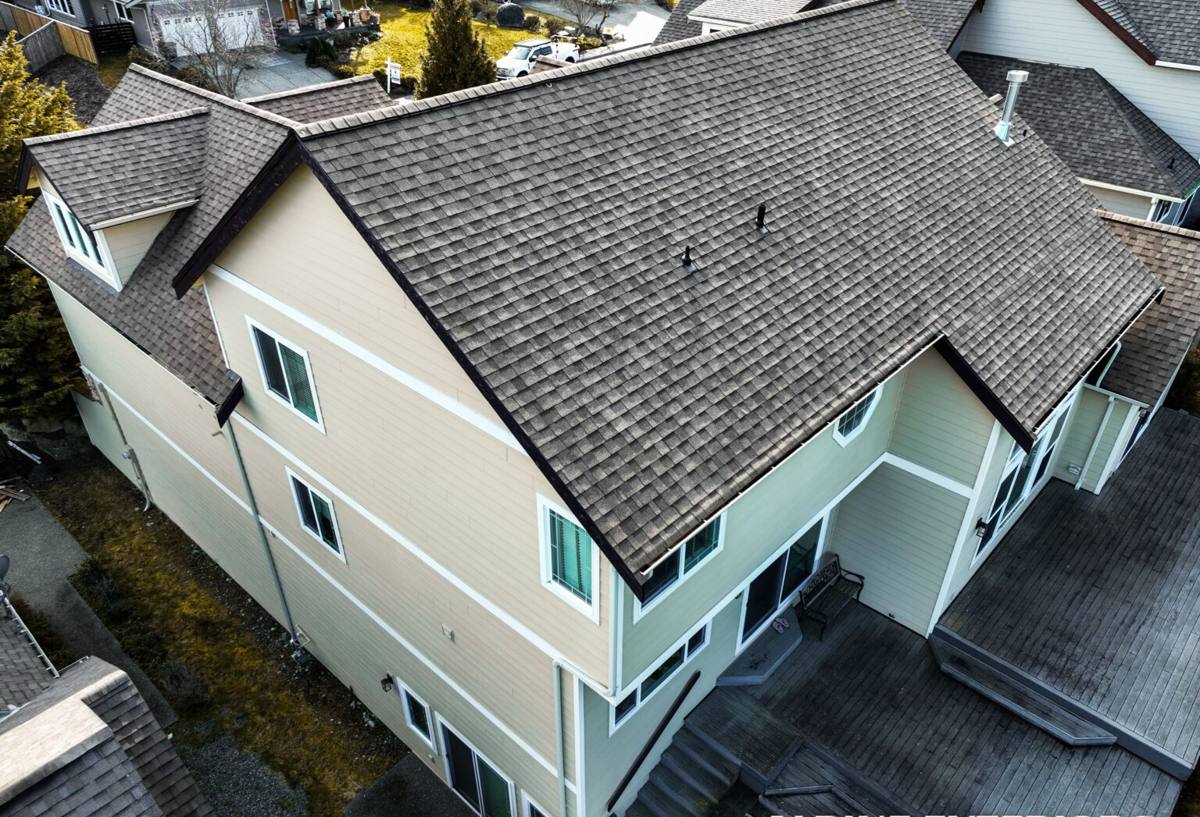
Aldergrove and the surrounding Fraser Valley get the same marine-influenced weather pattern we deal with in Whatcom County: long stretches of driving rain carried on wind off the water, salt-laden air that works its way inland, and a moss season that can run most of the year on north-facing walls and anything shaded by trees or a neighboring structure. None of that is exotic — it's just relentless. Siding here doesn't usually fail from one dramatic event. It fails from years of being wet, drying slowly, and never fully catching up before the next system rolls through.
Three things matter more here than in a dry climate:
- Water shedding, not just water resistance. The siding and the assembly behind it need to move water down and out, not just tolerate getting wet.
- Dimensional stability. Materials that swell and shrink with moisture open up gaps at seams and fasteners over time, and those gaps let more water in.
- Resistance to sustained moss and mildew contact. Anything that stays damp for days at a stretch is going to grow something on it eventually — the question is whether the material handles that without breaking down.
Signs Your Aldergrove Home Needs Replacement, Not Repair
Most homeowners call us because something looks off, but they're not sure if it's cosmetic or structural. Here's what tells us replacement is the right call:
- Siding that's soft, spongy, or crumbles when you press on it, especially near the bottom courses or below windows
- Paint that won't hold anymore — it's peeling within a year or two of a fresh coat, which usually means moisture is pushing out from behind the board
- Visible warping, buckling, or boards pulling away from the wall
- Persistent moss or black staining that comes back within months of cleaning
- Cracking concentrated at butt joints and corners, where water intrusion typically starts
- Interior signs — musty smell, staining on interior drywall near exterior walls, or soft spots in the sheathing when we open up a test section
One or two of these on their own might mean a repair. Several at once, especially combined with soft sheathing underneath, usually means the whole wall assembly needs to come off and be rebuilt correctly.
What a Correct Siding Replacement Job Actually Involves
Siding replacement isn't just swapping old boards for new ones. The siding is the last layer of a system, and if the layers underneath aren't right, new siding will fail the same way the old siding did — just on a delay. A proper job includes:
Tear-off and inspection
We remove the existing siding and inspect the sheathing and framing underneath. This is where hidden rot or water damage from years of a failing assembly usually shows up. It needs to be addressed before anything new goes on — covering damaged sheathing with new siding just hides the problem.
Water-resistive barrier and flashing
A correctly lapped house wrap or building paper, with proper flashing at every window, door, and penetration, is what actually keeps bulk water out of the wall. This step matters more in a climate like ours than the siding material itself — it's the layer doing the real work during a sustained rain event.
Fastening to spec
Fastener type, spacing, and placement affect how the siding holds up over 20-plus years, not just whether it looks straight on installation day. This is one of the most common places corners get cut, and it's invisible until siding starts pulling loose years later.
Trim, caulking, and finish details
Corners, butt joints, and transitions to windows, doors, and roofline are where most long-term failures start. Getting these details right the first time is the difference between siding that looks good for a decade and siding that looks good for two years.
Why We Install Only James Hardie Fiber Cement
We made a decision a while back to standardize on one product line rather than offer several, and it's worth explaining why. Different siding materials handle sustained coastal moisture differently, and in a climate like Aldergrove's, that difference shows up over time, not on installation day.
| Material | How it typically performs in this climate |
|---|---|
| Vinyl siding | Low maintenance and inexpensive, but it can warp or distort in heat and doesn't stop moisture from reaching the wall behind it — it relies entirely on the barrier underneath |
| Engineered wood (e.g. LP SmartSide) | Better than raw wood, but still wood-based — edges and cut ends are vulnerable if sealed imperfectly, and sustained moisture exposure is its weak point |
| Cedar or primed spruce | Attractive natural material, but requires ongoing refinishing and is genuinely susceptible to moisture, rot, and insect damage without diligent upkeep |
| James Hardie fiber cement | Non-combustible, dimensionally stable in wet-dry cycling, factory-applied ColorPlus finish resists the peeling that repainted wood siding is prone to |
Hardie isn't magic, and it still needs to be installed correctly to perform — the flashing and water-management points above matter just as much with Hardie as with anything else. But as a base material, it holds up to the wet-dry cycling, salt exposure, and constant moss pressure this region produces better than the alternatives, and it comes with a strong transferable warranty backing that performance. That's why it's the only product we put on homes, in Lynden or in Aldergrove.
Our Process, Start to Finish
- Walk-through and assessment. We look at the current siding, check for soft spots and hidden damage, and talk through what we're seeing.
- Written estimate. Clear scope, clear pricing, no vague allowances that turn into surprise add-ons later.
- Tear-off. Old siding comes off and we inspect the sheathing before anything new goes up.
- Repair as needed. Any damaged sheathing or framing gets addressed before the new assembly goes on — we'll show you what we found.
- Water barrier, flashing, and Hardie installation. Installed to manufacturer spec, with attention to the details that actually determine longevity.
- Final walk-through. We go over the finished job with you before we call it done.
What Affects Cost on an Aldergrove Siding Replacement
There's no honest flat number for siding replacement — every home is different — but these are the factors that move the price up or down:
| Factor | Why it matters |
|---|---|
| Home size and wall complexity | More corners, gables, and dormers mean more cutting, more trim work, and more labor hours |
| Condition of the sheathing underneath | If tear-off reveals rot or water damage, that repair work is separate from the siding install itself |
| Siding profile and accessories | Lap width, trim style, and any specialty accents affect material cost |
| Access and site conditions | Tight lots, second-story sections, or landscaping close to the house can add setup time |
| Existing siding removal | Multiple layers of old siding, or siding with old paint that needs careful handling, adds to tear-off time |
We walk through all of this in the estimate so you know what's driving the number, not just what the number is.
Why It Matters That Your Crew Already Works This Area
A crew that only occasionally crosses the border for a job in Aldergrove is learning the local realities — permitting expectations, typical construction of homes in the area, how the climate here compares to wherever they usually work — on your project. We've been working this corridor long enough that none of that is new to us. We know what a wall assembly here typically looks like when we open it up, and we know how this specific stretch of coastal-influenced weather treats a siding job over the following decade, because we're the ones who get called back if it doesn't hold up.
That local track record is worth asking about with any contractor you're considering, not just us. A company that's done real siding replacement work in your specific area, and is still around and answering the phone years later, is a very different bet than one that's bidding a job outside their usual territory.
After Your New Siding Goes On
Hardie siding is genuinely low-maintenance, but "low-maintenance" doesn't mean "no maintenance" in a climate that produces this much moss and moisture. A short list of what keeps it performing well for the long haul:
- Rinse off accumulated dirt, pollen, and moss growth once or twice a year, especially on shaded or north-facing walls
- Keep gutters clear so water isn't overflowing directly onto siding below
- Trim back vegetation and tree limbs that keep sections of wall shaded and damp
- Recaulk trim joints and penetrations if you notice gaps opening up over the years
- Have any impact damage or corner damage looked at promptly rather than left to sit
If you're seeing signs of trouble on your current siding, or you just want an honest read on whether repair or full replacement makes more sense for your home, we're happy to come take a look. The estimate is free, there's no pressure attached to it, and you'll walk away with a clear picture of what your options actually are — just fill out the form below.