 Lynden
 Window Installation Built for Acme's Climate
Acme sits in a part of Whatcom County where weather doesn't ease up for long stretches of the year. Homes here deal with driving rain that comes in sideways during winter storms, salt-laden air that drifts in off Puget Sound and the Strait of Georgia, and a moss season that can run from fall through spring. None of that is a problem for a window that was installed correctly. Almost all of it becomes a problem for a window that wasn't. When we talk about window installation for this area, we're not talking about a generic swap-and-caulk job. We're talking about how a window is flashed, sealed, and integrated into the wall so water has nowhere to go but back outside.
A lot of window failures we see in Whatcom County aren't glass failures at all. They're installation failures — a missing flashing detail, a gap in the weather-resistive barrier, a sill pan that was skipped to save time. The window itself might be a perfectly good product. It just never had a fighting chance against the amount of moisture this region throws at a house every year.
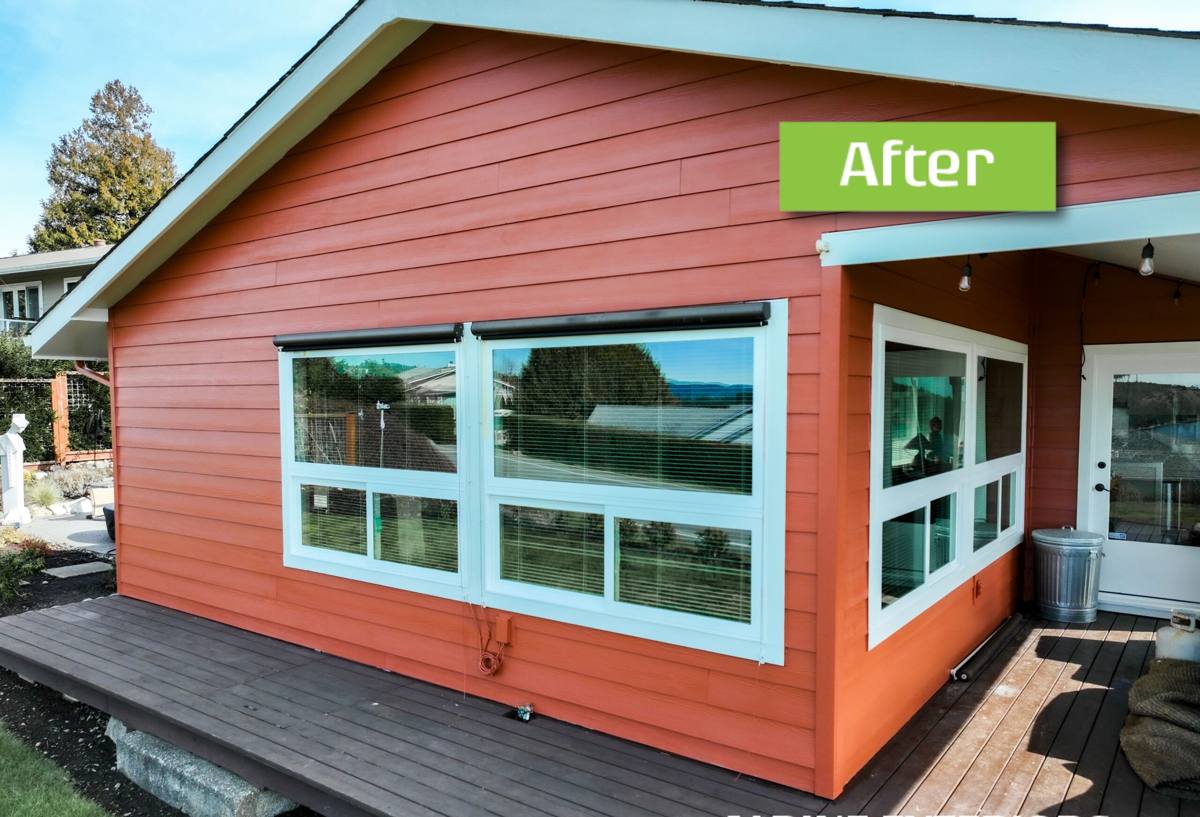
What Correct Window Installation Actually Involves
Whether we're replacing a single failing window or handling a whole-house upgrade, the sequence matters more than any single product choice. Skipping a step doesn't usually cause a problem in month one — it causes one in year three or four, after moisture has had time to work into framing that's now hidden behind trim and paint.
The details that actually keep water out
- A properly sloped sill pan so any water that gets past the glass drains outward, not into the wall cavity
- Correctly lapped flashing tape integrated with the house wrap or building paper — order matters, not just presence
- Backer rod and quality exterior sealant at the right joints, not sealant used as a substitute for flashing
- Shimming that's square and plumb, so the window operates smoothly and the seal isn't stressed unevenly over time
- Insulation in the gap between the window frame and the rough opening — not stuffed too tight, not left empty
- Interior air sealing so conditioned air isn't leaking out around the frame and causing condensation in the wall
Any one of these done wrong can undo the benefit of an expensive, well-rated window. This is why we treat installation technique as equal in importance to the window product itself, not an afterthought to it.
Signs Your Windows Are Already Struggling
Homeowners in and around Acme usually notice a problem before they can name it. A few signs are worth taking seriously rather than waiting out:
- Soft or discolored trim and sill wood, especially on south- and west-facing walls that take the worst of the wind-driven rain
- Fogging or moisture between the panes of a double-pane window, which means the seal between the glass layers has failed
- Drafts you can feel with a hand near the frame on a windy day, even with the window latched shut
- Moss or persistent green staining building up on the sill or the wall just below the window — a sign moisture is sitting there long enough to support growth
- Difficulty opening, closing, or latching a window that used to operate fine, which often points to a frame that's swelled or shifted from trapped moisture
None of these mean the whole house needs new windows. Sometimes it's one or two problem openings — often on the weather side of the house — while the rest are holding up fine. We'll tell you honestly which is which rather than pushing a full-house job you don't need.
Choosing Materials for This Climate
There's no single "best" window material — there's a best fit for your house, your budget, and how much upkeep you want to take on. Here's how the common options actually compare for a wet, salt-air-influenced climate like Whatcom County's:
| Material | Moisture Behavior | Maintenance | Typical Fit |
|---|---|---|---|
| Vinyl | Won't rot; performs well against rain and humidity | Low — occasional cleaning | Most homes; strong value and durability |
| Fiberglass | Very stable in wet, temperature-swinging conditions | Low | Larger openings, higher-end remodels |
| Wood (unclad) | Handsome but vulnerable to prolonged wet exposure | High — regular painting/sealing | Historic or period-accurate homes, protected elevations |
| Wood-clad | Exterior clad layer protects the wood from weather | Moderate | Homeowners wanting a wood interior look with better weather resistance |
| Aluminum | Prone to condensation and corrosion in salt-influenced air unless thermally broken | Moderate to high near moisture | Limited use; mostly commercial or specific architectural needs |
For most homes we work on near Acme, vinyl or fiberglass covers the durability-to-cost equation well. Where a homeowner wants real wood on the interior, we lean toward clad options rather than exposed wood on exterior-facing elevations that take the brunt of the weather — it's a maintenance and longevity call, not a knock on wood itself.
Glass and energy performance
Low-E, argon-filled double-pane glass is the practical standard for this region — it balances energy performance with cost. Triple-pane can make sense on a north-facing wall that takes constant wind, or for a homeowner prioritizing sound dampening near a busier road, but it's not a requirement for most homes here. We'll walk through the actual U-factor and condensation resistance numbers on the options we quote rather than just pointing at a sticker.
Replacement Windows vs. New Construction Windows
This distinction matters more than most homeowners realize going in. A new construction window has a nailing fin and gets installed into an open rough opening with full access to the framing — that's how it's done when siding is coming off anyway. A replacement (or "pocket") window is sized to fit into the existing frame with the old sashes removed, leaving exterior trim and siding undisturbed.
If you're also doing siding work, new construction windows with proper flashing integration are usually the better long-term choice — it's the one time the wall is fully open and every layer can be done right. If your siding is in good shape and you just need failing windows addressed, a well-fitted replacement window avoids unnecessary disruption. We'll tell you honestly which approach fits your situation rather than defaulting to whichever is more work.
Our Installation Process
We keep the process straightforward and predictable, because homeowners deserve to know what's happening in their house and when.
- On-site assessment — we look at each window individually, not just the house as a whole, since problem openings and healthy ones often sit side by side
- Measurement and product selection — exact sizing, plus a straightforward conversation about material and glass options that fit your budget
- Old window removal — done carefully to check the condition of the framing underneath before anything new goes in
- Framing repair if needed — if rot or moisture damage turns up, we address it before installing the new window, not after
- Installation with proper flashing and sealing — sill pan, flashing tape, insulation, and air sealing done in the correct order, every time
- Interior and exterior trim finishing — clean, weathertight, and matched to the rest of the house
- Walkthrough — we show you the finished work and answer questions before we consider the job done
Why a Crew That Already Works Acme Matters
Whatcom County isn't one uniform climate. Wind exposure, tree cover, elevation, and how close a property sits to open fields or water all change how hard weather hits a given wall. A crew that regularly works in and around Acme and Lynden has already seen how homes in this specific area age — which elevations take the worst of the driving rain, how moss builds up on north-facing trim, how salt-influenced air affects hardware and finishes over the years. That's not something you learn from a spec sheet. It's something you learn from being on this kind of roof and around this kind of framing repeatedly.
It also means straightforward logistics: someone local can get to your site for a walkthrough, come back for a follow-up question, and stand behind the work without a long-distance excuse in the way.
What Affects the Cost of a Window Installation
We won't quote a price without seeing the job, but these are the factors that actually move the number up or down:
| Factor | Why It Matters |
|---|---|
| Number and size of openings | Larger and more numerous windows mean more material and labor |
| Material choice | Vinyl, fiberglass, and wood-clad carry different product costs |
| Replacement vs. new construction | New construction involves more work if siding must be opened up and re-flashed |
| Hidden framing damage | Rot discovered once old windows come out adds repair scope |
| Glass package | Double-pane Low-E vs. triple-pane vs. specialty coatings affects unit price |
| Access and site conditions | Second-story openings or tight access can add time |
Broad ranges vary widely by these factors — a single problem-window replacement is a very different job from a full-house window package. We'd rather give you a real number after seeing your home than a range that doesn't mean much either way.
Simple Maintenance That Extends Window Life
- Rinse sills and tracks a couple times a year to clear pollen, moss spores, and grit before they trap moisture
- Check exterior caulking annually, especially after a hard winter, and touch up any cracked or separated joints
- Keep gutters clear so overflow isn't running directly down onto window heads below
- Trim back vegetation that keeps a window shaded and damp longer than the rest of the house
- Operate each window a few times a season so hardware doesn't seize and weatherstripping stays seated correctly
If you're noticing drafts, fogged glass, or soft trim around your windows — or you're planning ahead for a remodel — we're happy to take a look and give you a straightforward, no-pressure assessment of what your Acme-area home actually needs. Use the form below to request a free estimate.