 Lynden
 Why Nooksack Siding Takes a Beating
Nooksack sits in a part of Whatcom County that gets hit from multiple directions at once. Marine air moving inland off the Salish Sea keeps humidity high for most of the year, driving rain off the Cascade foothills comes in sideways during fall and winter storms, and the shaded, damp conditions along the Nooksack River valley extend moss season far longer than homeowners expect. Any one of these on its own is manageable. Together, they create a slow, steady attack on siding that most homeowners don't notice until it shows up as a soft spot, a stain, or a board that's started to pull away from the wall.
Siding is the only thing standing between that weather and your home's framing. When it's doing its job, water sheds off the surface and never gets a chance to sit against the wood underneath. When a seam opens, a fastener backs out, or paint fails and lets moisture in, the clock starts ticking on rot — and rot doesn't announce itself until it's already spread.
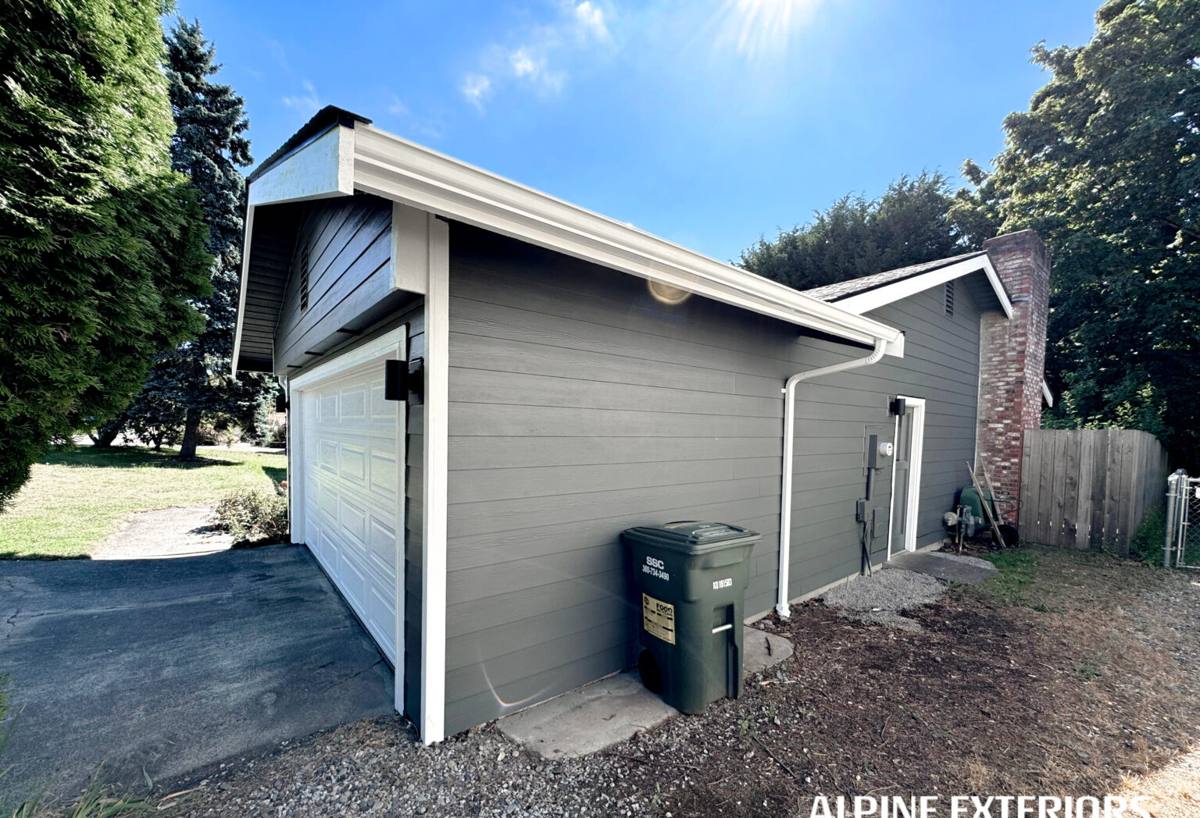
Signs Your Siding Needs Repair Now
Most siding repairs are cheaper and simpler if they're caught early. Once moisture gets behind the siding and into the sheathing, the job gets bigger fast. Here's what we tell Nooksack homeowners to watch for between now and the next wet season:
- Soft or spongy spots when you press on siding, especially near the bottom courses and around window trim
- Visible gaps at seams, corners, or where siding meets trim, fascia, or the foundation
- Persistent green or black staining that comes back within weeks of cleaning
- Paint that's peeling, bubbling, or chalking well before its expected repaint interval
- Boards that have visibly cupped, bowed, or pulled loose from the wall
- Interior signs — a musty smell, a soft spot on an interior wall, or a stain near a window — that trace back to an exterior wall
- Caulk joints that have shrunk, cracked, or separated from the siding edge
If you're seeing more than one of these, it's worth getting a professional look before the next storm cycle rather than after.
Nooksack's Moss Problem Is More Than Cosmetic
Moss and algae growth on siding isn't just an appearance issue. Moss holds moisture against the surface long after the rain has stopped, which keeps that section of wall wet far longer than the rest of the house. On wood-based or poorly finished siding, that constant dampness is exactly what accelerates rot underneath. On a properly finished fiber cement surface, moss is mostly a cleaning problem — but it still needs to be addressed, because heavy growth can trap grit and moisture against caulk joints and fasteners over time.
Common Siding Problems We See in Nooksack
Every house is different, but the same handful of failure points show up again and again in this area. Understanding the cause helps explain why the fix needs to be more than cosmetic.
| Problem | What's Usually Causing It | What a Correct Repair Involves |
|---|---|---|
| Buckled or cupped boards | Moisture absorption, poor original installation, or lack of expansion clearance | Remove affected boards, check sheathing underneath, reinstall with correct fastening and clearance |
| Failed caulk joints | UV exposure, temperature swings, and constant damp/dry cycling | Full removal of old caulk, dry-out period, reapplication with proper joint prep |
| Dark staining or moss | Shade, humidity, and infrequent cleaning | Gentle cleaning, inspection for trapped moisture, repaint or refinish if needed |
| Soft or rotted sections | Long-term water intrusion behind the siding, often from a failed seam or flashing | Cut back to solid material, correct the water source, replace with matched siding |
| Nail pops or fastener rust | Wrong fastener type or spacing for the siding and climate | Remove and refasten with corrosion-resistant fasteners at correct spacing |
What a Correct Repair Actually Involves
A siding repair that just patches the visible problem often fails again within a season or two. Doing it right means treating the visible damage as a symptom and finding the cause.
Start With Moisture, Not Just Appearance
Before we touch a single board, we check what's happening behind it. That means pulling back suspect siding to look at the house wrap or sheathing, checking for soft spots with a probe, and tracing water stains back to their actual entry point — which is often several feet away from where the damage shows up on the surface.
Match the Material, Not Just the Color
Patching in a mismatched product — different thickness, different exposure, a different manufacturer's profile — creates a visible seam and a future failure point. When we repair a section, we match the existing siding's profile and reveal as closely as possible, and where an exact match isn't available, we plan the repair line at a natural break point like a corner or trim board rather than mid-wall.
Fix Flashing and Water Management, Not Just Siding
A huge share of "siding failures" are actually flashing failures — around windows, at butt joints, above trim, or where siding meets a roofline. Replacing the siding without correcting the flashing underneath just resets the timer on the same problem.
Repair vs. Replacement: How We Decide
Not every problem area needs a full re-side, and not every damaged section can be safely patched. We look at scope, cause, and age together before recommending either path.
| Factor | Favors Repair | Favors Full Replacement |
|---|---|---|
| Extent of damage | Isolated to one or two wall sections | Spread across multiple elevations |
| Underlying cause | Single identifiable source (one flashing, one seam) | Systemic, such as widespread original installation errors |
| Age and material | Newer siding still within its expected service life | Siding past its practical lifespan or already failing broadly |
| Sheathing condition | Sheathing underneath is dry and sound | Rot has spread into sheathing or framing in multiple areas |
We'll give you a straight answer either way. If a repair is the honest, cost-effective solution, that's what we recommend — a full re-side isn't automatically the "better" answer just because it's the bigger job.
Why We Only Repair and Install With James Hardie Fiber Cement
When a repair calls for new material — a section of siding, trim, or a full elevation — we use James Hardie fiber cement, and we don't keep vinyl, LP SmartSide, cedar, primed spruce, or other fiber cement brands in our lineup. That's a standard we hold across every job, not just new installs.
In a climate like Whatcom County's, the material matters as much as the workmanship. Fiber cement doesn't absorb moisture and swell the way wood-based products can, and it won't soften or delaminate the way some engineered wood siding does when water gets past a seam. Hardie's HZ product lines are engineered specifically for climate zones like ours, factory-finished ColorPlus coating resists the fade and chalking that constant damp exposure causes on field-painted siding, and the material is non-combustible. Repairs done in matching Hardie product also carry forward Hardie's transferable warranty coverage rather than starting from scratch with an unrelated patch material.
We stand behind this standard because we've seen what happens when repairs are done with whatever's convenient rather than what actually holds up here. A mismatched or lower-grade patch might look fine for a season, but it becomes the next callback.
Our Siding Repair Process
- On-site inspection. We look at the full elevation, not just the spot you called about, and check for moisture behind the siding.
- Honest diagnosis. We identify the actual cause — flashing, caulk failure, fastener issue, or a deeper moisture problem — and explain it in plain terms.
- Written scope and estimate. You'll know exactly what's being repaired, what material is being used, and what it costs before work starts.
- Repair or replace as needed. Damaged material comes out, sheathing is checked and dried or repaired if needed, and new Hardie material goes in matched to your existing siding.
- Water management check. Flashing, caulking, and drainage details are corrected as part of the repair, not left for next time.
- Final walkthrough. We show you what was done and what to watch for going forward.
Why a Crew That Already Works in Nooksack Matters
Siding repair done right depends on understanding how a specific area's weather actually behaves, not just general Pacific Northwest conditions. A crew that regularly works in and around Nooksack knows how long moss season really runs here, which elevations tend to take the worst of the driving rain, and how the damp, shaded conditions along the river valley affect drying time between rainfall — all of which shape how a repair should be sequenced and finished. That local familiarity also means fewer surprises on scheduling: knowing when there's a realistic dry window to work with versus when a repair needs to be planned around an incoming wet stretch.
It also means accountability. A local crew has a reputation in the community to maintain, and is around to stand behind the work in the years after the job is done — not just through the workday.
If you're seeing signs of trouble on your Nooksack home's siding, or just want an honest opinion on whether it's a repair or something bigger, we're happy to take a look. Estimates are free and there's no pressure — just a clear, straight answer about what your siding actually needs.