 Lynden
 Aldergrove's Climate Is Harder on Siding Than It Looks
Aldergrove sits just across the international line from Lynden, close enough that many homeowners there already know our crews from work on the Washington side. The climate doesn't change much crossing that border, either. It's the same Pacific Northwest marine pattern: mild temperatures, long wet winters, and air that carries more moisture and salt than most people expect for a spot that isn't technically "on the coast." That combination is deceptively hard on exterior siding. A wall can look fine for a few years and then start failing all at once at the seams, the butt joints, and the lowest few feet near grade — right where wood-based and vinyl products are weakest.
We install James Hardie fiber cement siding exclusively, and a big part of why is this exact climate. Whatcom County and the Fraser Valley get a specific mix of stress — salt-laden air, sideways rain, and shaded, moss-prone lots — that separates products which merely look good on install day from products that still perform a decade later.
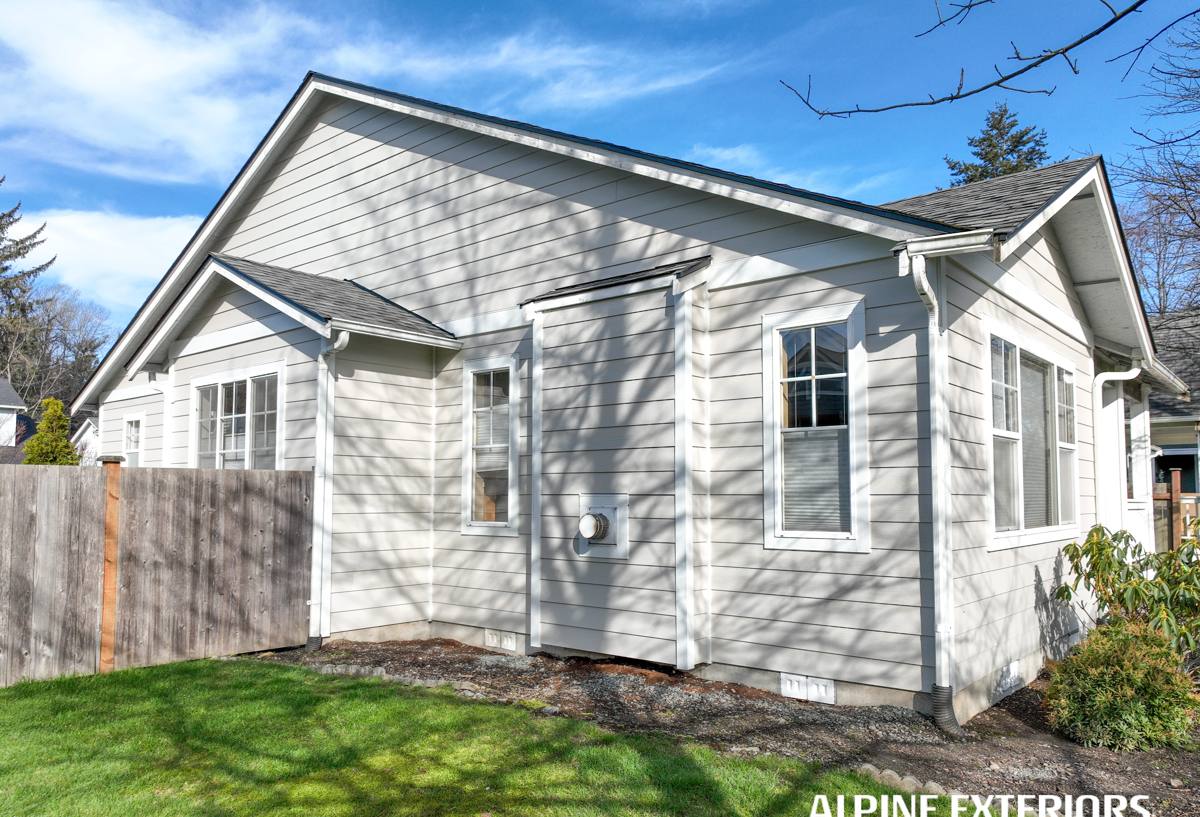
What Salt Air, Driving Rain, and Moss Actually Do to a Home
Salt-Laden Marine Air
Wind off the Salish Sea and Georgia Strait moves inland across this whole region, and it carries fine salt with it. You won't see it, but it settles on exterior surfaces constantly. Over time it accelerates corrosion on exposed fasteners, staples, and metal flashing, and it draws moisture into any material with porosity — which is most wood and wood-composite siding. Corroded fasteners loosen panels; loosened panels let more water in behind the surface.
Wind-Driven Rain
Storms in this area rarely fall straight down. They come in at an angle, driven by wind off the water, and that rain gets pushed up and sideways into places a vertical rain never reaches — under laps, around window and door trim, and into any seam that wasn't properly lapped or flashed. Gable ends and upper stories, which take the most direct wind exposure, are usually where problems show up first.
Moss and Trapped Moisture
Mature trees, cooler shaded lots, and a long damp season add up to serious moss growth on north- and west-facing walls. Moss holds water directly against the siding surface long after a storm has passed. On wood or wood-composite products, that sustained dampness feeds rot at the fibers. On any product, it breaks down paint film and caulking faster than direct sun and rain alone would.
Why We Only Install James Hardie Fiber Cement
We made a deliberate call years ago to stop installing anything other than James Hardie fiber cement siding. Not because every other product is bad at everything — it's that in a climate like this one, the trade-offs of wood, vinyl, and engineered-wood products show up as real maintenance headaches and shortened lifespans, while fiber cement is built specifically to resist them.
| Material | Salt Air & Corrosion | Moss & Trapped Moisture | Ongoing Maintenance |
|---|---|---|---|
| Cedar / solid wood | Fasteners and fittings corrode over time; wood itself doesn't rust but absorbs the moisture salt air carries | Prone to rot wherever moss holds water against the grain | Regular refinishing, caulking, and spot repair |
| Vinyl | Doesn't corrode, but seams and J-channels can loosen and let water track behind the panels | Moss grows on the surface easily; trapped moisture behind panels goes unnoticed | Low surface upkeep, but hidden water damage is common and hard to spot |
| LP SmartSide (engineered wood) | Fasteners face the same corrosion risk as any exposed metal in this air | Engineered wood core is more moisture-resistant than raw cedar, but still vulnerable at cut edges and damaged coating | Coating maintenance and prompt repair of any breach is important |
| James Hardie fiber cement | Fiber cement doesn't corrode or absorb moisture the way wood fiber does | Dense cement composition resists moss-driven rot; surface can be rinsed clean | Baked-on ColorPlus finish means little to no repainting for years |
That's the honest comparison, not a knock on any single product. Vinyl and engineered wood both have a place in the industry. We simply decided that for the climate our customers live in, fiber cement is the material we're willing to put our name behind.
What a Correct Fiber Cement Siding Installation Involves
Fiber cement performs the way it's supposed to only when it's installed to spec. This is a product that's unforgiving of shortcuts, and in a wet, wind-driven climate like this one, a sloppy install shows its problems faster than it would in a drier region. A correct job includes:
- A properly lapped weather-resistant barrier behind the siding, with no gaps or reversed laps
- Flashing at every window, door, and penetration — not caulk used as a substitute for flashing
- Fasteners driven flush, never overdriven, at the manufacturer's specified spacing
- Correct gapping at butt joints and trim to allow for expansion, per James Hardie's published specifications
- Caulk used only where Hardie's install guide calls for it, not everywhere as a catch-all
- Field-cut edges primed or painted before installation, since raw cut edges are the most vulnerable point on the board
- Proper clearance between the bottom of the siding and grade, decking, or roofing to avoid wicking moisture
If you're comparing quotes or evaluating an existing installation, those are the details worth asking about. Most fiber cement failures we get called out to inspect trace back to one of these steps being skipped — not to a defect in the material itself.
Matching the Right Hardie Product Line to This Climate
James Hardie engineers its siding by climate zone, and homes in this region call for the HZ5 product line, built for areas with cold, wet winters and significant moisture exposure. We spec HZ5 as the baseline here rather than treating it as an upgrade. Beyond the climate engineering, the ColorPlus factory finish matters a lot in a moss-prone, high-moisture area — it's baked on at the factory under conditions a job-site paint job can't match, and it holds color and resists fading and moisture intrusion far longer than field-applied paint. For most homes we install lap plank siding as the primary field material, with shingle-style or panel accents where the architecture calls for it, and Hardie trim to match.
Serving Aldergrove From Lynden — What That Means for You
Lynden and Aldergrove are connected by one of the more direct border crossings on this stretch of the line, and we treat that as a short commute, not a complication. Crews and materials move between the two towns routinely. That said, permitting and inspection requirements on the Canadian side are separate from Whatcom County's, and it's the homeowner's local jurisdiction that governs what's required for a siding project — we'll walk you through what applies to your specific home rather than assume it works the same as it does south of the line.
| Factor | Why It Affects Your Estimate |
|---|---|
| Home size and number of stories | More surface area and taller walls mean more material, staging, and labor time |
| Condition and type of existing siding | Tear-off, disposal, and any sheathing repair found underneath add time before new siding goes up |
| Trim, window, and architectural detail | Homes with more corners, dormers, and trim lines take longer to flash and fit correctly |
| Site access | Tight lots, fencing, or landscaping close to the house can slow staging and material handling |
Our Process, Start to Finish
- A free, no-pressure on-site estimate where we measure the home and inspect the current siding and sheathing condition
- Product and color selection from James Hardie's ColorPlus lineup
- Careful removal of old siding and inspection of the wall assembly underneath before anything new goes up
- Installation to James Hardie's published specifications — barrier, flashing, fastening, and gapping done right the first time
- A final walkthrough with you before we consider the job done
Living With Fiber Cement Siding in a Moss-Prone Climate
Fiber cement asks for very little upkeep, but "very little" isn't "none." An occasional gentle rinse on north- and west-facing walls keeps moss from getting a foothold in the first place. Keeping gutters clear and trimming back vegetation that shades the siding improves airflow and helps walls dry out between storms, which matters more here than in a drier climate. Because the ColorPlus finish is factory-applied, you're not looking at a repaint cycle the way you would with site-painted wood or trim — just occasional cleaning and prompt attention if a panel is ever damaged. James Hardie also backs the product with a strong transferable warranty, which matters most in a climate that tests siding this consistently.
If you're weighing your options for a home in Aldergrove, we're happy to come take a look and give you a straightforward, no-pressure estimate — no invented urgency, just an honest read on what your home needs.