 Lynden
 Ferndale sits close enough to the water and the marine air that moves through Whatcom County that its homes take on a different kind of weathering than houses ten or fifteen miles inland. Salt-laden air, wind-driven rain off the Strait, and a moss season that can run more than half the year all work on exterior siding at once. If your siding is original to the house, or if it's an older wood or vinyl product that's starting to show its age, replacement isn't just a cosmetic project here — it's how you stop moisture and organic growth from getting a foothold on the structure underneath.
We install siding across Whatcom County, and Ferndale homes get a specific set of problems that a generic siding job doesn't account for. This page covers what that looks like in practice: what the climate does to different siding materials, what a correct replacement involves, and why a crew that already knows this area's conditions matters more than it might seem.
What Ferndale's Climate Actually Does to Siding
Three factors combine on Ferndale homes in a way that's worth understanding before you pick a replacement material.
Salt Air
Proximity to Bellingham Bay and the Strait of Georgia means airborne salt is a real factor here, not a coastal-town cliché. Salt accelerates corrosion on fasteners, staples, and any exposed metal trim, and it can degrade certain paint and coating systems faster than they'd wear inland. Siding and finish systems that aren't engineered for it tend to chalk, fade, or fail at the fastener points years ahead of schedule.
Driving Rain
Rain in this part of Whatcom County rarely falls straight down. Wind off the water pushes it sideways into wall assemblies, which puts real stress on laps, seams, and butt joints — the places where water intrusion actually starts. A siding system's water-management detailing (how it sheds water at horizontal laps, how it's flashed at penetrations, how it interfaces with trim) matters as much as the material itself.
Moss and Organic Growth
Whatcom County's damp, mild climate keeps surfaces wet for long stretches, which is exactly what moss, algae, and mildew need to establish. North-facing walls and anything shaded by trees or neighboring structures are especially prone. Materials that hold moisture at the surface — instead of shedding it — stay damp longer and give organic growth more time to take hold.
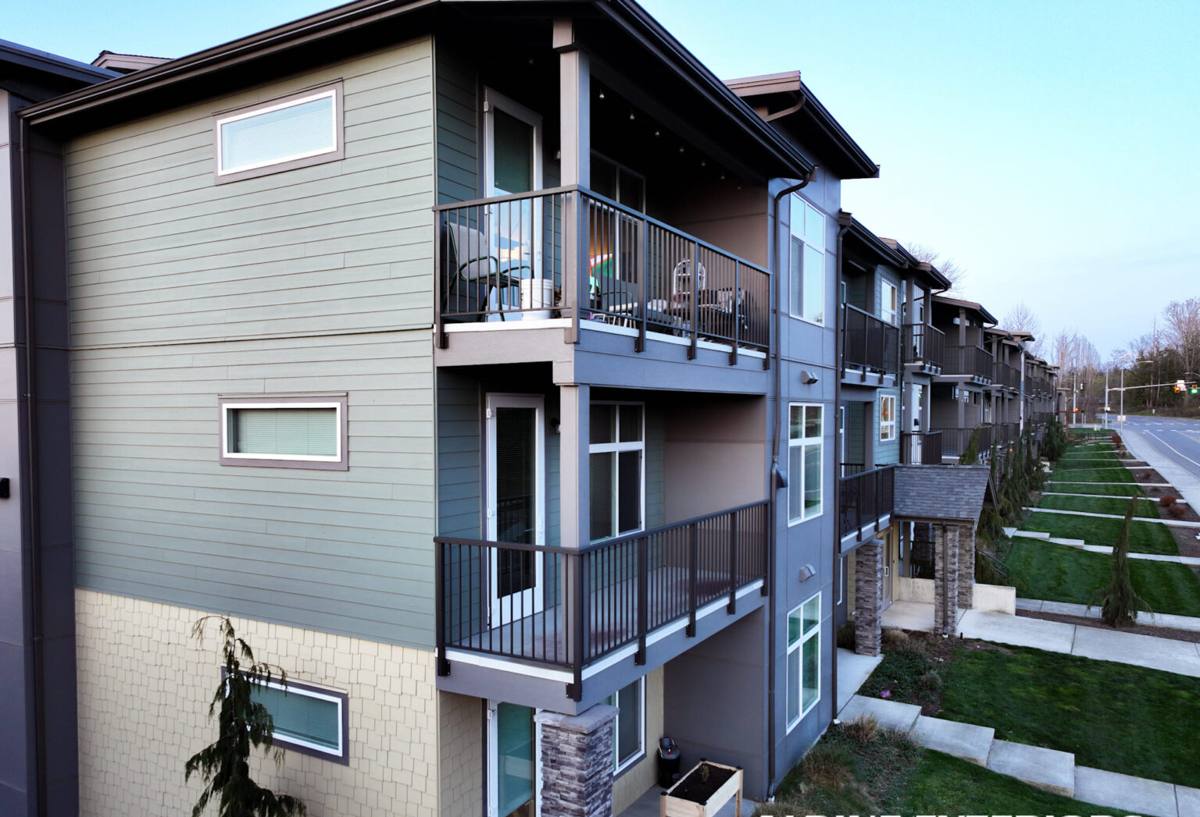
Why Material Choice Matters More in Ferndale Than Elsewhere
Every siding material handles this combination of salt, rain, and moisture differently. This is the core of our standardization decision.
- Wood siding (cedar, primed spruce): Beautiful, but it's an organic material in a climate that's actively trying to rot and grow moss on organic materials. It needs regular refinishing, and any lapse in maintenance shows up fast as moisture damage or surface growth.
- Vinyl siding: Doesn't rot, but it isn't rigid enough to stay flat under real wind-driven rain over time, and its color is baked into a thin material that can fade and become brittle with UV and weather exposure. It also isn't fire-resistant.
- Engineered wood (LP SmartSide and similar): Better moisture resistance than raw wood, but it's still a wood-based substrate. If a seam, cut edge, or fastener point isn't sealed correctly, moisture can get into the core and cause swelling or delamination — and driving rain is exactly the condition that finds those gaps.
- Fiber cement (James Hardie): A cement-based composite that doesn't rot, doesn't support organic growth the way wood does, and holds a factory-applied finish that's engineered to resist fading and cracking in coastal, wet climates. It's also non-combustible.
This is why we install James Hardie fiber cement siding exclusively. We're not against the other products in the abstract — some of them are reasonable choices in drier, more sheltered climates. But for a Ferndale home sitting in salt air with regular wind-driven rain and a long wet season, we've seen enough of how each material actually performs here to standardize on the one that holds up with the least maintenance burden.
How James Hardie Handles These Three Conditions
James Hardie siding is fiber cement — a mix of cement, sand, and cellulose fibers, engineered specifically for climate performance rather than as a general-purpose product.
Against Salt Air
The ColorPlus finish system is factory-applied and baked on under controlled conditions, which gives it more consistent, durable coverage than field-applied paint. It's engineered to resist the fading and chalking that salt air and UV exposure accelerate on lesser coatings.
Against Driving Rain
Hardie's HZ5 product line is specifically engineered for climates like ours — cold, wet, and windy — with a plank profile and installation specs designed around proper water shedding at the laps. Combined with correct flashing and house-wrap detailing at every seam and penetration, this is what actually keeps wind-driven rain out of the wall assembly.
Against Moss and Moisture
Fiber cement doesn't provide the organic material that moss and mildew feed on, and it doesn't swell or delaminate the way wood-based products can when they stay damp. It won't stop moss from forming on the surface entirely — nothing does in this climate — but it holds up structurally under sustained dampness in a way organic substrates don't.
What a Correct Siding Replacement Involves
Replacing siding is not just pulling off old panels and nailing up new ones. In a climate like Ferndale's, the work that happens underneath the siding matters as much as the siding itself.
- Tear-off and inspection: Remove the old siding and inspect the sheathing underneath for rot, water staining, or soft spots — especially around windows, doors, and any prior penetration points. This is often where hidden moisture damage from the old siding system shows up.
- Sheathing repair: Replace any compromised sheathing before anything else goes back on the wall. Siding installed over damaged sheathing just traps the problem.
- Weather-resistive barrier: Install a correctly lapped house wrap or building paper, which is the actual first line of defense against wind-driven rain — the siding is the second.
- Flashing: Properly flash all windows, doors, and penetrations so water is directed out and away from the wall assembly, not just covered over.
- Installation to Hardie spec: Install the Hardie planks with correct nailing patterns, lap dimensions, and clearances (ground clearance, roof-line clearance) per manufacturer specification — this is what keeps the warranty valid and what determines how the siding actually performs over the next several decades.
- Trim and caulking: Finish with compatible trim and sealants at joints and transitions, so the whole system sheds water as a unit rather than relying on caulk alone.
Cost Factors for Ferndale Siding Replacement
Every home is different, but these are the variables that most affect the scope and cost of a siding replacement project in this area.
| Factor | Why It Matters Here |
|---|---|
| Home size and wall complexity | More corners, gables, and dormers mean more cutting, flashing, and labor time |
| Sheathing condition | Ferndale's damp climate means hidden water damage under old siding is common and adds repair scope |
| Existing siding material | Vinyl and wood tear-off differ in disposal and prep work compared to older fiber cement |
| Trim and detail work | Proper flashing and trim detailing for driving-rain exposure adds labor but is not optional |
| Hardie product line selected | HZ5 panels, plank profiles, and factory finish options vary in material cost |
| Access and site conditions | Tree cover, tight lot lines, or multi-story walls affect staging and labor time |
Why a Crew That Already Works Ferndale Matters
Whatcom County's coastal-influenced climate isn't uniform — a wall that catches direct wind off the water behaves differently than a sheltered, tree-shaded elevation on the same house. A crew that's worked jobs in and around Ferndale already understands which walls typically need extra attention to flashing and drainage, how the local moss and moisture cycle affects timing and prep, and what correct clearances and detailing actually hold up here versus in a drier inland climate. That local pattern recognition is the difference between a siding job that looks right on installation day and one that's still performing correctly in fifteen years.
Signs Your Ferndale Home Needs Siding Replacement
- Visible moss or algae growth that returns quickly after cleaning
- Soft spots, warping, or bubbling in the siding surface
- Paint that's peeling, chalking heavily, or fading unevenly
- Cracked or separated caulking at seams and trim joints
- Visible gaps or separation at lap joints
- Interior signs of moisture — musty smells, staining on interior walls near exterior corners
- Siding that's more than 20-25 years old, regardless of visible condition
What to Expect From Our Process
We start with an on-site assessment of your home's specific exposure — which walls take the most weather, what condition the current siding and underlying sheathing are in, and what that means for scope. From there we walk through Hardie product options, colors, and a clear, itemized estimate before any work begins. Every job follows manufacturer installation specifications, not shortcuts, because that's what keeps the warranty intact and the siding performing the way it's supposed to in this climate.
If your Ferndale home's siding is showing its age or you're planning ahead of a problem, we're happy to take a look and give you a straightforward, no-pressure estimate — just fill out the form below.