 Lynden
 Building Decks for Maple Falls' Wet, Wooded Climate
Maple Falls sits up in the Whatcom County foothills, and that location changes what a deck has to deal with compared to a deck built down in Lynden or out on the flatter farmland. More tree cover means more shade on the deck surface for most of the day. More elevation and proximity to the mountains means more rainfall and a longer stretch of the year where wood surfaces simply don't dry out between storms. Add in salt-laden air that reaches inland from Puget Sound on a wet westerly wind, and you've got a combination that's hard on fasteners, hard on finishes, and very hard on any decking material that isn't built to shed water and resist rot.
We're not describing a worst-case scenario here — this is just normal weather for a Maple Falls property most of the year. A deck built without that in mind might look fine for a season or two, then start showing soft spots, black staining, or squeaky, shifting boards well before it should. A deck built correctly for this specific climate holds up for decades with reasonable upkeep.
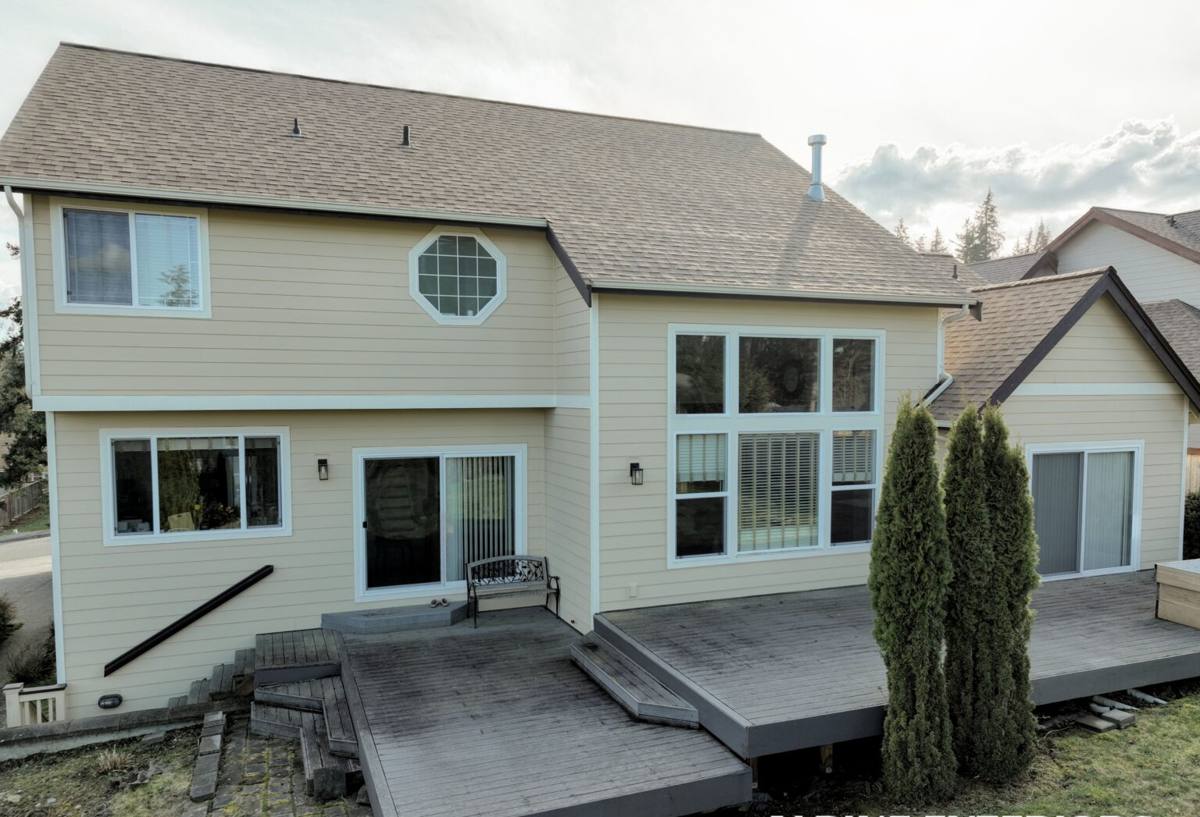
What Maple Falls Homes Actually Need From a Deck
Every deck we build in this area has to answer to a few specific local conditions, not generic "Pacific Northwest weather" assumptions:
Shade and Slow Drying
Evergreen canopy over or near a deck keeps the surface damp longer after rain than an open, sun-exposed deck would stay. That slower drying time is the single biggest driver of moss growth, mildew staining, and premature wood decay. Materials and fastening details that would be fine on an open lot in town need extra attention here.
Sustained Rainfall Volume
The foothills catch more rain than the valley floor. That means more total water moving across every horizontal surface, more water finding its way into end grain, screw holes, and butt joints, and more water working its way down through gaps to the framing below if the deck wasn't built with drainage in mind from the start.
Ground Moisture and Debris
Wooded lots mean more leaf litter, needle drop, and organic debris landing on the deck surface and packing into board gaps. That debris holds moisture against the wood and is the number one food source for the moss and algae that stain and eventually degrade a deck surface.
Salt Air, Even This Far Inland
It surprises some homeowners, but moisture carried in off Puget Sound reaches well into Whatcom County on wet weather systems. Over years, that salt content accelerates corrosion on lower-grade fasteners and hardware — which is why we don't cut corners on connector and screw specification just because a property isn't waterfront.
Choosing the Right Decking Material for This Climate
There's no single "best" decking material for every home — it depends on budget, how much shade the deck sits in, and how much maintenance a homeowner actually wants to keep up with. Here's how the common options compare for a shaded, high-rainfall property like a typical Maple Falls lot.
| Material | Moisture & Moss Resistance | Maintenance Needed | Typical Lifespan |
|---|---|---|---|
| Pressure-treated wood | Fair — treatment resists rot but surface still holds moisture and grows moss in shade | Annual cleaning, periodic staining/sealing | 15-20 years with upkeep |
| Cedar | Good natural rot resistance, but surface still needs care in constant shade | Regular cleaning, re-staining every 2-3 years | 15-25 years with upkeep |
| Composite decking | Very good — dense, capped boards shed water and resist rot, though algae can still film the surface in deep shade | Periodic washing, no staining or sealing | 25-30+ years |
| PVC decking | Excellent — fully synthetic, doesn't absorb moisture at all | Occasional washing | 30+ years |
In heavily shaded, high-moisture settings, we generally steer homeowners toward composite or PVC decking for the walking surface, since neither one absorbs water into the board itself the way wood does. That's a maintenance and moisture-behavior recommendation based on how these materials perform in wet shade over decades — not a knock on wood decking, which still has a place on drier, more open lots or for homeowners who like the look and don't mind the upkeep.
What a Correctly Built Deck Involves
The decking material is what you see, but the part that determines whether a deck lasts is mostly hidden. In a climate like this, a few details matter more than they would in a drier region:
- Footings set below frost depth and on solid, well-drained soil — critical on sloped or wooded foothill lots where soil composition varies more than it does on flat, cleared ground.
- Proper ledger board flashing where the deck attaches to the house, so water is directed out and away from the wall rather than behind the siding.
- Joist tape or equivalent protection on the tops of all framing members, so the framing itself isn't absorbing rainwater through end grain and fastener penetrations for years on end.
- Correct board spacing for drainage and airflow — tight enough for a clean look, wide enough that water and debris don't just sit and pack into the gaps.
- Corrosion-resistant fasteners and connectors rated for exterior, ground-contact, or coastal-air exposure, given the salt content that reaches this area.
- Code-compliant guardrails and stair framing, sized and fastened correctly rather than just "close enough."
Skip any one of these and the deck might still look right for a while. The problems just show up underneath, where nobody's looking, until a board goes soft or a railing starts to move.
Our Process for a Maple Falls Deck Project
We keep the process straightforward, and we don't change our standards based on how visible a job site is:
- On-site assessment. We look at the actual lot — slope, tree cover, sun exposure, soil, and how the deck will tie into the house — before we talk materials or design.
- Material and layout conversation. We walk through the tradeoffs above in plain terms, based on your specific shade and budget situation, and help you land on a decking material and layout that fits.
- Permitting. Deck projects of most sizes require a permit and inspection under Whatcom County building code. We handle that paperwork and coordinate inspections as part of the job.
- Framing and structural work. Footings, ledger flashing, joists, and all the hidden structural details get done to code, with the moisture protection this climate calls for.
- Decking, railings, and finish work. Surface materials, railings, stairs, and any fascia or skirting go in last, with attention to clean, tight, properly fastened joints.
- Final walkthrough. We go over the finished deck with you, including what maintenance (if any) the material you chose will need going forward.
Living With a Deck in a High-Moss, High-Rainfall Area
Even a well-built deck in a shaded, wet spot needs some ongoing attention — the goal of good construction is to make that maintenance manageable, not to eliminate it entirely. A basic seasonal routine goes a long way:
- Sweep off leaves, needles, and other debris regularly, especially through fall and winter — this is the single biggest factor in preventing moss and staining.
- Rinse or gently wash the surface a few times a year to keep algae and moss from getting a foothold, particularly in permanently shaded areas.
- Check board gaps periodically to make sure they haven't packed solid with organic debris, which traps moisture against the surface.
- If you have a wood deck, plan on re-staining or sealing on the schedule the product calls for — skipping a cycle in this climate shows up fast.
- Walk the deck once or twice a year and check railings, stair connections, and any spots where boards meet framing for movement or soft spots.
Permits and Structural Realities in Whatcom County
Deck construction here isn't a weekend DIY footnote — most new decks and significant rebuilds require a building permit, with inspections tied to footing depth, framing, and guardrail compliance. That's not paperwork for its own sake; it exists because a deck is a structure people stand on, and footing depth and connection details matter more once you're dealing with sloped, wooded foothill lots rather than flat, cleared ground. We handle the permit process as a standard part of the job rather than treating it as optional or something to work around.
Why Hire a Crew That Already Works in Maple Falls
A deck built by someone unfamiliar with foothill lots, heavy shade, and this area's rainfall totals can look identical to a correctly built one on the day it's finished. The difference shows up two, five, and ten years down the road — in whether the framing stayed dry, whether the fasteners held up, and whether the homeowner is fighting moss and soft boards or just doing simple seasonal cleaning.
Working regularly in and around Lynden and the surrounding Whatcom County foothill communities means we're not guessing at how a lot like yours behaves through a wet winter. We already know to flash ledgers a certain way, spec fasteners for the moisture and salt-air conditions here, and account for shade and drainage on sloped, tree-covered ground — because we've built and followed up on decks under exactly these conditions before.
Get a Straightforward Estimate
If you're planning a new deck or replacing one that hasn't held up to the Maple Falls climate, we're happy to take a look and give you an honest, no-pressure estimate — including a straight answer on what material makes sense for your specific amount of shade and sun. There's a form below to get started.