 Lynden
 When a Bellingham Home Needs Full Siding Replacement, Not Another Repair
Repair keeps a lot of Bellingham homes looking fine for years past the point where the wall assembly underneath is actually still doing its job. Full siding replacement becomes the right call when the damage is no longer isolated to one board or one corner, but is spread across a wall, or has been sitting behind the siding long enough to affect the sheathing and framing it's supposed to protect. That's a different job than patching a cracked panel, and it's worth understanding the difference before you spend money on either one.
Bellingham's location on the bay puts a specific kind of pressure on siding that inland homes don't deal with in the same way. Salt-laden marine air works on fasteners, trim hardware, and lower-grade finishes year-round, not just during storms. Add wind-driven rain that hits walls sideways instead of falling straight down, and a moss and mildew season that can stretch across most of the calendar year on shaded, north-facing walls, and you get a climate that finds every weak point in a siding system faster than most of the country. When we talk about full replacement in Bellingham specifically, this is the combination we're weighing the job against.
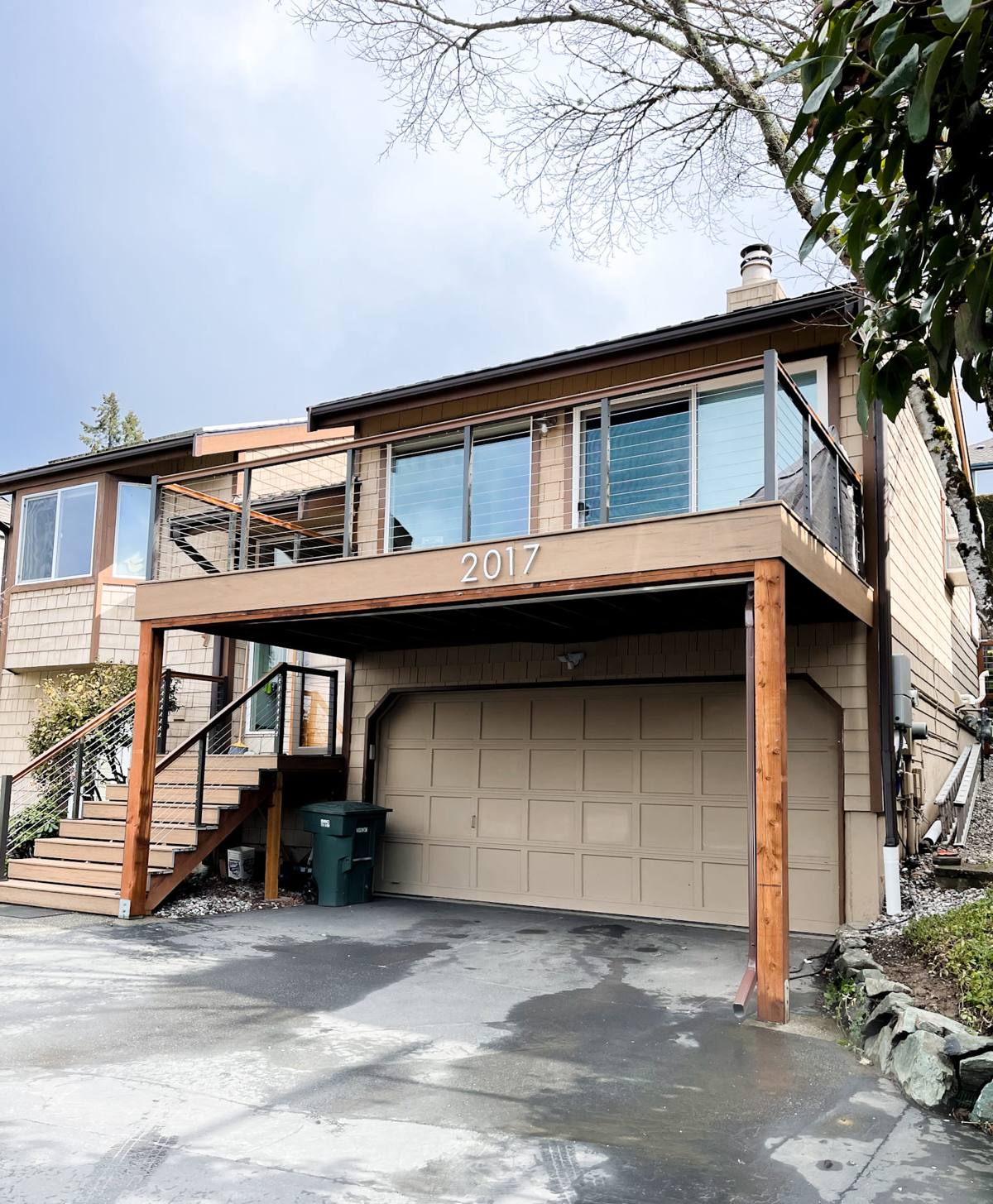
Signs You're Looking at Replacement Instead of Repair
- Soft, spongy, or crumbling siding in more than one location, especially near the base of walls or below window sills
- Moss or dark staining that returns within weeks of cleaning, on multiple wall sections
- Visible warping, cupping, or delamination across several boards rather than one isolated spot
- Persistent musty smell along an exterior wall, which often points to moisture already inside the assembly
- Siding that's original to a home built more than 20-25 years ago, especially older wood-based or low-grade composite products
- Rising heating or cooling costs that track with a wall assembly no longer sealing the way it should
- Paint that won't hold anymore no matter how often it's redone
One or two of these on their own might mean a repair is enough. Several of them together, especially on more than one elevation of the house, usually mean the underlying wall assembly has been compromised long enough that a full re-side is the more honest recommendation.
What We Actually Check Before Recommending Replacement
Tear-Off Inspection, Not a Guess From the Ground
We don't recommend full replacement off a walk-around. Where we suspect trouble, we pull siding in that area to look directly at the sheathing, house wrap, and framing underneath. That's the only way to know whether water has actually tracked behind the wall, how far it's traveled, and whether the substrate itself needs repair before any new siding goes on.
What Hidden Moisture Damage Looks Like in This Climate
In a marine climate like Bellingham's, moisture that gets behind siding rarely announces itself right away. It tracks along sheathing, follows framing members, and shows up as soft or discolored wood well outside the spot where it originally got in. That's why an honest replacement quote accounts for the possibility of substrate repair, rather than assuming every wall behind the old siding is in good shape.
Why We Replace With James Hardie Fiber Cement, and Nothing Else
We install one siding system on every full replacement we do: James Hardie fiber cement. That's not a sales preference, it's a standard we settled on after years of tear-offs and repair calls across this stretch of Whatcom County.
- Non-combustible core: Fiber cement doesn't feed a fire the way wood-based products can, which matters for both household safety and insurance considerations.
- Factory-applied ColorPlus finish: Color is cured onto the board under controlled conditions rather than brushed on after installation, so it holds up far longer against salt air and UV than field-applied paint.
- Climate-engineered HZ formulation: Hardie's HZ5 line is built for regions with heavy sustained moisture, which fits Bellingham's bay-facing exposure better than a generic national spec.
- Dimensional stability: Fiber cement doesn't swell, cup, or warp the way engineered wood siding can after repeated wet-season moisture cycles.
- Strong transferable warranty: backed by Hardie, provided the installation follows spec, which is a big part of why our installation detail matters as much as the material choice.
What Gets Traded Away With Other Products
LP SmartSide is an engineered wood product that performs reasonably in drier regions, but its resin-treated strand core is more sensitive to moisture intrusion at cut edges and fastener points than fiber cement is, and Bellingham's sustained rain gives it plenty of chances to find those weak points. Vinyl siding is inexpensive and low-maintenance in a general sense, but it can crack in a cold snap, distort under direct sun exposure, and trap moisture behind the panel if the house wrap and flashing details underneath aren't handled with real care. Cedar and primed spruce look good and age well when maintained, but that maintenance is ongoing, and in a climate this wet, a slipped repainting or resealing schedule shortens the material's real-world life faster than most homeowners expect. These aren't bad products in every setting. We just don't think they're the right call for full replacement on a home that's going to sit through decades of Bellingham weather.
What a Correct Siding Replacement Actually Involves
Full Tear-Off and Substrate Repair
A proper replacement removes the old siding down to the sheathing, not over it. That's the point where hidden rot, soft framing, or failed house wrap gets found and fixed, before anything new goes on top of a problem that's just going to keep growing behind the wall.
House Wrap and Flashing as One System
New house wrap and flashing get installed together, lapped and sealed so water is directed out and down rather than trapped behind the siding. In a climate with wind-driven rain, flashing at windows, doors, and roof-to-wall transitions is where a lot of failures actually start, so this step gets as much attention as the siding itself.
Fastening, Clearances, and Joints
Hardie siding has to be fastened at the pattern and spacing the manufacturer specifies, held to the correct clearance from grade and roofline, and lapped and sealed at joints and corners. Skipping or rushing any of that is one of the most common reasons a good product develops problems that get blamed on the material instead of the install.
Our Siding Replacement Process, Start to Finish
- On-site assessment: we walk the property, look at the existing siding and any suspect areas up close, and give you a straight read on repair versus full replacement.
- Written estimate: a clear scope and price based on what we actually found, not a generic per-square-foot number.
- Material selection: choosing the Hardie product line, profile, and ColorPlus color that fit the home and its exposure.
- Tear-off: removing old siding and inspecting sheathing and framing underneath before anything new is installed.
- Substrate repair: replacing any damaged sheathing or framing found during tear-off, priced and explained before we proceed.
- House wrap and flashing: installed as a coordinated system at all windows, doors, and wall penetrations.
- Siding installation: fastened and lapped to manufacturer spec, with trim and joints sealed correctly.
- Final walkthrough: going over the finished work with you before we consider the job done.
Cost Factors for a Bellingham Siding Replacement
| Factor | What It Affects | Why It Matters in Bellingham |
|---|---|---|
| Extent of substrate damage | Repair costs found during tear-off | Years of hidden moisture behind older siding is common in this climate and isn't visible until the wall is opened up |
| Home size and wall complexity | Total material and labor | Bellingham's older hillside homes often carry more dormers, trim, and roofline intersections where wind-driven rain gets in |
| Siding profile and color | Material cost and finish longevity | ColorPlus factory finishes outlast field-applied paint against salt air and UV exposure |
| Site access and terrain | Labor time and staging needs | Sloped lots and mature tree cover common around Bellingham can add setup and access time |
| Disposal and tear-off volume | Debris removal costs | Full tear-offs generate more waste than overlay jobs, especially on multi-layer older homes |
These are the variables that move a price up or down. We don't quote off square footage alone, because two homes the same size can need very different amounts of substrate repair once the old siding comes off.
Why Hiring a Crew That Already Works Bellingham Matters
A crew that replaces siding across this stretch of Whatcom County regularly has already seen how salt air, driving rain, and moss behave on real Bellingham homes over a full year, not just how a product performs on a spec sheet. That shows up in specific decisions on a replacement job: which wall orientations tend to hide the worst substrate damage, where extra flashing attention actually pays off, and which shortcuts cause callbacks two winters later instead of holding up. Bellingham's mix of bay-facing lots, hillside terrain, and older housing stock isn't uniform, and a crew with real hands-on experience here treats each home's exposure differently instead of applying one approach to every job.
If you're weighing a repair against a full siding replacement on a Bellingham home, or you just want an honest look at what's really going on behind an aging wall, we're happy to take a look. Reach out using the form below to schedule a free, no-pressure estimate.