 Lynden
 Window Replacement Built for Deming's Climate
Deming sits in the Nooksack River valley at the foot of the Mount Baker foothills, and that location shapes what a window replacement job actually needs to hold up to. Heavy tree canopy keeps shade and moisture on the north and west sides of most homes for months at a time. Rain moves through the valley in long, low-pressure stretches rather than quick storms, and cold air draining down from the higher terrain can push driving wind and moisture straight into window assemblies that aren't sealed correctly. Add in the broader Whatcom County pattern of salt-laden coastal air working its way inland and settling into hardware and finishes over the years, and you've got a climate that's genuinely hard on windows — not dramatic, just relentless.
A window that's installed correctly in Deming can go decades without a problem. One that's installed with shortcuts — no sill pan, poor flashing sequence, gaps behind the trim — will show it within a few wet seasons. This page is about what a correct job looks like here specifically, not window replacement in general.
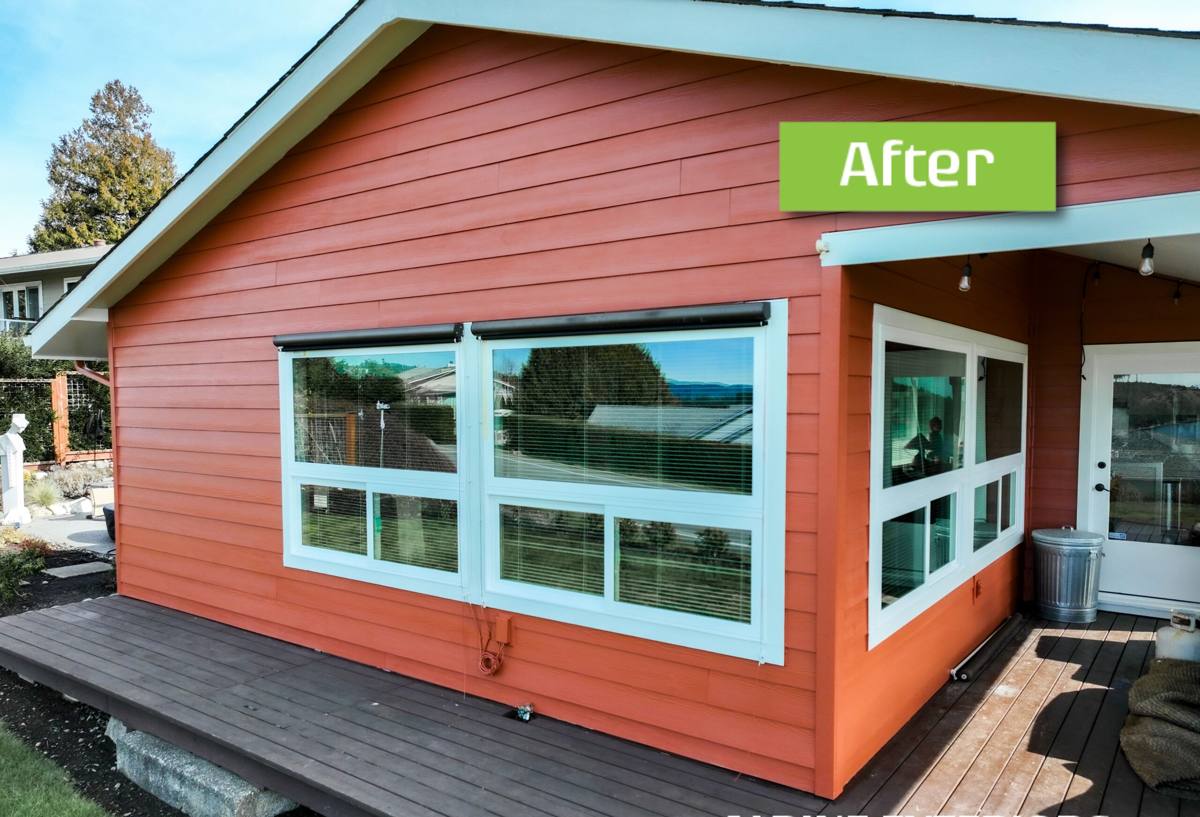
What Deming's Weather Actually Does to Windows
Moss and Constant Dampness
Wooded lots and limited direct sun mean moss and algae growth isn't limited to the roof. It creeps into window sills, tracks, and the caulk lines around frames, holding moisture against wood and vinyl surfaces far longer than a home in an open, sunny spot would experience. Over time that trapped moisture is what causes sill rot, cloudy glass seals, and swollen sashes that stop closing cleanly.
Driving Rain and Valley Wind
When wind funnels down the valley during a storm, rain doesn't just fall on a window — it's pushed sideways into it. That's a flashing and drainage problem, not a glass problem. Windows that rely on caulk alone to keep water out, instead of a proper drainage path built into the installation, are the ones that eventually leak into the wall cavity.
Temperature Swings
Whatcom County gets cold snaps that arrive quickly, especially with outflow conditions moving through the foothills. Older single-pane and early dual-pane windows respond to that with condensation, drafts, and noticeably colder rooms near the glass — one of the most common reasons Deming homeowners start looking at replacement in the first place.
Signs a Deming Home Needs Window Replacement
- Fogging or a milky haze between the panes — the seal has failed and the gas fill is gone
- Soft, discolored, or spongy wood at the sill or bottom corners of the frame
- Visible moss, algae, or black staining building up on the frame or sill even after cleaning
- Windows that are difficult to open, won't stay open, or don't latch flush anymore
- Noticeable drafts or a cold zone near the window even with it fully closed
- Paint that keeps failing on the same window no matter how often it's touched up
- Rising heating bills without any other clear explanation
Any one of these can be a minor fix. Two or three together on the same window usually means the assembly has reached the end of its useful life.
What a Correct Window Replacement Involves
The window itself is only part of the job. In a climate like this, the installation details determine whether that window performs for twenty-five years or five.
Proper Removal and Inspection
Before anything new goes in, the old unit comes out carefully so we can actually see the condition of the framing, sheathing, and any existing flashing. This is where hidden rot or moisture damage from a prior bad install gets caught — and dealt with — instead of sealed behind a new window.
Flashing and Drainage, Not Just Caulk
A correct install builds a drainage path: a sloped sill pan so any water that gets past the exterior gets directed back out, proper integration with the home's weather-resistive barrier, and flashing tape sequenced so each layer overlaps the one below it — shingle-style, the same way water actually runs down a wall. Caulk is the last line of defense here, not the only one.
Correct Fastening and Shimming
Windows need to be shimmed square and fastened per the manufacturer's schedule, not just screwed in wherever it's convenient. A window that's slightly out of square will bind, won't seal evenly, and puts uneven stress on the glass over time.
Insulation Without Overpacking
The gap between the window frame and the rough opening gets filled with a low-expansion foam or backer rod and sealant — enough to stop air movement without bowing the frame inward, which is a common mistake that causes windows to bind right after install.
Interior and Exterior Finish Work
Trim, sill extensions, and exterior caulking get finished cleanly and matched to the home, so the replacement doesn't look like a patch job.
Choosing the Right Window for This Climate
There isn't one universally "best" window — there's a best fit for your home, your budget, and how much maintenance you want to take on. In a damp, wooded, shaded environment like Deming, we generally steer homeowners toward frame materials and glass packages that handle sustained moisture well and don't demand constant upkeep.
| Frame Material | Moisture & Moss Resistance | Maintenance | Typical Cost Tier |
|---|---|---|---|
| Vinyl | Very good — won't rot, resists moss staining, low water absorption | Low — occasional cleaning | Lower |
| Fiberglass | Excellent — dimensionally stable in wet/cold swings, holds paint well | Low | Higher |
| Wood-clad | Good exterior protection, but any breach in the cladding exposes wood to rot | Higher — requires monitoring and occasional resealing | Higher |
| Aluminum | Weaker — prone to condensation and cold transfer in this climate | Moderate | Lower to moderate |
We don't install every option on that list on every home. Where wood-clad windows go against deeply shaded, moss-prone walls, we'll say so honestly — it's a maintenance commitment, not a flaw in the product, and it's fair for a homeowner to know that going in.
Glass Packages Worth Considering
Dual-pane with a low-E coating and argon fill is the practical baseline for this area — it cuts heat loss and reduces condensation risk significantly over older single-pane or basic dual-pane glass. Triple-pane is available and does perform better in sustained cold, but for most Deming homes the added cost doesn't pencil out unless you're dealing with a north-facing room that's consistently cold or a home right along an open wind corridor.
How Our Process Works
- On-site assessment — we look at every window being considered, check for existing rot or flashing issues, and take real measurements rather than estimating from a photo.
- Honest recommendation — we tell you which windows genuinely need replacement now, which can wait, and which material and glass package fits your home and budget.
- Written estimate — a clear scope and price before any work starts, no vague allowances.
- Installation — removal, inspection, correct flashing and drainage detailing, fastening, insulation, and finish work as described above.
- Walkthrough and cleanup — every window opens, closes, and locks properly before we consider the job done, and the site is left clean.
What Affects the Cost of Your Project
| Factor | Why It Matters |
|---|---|
| Number and size of windows | Larger openings and full-house projects have different labor and material needs than a handful of replacements |
| Frame material chosen | Vinyl, fiberglass, and wood-clad carry different material costs, as shown above |
| Condition of the existing opening | Hidden rot or old flashing failures found during removal add repair time before the new window can go in |
| Full-frame vs. insert replacement | Full-frame replacement (down to the rough opening) costs more but is often the right call when the existing frame is compromised |
| Access and site conditions | Rural lots, steep driveways, or upper-story windows can affect setup time and equipment needs |
We'd rather walk your home and give you real numbers than throw out a broad range that doesn't mean much either way.
Why It Matters to Hire a Crew That Already Works in Deming
Window replacement done wrong in a dry climate might just mean a drafty room. Done wrong here, it means water working its way behind the siding and into framing that's already fighting moss, shade, and constant dampness for most of the year. A crew that regularly works Deming and the surrounding Whatcom County foothills knows what that looks like when it's already gone wrong — and builds the installation to prevent it, not just patch the surface.
That local experience also means fewer surprises with permitting expectations, realistic scheduling around the wetter months, and practical knowledge of how rural properties, longer driveways, and heavily treed lots affect access and setup. It's the difference between a contractor learning your area's quirks on your job and one who already knows them.
Simple Maintenance That Extends the Life of New Windows
- Clear moss and debris from sills and tracks a couple of times a year, especially on shaded sides of the house
- Check and refresh exterior caulking annually — it's cheap insurance against water intrusion
- Keep gutters and downspouts clear so runoff isn't sheeting down across window heads
- Trim back vegetation that keeps foliage or branches in constant contact with the window or frame
- Operate each window a few times through the year so mechanisms don't seize from disuse and damp
If your windows are showing any of the signs above, or you're simply ready to stop fighting drafts and fogged glass through another Deming winter, we're happy to come take a look. We'll give you a straightforward, no-pressure estimate and an honest read on what your home actually needs — just fill out the form below to get started.