 Lynden
 Blaine's Marine Climate: What It Does to Windows Over Time
Blaine sits right up against Drayton Harbor and Semiahmoo Bay, at the edge of the Salish Sea, which means homes here deal with a version of Whatcom County weather that's a little harsher than what you'd find a few miles inland in Lynden. Salt-laden air off the water speeds up corrosion on anything metal. Wind coming off open water drives rain sideways into wall and window assemblies that a calmer site would never test. And the long, wet stretch from October through April gives moss, algae, and mildew months to work into any gap, crack, or unsealed joint they can find.
None of that is exotic — it's the same climate the rest of Northwest Washington deals with, just turned up a notch for anything close to the shoreline. Windows take the brunt of it because they're the weak point in an otherwise sealed wall: moving parts, multiple materials meeting at one frame, and a lot of surface area exposed to wind and water at once. Over ten or fifteen years, that adds up to failed seals, soft wood at the sill, and heating bills that creep up as the glass and frame quietly stop doing their job.
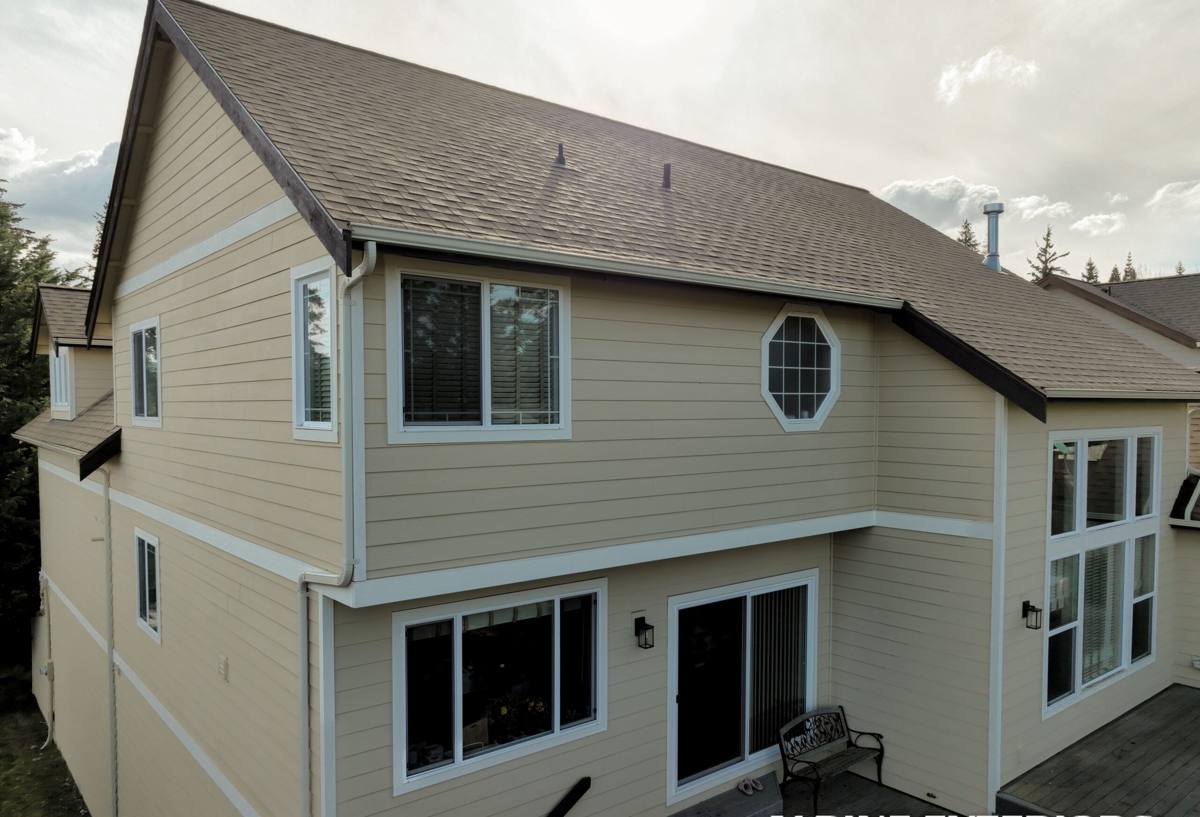
What "Energy-Efficient" Should Actually Mean for a Blaine Home
"Energy-efficient" gets used loosely in window advertising. For a house exposed to marine air and a heating-dominated climate like ours, it should translate to a few specific, checkable numbers and features — not just a sticker on the glass.
U-Factor
U-factor measures how much heat a window lets escape — lower is better. In a climate where the furnace or heat pump runs more months than it doesn't, a lower U-factor window pays for itself in comfort near the glass, not just on the utility bill. Look for the NFRC label on any window you're quoted, and ask what U-factor the installer is actually proposing, not just the brand name.
SHGC and Low-E Coatings
Solar Heat Gain Coefficient (SHGC) matters less here than it does in a sunnier climate, but the Low-E coating that controls it also affects how much of your heat stays inside during our long grey stretches. The right Low-E package for this area balances a bit of solar gain on south and west faces with keeping interior heat from radiating back out through the glass at night.
Gas Fills and Spacers
Argon-filled double panes are standard now, and worth having — but the spacer between the panes (the strip that separates the two sheets of glass at the edge) matters just as much in a humid marine climate. A poor-quality spacer lets moisture creep in at the edge over time, which is exactly where you'll first notice fogging between panes on an older or lower-grade window.
Frame Materials: What Holds Up Near Salt Water
Frame choice matters more in Blaine than it would twenty miles inland. Salt air accelerates corrosion on hardware and fasteners, and constant moisture punishes any material that absorbs water or needs regular refinishing to stay sealed.
| Material | Behavior in Salt Air / Moisture | Maintenance |
|---|---|---|
| Vinyl | Doesn't corrode or absorb water; performs consistently near the coast | Low — occasional cleaning |
| Fiberglass | Very stable dimensionally, holds paint and seals well in wet, salty air | Low |
| Aluminum (uncoated or poorly finished) | Prone to pitting and corrosion from salt air unless properly coated | Moderate to high depending on finish |
| Wood (unclad) | Absorbs moisture, swells, and is vulnerable to rot at joints and sills in this climate | High — regular repainting/sealing |
We don't refuse to install any particular material — some homeowners want the look of wood, and clad-wood or well-finished aluminum can work if it's detailed and maintained correctly. What we won't do is install a frame material in a way that ignores how it actually behaves in salt air and driving rain. That's a maintenance burden we'd rather explain up front than let you discover in year six.
The Installation Details That Actually Stop Leaks
Most window failures in this climate aren't the glass — they're the installation. A window is only as good as the flashing, sealant, and framing details around it, and those details matter more here because of how much wind-driven rain the assembly has to shed.
Flashing and Sill Pans
Every opening needs a sloped sill pan that directs any water that gets past the window back out, not into the wall cavity. Flashing tape needs to integrate with the weather-resistive barrier behind the siding in the correct shingle-lap order — head flashing over the top, side flashing lapped correctly, sill pan underneath everything. Skip that sequence and water finds its way in eventually, especially on a wall that takes wind-driven rain directly.
Sealants and Backer Rod
Exterior sealant needs to be a product rated for this climate's temperature swings and constant moisture, applied over backer rod so it can flex instead of cracking. A bead of caulk over a gap that's too wide, with no backer rod, is one of the more common corner-cutting mistakes we see on older installs — it looks fine for a year or two, then fails.
A properly installed energy-efficient window should check every one of these boxes:
- Sloped sill pan under the window, not just a flat surface
- Flashing integrated with the house wrap in the correct water-shedding order
- Backer rod behind all exterior sealant joints
- Frame shimmed square and plumb before fastening — no racking
- Low-expansion foam or approved insulation in the gap between frame and rough opening (not standard high-expansion foam, which can bow vinyl frames)
- Interior air seal completed, not just exterior caulk
- NFRC label numbers matching what was actually quoted
Signs Your Current Windows Are Already Losing the Battle
Homeowners near the water usually notice the same handful of warning signs before they call. Worth checking for on your own place:
- Moss or dark staining collecting on the sill or bottom corners of the frame
- Fogging or a hazy ring between the panes of double-pane glass
- Soft or spongy wood at the sill or lower corners when pressed
- A noticeable draft near the frame edge on windy days
- Difficulty opening or latching a window that used to operate smoothly
- Condensation forming on the interior glass or frame during cold snaps
Any one of these is worth a look. A few of them together usually means the seal or flashing has already failed and moisture has been getting into the wall assembly for a while, even if it's not visible yet from inside.
Our Process for a Blaine Window Replacement
- Walkthrough and assessment — we look at existing window condition, check for water damage or soft framing around each opening, and talk through which rooms matter most for comfort and noise.
- Product selection — we go over frame material, glass package, and U-factor options based on the specific exposure of each wall (a west-facing wall catching wind off the water gets treated differently than a sheltered side of the house).
- Careful removal — old units come out without unnecessary damage to surrounding siding or trim, and we check the rough opening and sheathing underneath for any hidden rot before anything new goes in.
- Flashing and sill pan installation — this is the step that determines whether the window performs for twenty years or ten, and it's not optional or rushed.
- Window setting and sealing — shimmed square, fastened per manufacturer spec, insulated correctly, and sealed inside and out.
- Trim and finish work — interior and exterior trim reinstalled or replaced to match, with final sealant and paint touch-up as needed.
- Walkthrough and cleanup — we go over each opening with you, confirm smooth operation, and haul away the old units and debris.
What Drives the Cost
Every job is different, but the same handful of factors move the price up or down on most Blaine window replacements:
| Factor | Why It Matters |
|---|---|
| Frame material | Vinyl is typically the most budget-friendly; fiberglass and clad-wood cost more up front but may suit certain homes better |
| Glass package | Higher-performance Low-E coatings and gas fills add cost but lower long-term heating expense |
| Number and size of openings | Larger or custom-sized windows cost more per unit than standard sizes |
| Condition of the rough opening | Hidden rot or water damage found during removal adds repair work before the new window can go in |
| Access and wall height | Second-story or hard-to-reach openings take more time and equipment |
| Trim and siding tie-in | Matching existing trim profiles or siding cuts adds finish labor |
We'd rather walk your specific house and give you real numbers than quote a range that doesn't mean much either way.
Why It Matters That We Already Work in Blaine
We're based in Lynden, and we've done enough work along the Whatcom County coastline to know that a window install that holds up in a sheltered inland yard doesn't automatically hold up on a wall taking wind straight off Semiahmoo Bay or Drayton Harbor. That's not a knock on any particular crew — it's just a different exposure, and it changes real decisions: how much flashing overlap you actually need, which sealants hold up under constant salt-laden humidity, and which frame materials are worth the extra cost versus which ones are just marketing.
Because we handle siding as well as windows, we're also looking at how the window ties into the wall system around it — the flashing, the water-resistive barrier, the trim — instead of treating the window as an isolated product install. That matters more in a climate that punishes any weak point in the whole assembly, not just the window itself.
If your windows in Blaine are fogging, drafting, sticking, or just costing more to heat around every winter, we're happy to take a look and give you a straightforward, no-pressure estimate — no obligation, just an honest read on what your home actually needs. The form below is the easiest way to get that started.