 Lynden
 Why Acme's Terrain Wears Out Siding Faster Than People Expect
Acme sits in a different microclimate than a lot of homeowners realize. Between the tree cover along the South Fork Nooksack corridor, the elevation gain toward the Mount Baker foothills, and the moist marine air that moves inland across Whatcom County, homes here deal with more sustained dampness than a house just a few miles away in open terrain. Rain doesn't just fall and run off — it lingers. Shade from tall conifers keeps siding wet longer after a storm, and that extra drying time is exactly what moss, algae, and soft-rot organisms need to get established.
Add driving rain that gets pushed sideways into wall assemblies during winter storms, and you've got a combination that punishes any siding material with a weak point at the seams, fasteners, or field finish. We've seen it play out the same way on wood-based and composite sidings across the county: moisture gets behind the material faster than it can dry out, and the damage starts from the inside of the wall assembly before it's ever visible on the surface.
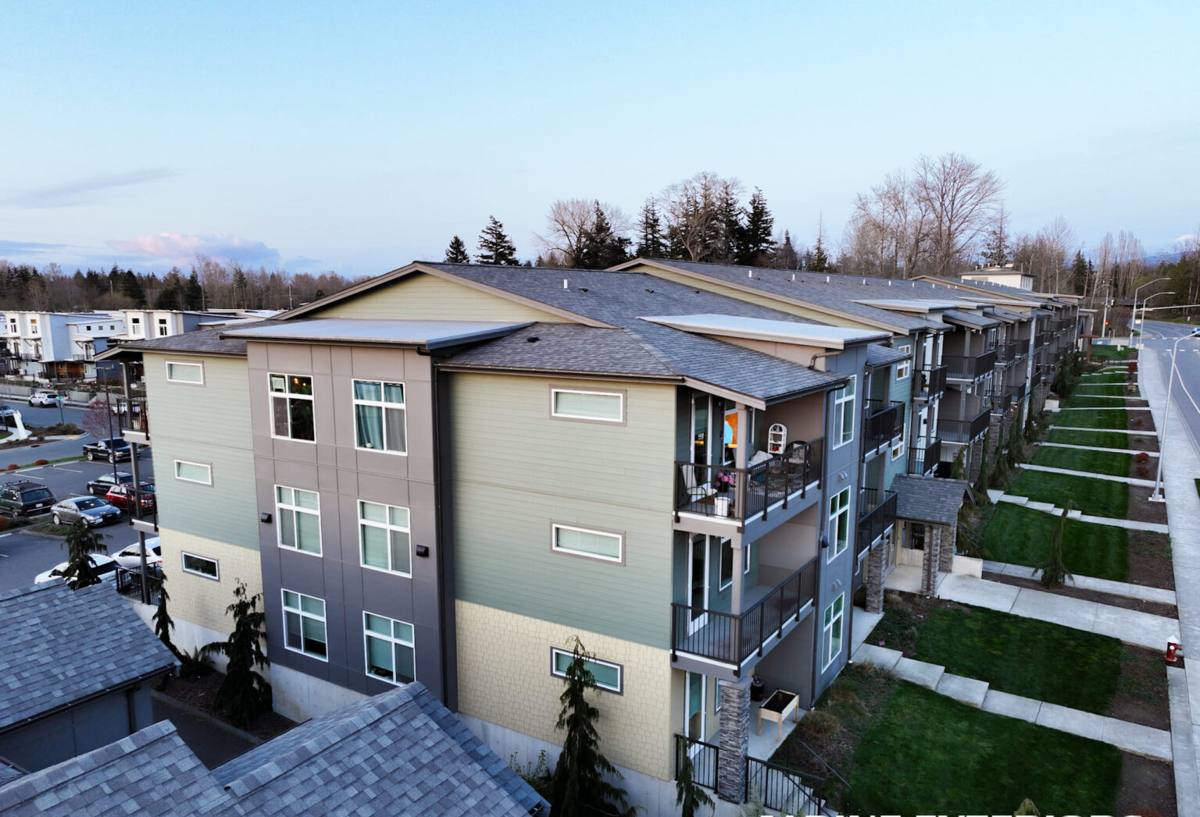
What Fiber Cement Actually Solves for a Property Like This
Fiber cement siding is cement, sand, and cellulose fiber pressed and cured into a rigid board. It doesn't have wood grain to swell and split, it isn't a petroleum-based plastic that can warp in temperature swings, and it's non-combustible — a real consideration for properties near tree lines and brush. For an area like Acme, the specific advantage is moisture stability: fiber cement doesn't absorb and release water the way wood-based products do, so the repeated wet-dry cycling that comes with a long moss season doesn't degrade the board itself the way it will with softer materials.
That's the core reason this company installs only James Hardie fiber cement siding, and not LP SmartSide, vinyl, or other fiber cement brands. Hardie's HZ5 formulation is engineered specifically for climates with significant moisture exposure like the Pacific Northwest, and their ColorPlus factory finish is baked on under controlled conditions rather than field-applied — which matters enormously in a place where you can't count on a reliable multi-day dry stretch to cure paint correctly on site.
Where Other Materials Fall Short Here
- Vinyl can warp and gap at a moderate range of temperature swings, and its seams rely on overlap rather than a sealed, engineered joint — every seam is a potential entry point for wind-driven rain.
- LP SmartSide and primed wood products are wood-based (OSB or solid lumber) with a factory or field coating. Any breach in that coating exposes wood fiber to moisture, and in a shaded, high-humidity setting like Acme, that breach doesn't take long to find.
- Cedar looks great new but needs ongoing sealing and refinishing to hold up against sustained moisture and moss growth — it's a material that demands maintenance discipline most homeowners don't keep up with year after year.
What a Correct Fiber Cement Installation Actually Involves
Fiber cement siding fails less often because of the board itself and more often because of how it was installed. In a wet climate, the installation details are the whole game.
Drainage Plane and Rainscreen
Siding should never be the only line of defense against water. Behind the boards, a correctly built wall assembly needs a weather-resistant barrier and, ideally, a rainscreen gap that lets any moisture that does get past the siding drain and evaporate instead of sitting against the sheathing. This is especially important on shaded elevations that stay damp longer after rain.
Flashing and Fastening
Every window, door, and butt joint needs flashing that directs water outward, not into the wall cavity. Fasteners have to be placed and driven to Hardie's specification — over-driven or under-driven nails are one of the most common causes of early siding failure, and it's a detail that's easy to rush and hard to spot after the fact.
Joints, Caulking, and Clearances
Butt joints need to be treated correctly (sealed or shielded per manufacturer spec), siding needs proper clearance from grade, decks, and roof lines, and caulking has to be used at transitions — not as a substitute for proper flashing, but as a secondary defense. Get any of this wrong and you've built a house that looks fine on day one and starts showing problems in two or three wet seasons.
James Hardie Product Lines We Install
| Product | Best Use | Why It Fits This Climate |
|---|---|---|
| HardiePlank Lap Siding | Most home exteriors | Engineered HZ5 formulation resists moisture-driven damage; factory ColorPlus finish holds up without field painting |
| HardiePanel Vertical Siding | Accent walls, gables, modern styling | Fewer horizontal ledges for standing moisture and debris buildup |
| HardieShingle | Accent sections, craftsman detailing | Textured look without the maintenance burden of real wood shingle |
| HardieTrim | Corners, window and door surrounds | Matches siding durability so trim doesn't become the weak point |
Our Process, Start to Finish
- On-site assessment. We look at your home's exposure — shade, wind direction, existing moisture or moss patterns — not just square footage.
- Inspection of the existing wall assembly. Where old siding comes off, we check sheathing and framing for hidden moisture damage before anything new goes up.
- Weather barrier and drainage detail. This is where most of the long-term performance is decided, and it happens before a single piece of siding is installed.
- Installation to manufacturer spec. Correct fastener placement, clearances, and flashing at every penetration.
- Final walk-through. We go over the finished work with you directly, not just hand you an invoice.
Living With Fiber Cement in a Wet, Shaded Climate
One advantage homeowners appreciate once they've lived with Hardie siding through a few Whatcom County winters: the maintenance list is short. It's not zero — nothing that sits outside year-round is maintenance-free — but it's manageable without specialized skill or constant attention.
- Rinse siding with a garden hose once or twice a year to clear pollen, dust, and early moss spores before they establish, especially on shaded north- and west-facing walls
- Keep gutters clear so overflow doesn't run down the siding face repeatedly in one spot
- Trim back vegetation and tree limbs that keep a wall section in constant shade and slow drying
- Check caulking at trim and window transitions every year or two and re-caulk if it's cracked or pulling away
- Watch for any dark streaking or soft moss patches near ground level, which usually points to a splash-back or drainage issue worth addressing early
Why Local Installation Experience Matters in Acme
Acme isn't downtown Lynden. Properties out here tend to sit on larger, more wooded lots, often with longer driveways, well and septic systems, and more variable site access than an in-town lot. That changes how a crew stages material, where scaffolding and lifts can go, and how a job gets sequenced around tree cover and terrain. A crew that has already worked jobs in this area isn't guessing at any of that — they've dealt with the access, the shade patterns, and the moisture behavior specific to this part of Whatcom County before they ever show up at your property.
Permitting and inspection also run through Whatcom County rather than a city building department in some cases depending on your exact location, and a contractor familiar with that process avoids delays that catch out-of-area crews off guard. None of this is exotic knowledge — it's just the difference between a crew learning the area on your job versus one that already knows it.
What Drives the Cost of a Fiber Cement Siding Project
We don't quote pricing without seeing the property, but these are the real factors that move the number up or down on most jobs:
| Factor | Why It Matters |
|---|---|
| Existing siding removal | Tear-off and disposal adds labor versus siding over a suitable substrate |
| Sheathing/framing condition | Hidden moisture damage found underneath old siding needs repair before new siding goes on |
| Home shape and trim detail | More corners, gables, and window/door openings mean more cutting, flashing, and trim work |
| Site access | Longer driveways, wooded lots, and slope can affect staging and equipment needs |
| Product line and finish | Panel vs. lap vs. shingle accents, and ColorPlus color selection, affect material cost |
| Height and stories | Multi-story sections require additional scaffolding or lift time |
If you're weighing fiber cement against a lower-cost material, it's worth thinking in terms of total cost over the life of the siding — repainting, moisture repair, and early replacement all add up on materials that don't hold up as well to this climate.
If you're in Acme or elsewhere around Lynden and want a straight answer on what your home's siding actually needs, we're happy to take a look. The estimate is free, there's no pressure, and you'll get a clear explanation of what we see and why — use the form below to get started.