 Lynden
 Siding Installation Near Abbotsford, BC: A Different Climate Problem Than Most Contractors Admit
Homes in and around Abbotsford, BC sit in one of the wetter corners of the Pacific Northwest, and the siding on those homes works harder than most manufacturers' spec sheets assume. This stretch of the Fraser Valley and northern Whatcom County shares the same weather system: long stretches of low-pressure rain off the Pacific, humid air pulled in from the Strait of Georgia, and winters where siding rarely gets more than a day or two to fully dry out between soakings. Add shaded north-facing walls, mature trees, and cul-de-sac lots with limited airflow, and you get conditions that are genuinely tough on exterior cladding — not because the weather is extreme, but because it's relentless.
This page is about one thing: what it actually takes to install siding correctly on a home in this area, and why the crew doing that work should already understand the climate before they show up with a nail gun.
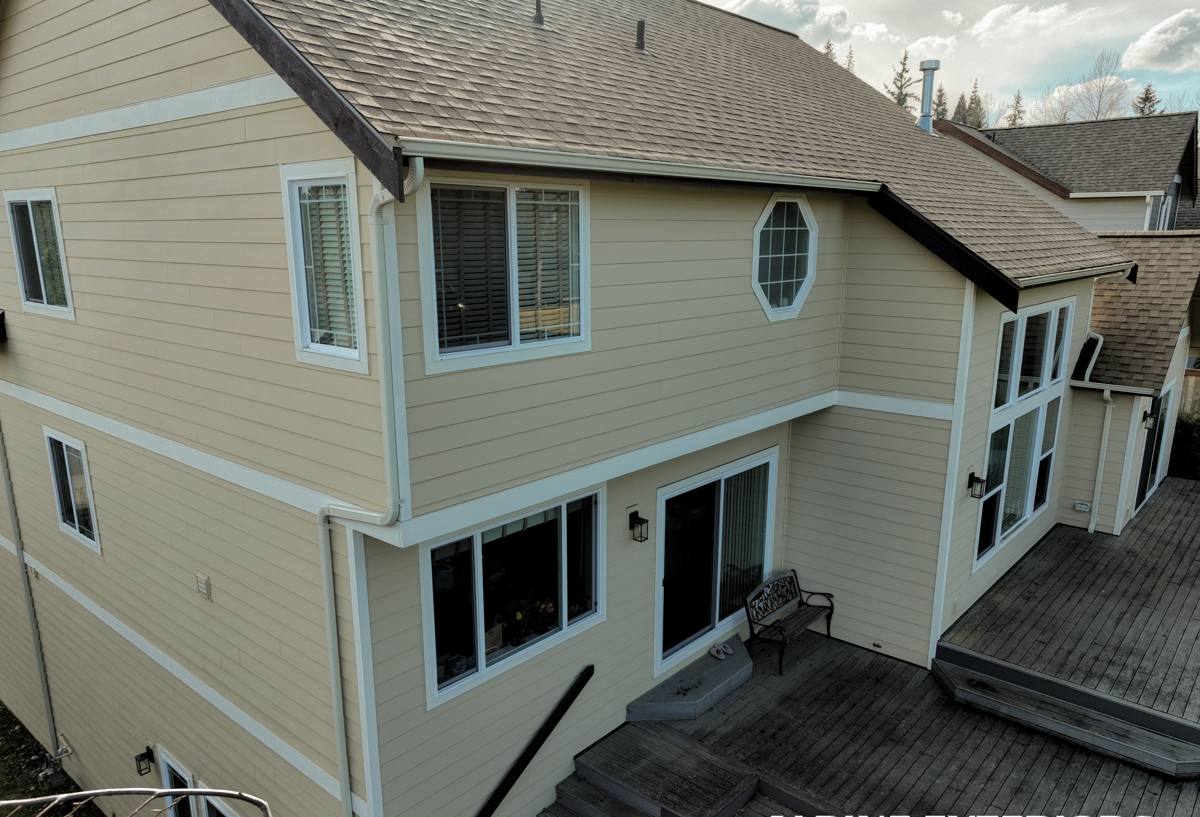
What Salt Air, Driving Rain, and Moss Season Actually Do to Siding
Salt-Tinged Marine Air
Abbotsford isn't oceanfront, but the marine air that moves inland off the Strait of Georgia and Puget Sound still carries enough moisture and salinity to accelerate corrosion on fasteners, flashing, and trim hardware that isn't rated for it. Over years, that shows up as rust streaking, failed caulk joints, and fasteners that back out or stain the face of the siding.
Driving, Wind-Driven Rain
This region doesn't just get rain — it gets rain pushed sideways by wind off the valley, which finds every gap in flashing, every under-caulked seam, and every place where siding was nailed too tight to the wall. Water that gets behind siding in a driving-rain climate doesn't just sit there; it wicks upward and sideways, which is why rot damage here often shows up well away from where the original leak point was.
The Long Moss and Algae Season
Wet, mild winters with limited direct sun on north- and east-facing walls create a long window — often five to seven months — where siding stays damp enough for moss, algae, and mildew to take hold. On absorbent or poorly finished materials, that growth isn't just cosmetic; trapped moisture under moss mats accelerates paint failure and, on wood-based products, accelerates decay.
What Correct Siding Installation Involves in This Climate
A siding job can look identical to a homeowner at handoff and still fail in five years if the details underneath were rushed. In a climate like this, the parts nobody sees matter more than the parts everybody sees.
- A continuous, properly lapped weather-resistive barrier (house wrap) with every seam taped, not just stapled
- Correct flashing at every window, door, and horizontal trim transition — installed shingle-style so water sheds outward, never inward
- Kick-out flashing at every roof-to-wall intersection, directing runoff away from the wall instead of behind the siding
- A rainscreen or drainage gap where conditions call for it, so moisture that does get behind the cladding can actually drain and dry
- Manufacturer-specified fastener type, spacing, and depth — hand-nailed or gun-set to the correct depth, not overdriven
- Proper clearance between siding and grade, decks, roofs, and other hard surfaces to prevent wicking
- Factory-primed or factory-finished cut edges sealed per manufacturer instructions, especially at butt joints
- Caulking only where the manufacturer calls for it — over-caulking traps moisture just as often as under-caulking lets it in
Every one of those steps is inspectable, and every one of them is something we're happy to walk a homeowner through before we close up a wall.
Why We Install James Hardie Fiber Cement — And Only That
We don't install vinyl, LP SmartSide, Cemplank, Allura, or bare cedar or primed spruce. That's a deliberate standard, not an oversight, and it comes directly from what this climate does to siding over a 15- to 30-year horizon.
| Material | Moisture Behavior | Fire Rating | Maintenance Load |
|---|---|---|---|
| James Hardie fiber cement | Won't rot, swell, or delaminate from moisture | Non-combustible | Low — factory ColorPlus finish, occasional wash |
| Vinyl | Doesn't absorb water, but seams and J-channels let water track behind it; can warp with heat/cold cycling | Combustible, can melt/deform near heat sources | Low, but limited repair options if damaged or faded |
| LP SmartSide (engineered wood) | Wood-based core; vulnerable at cut edges and joints if caulking or paint fails | Combustible | Moderate — edge sealing and repainting matter more over time |
| Cedar / primed spruce | Natural wood; absorbs moisture, prone to cupping, checking, and rot without diligent upkeep | Combustible | High — regular refinishing required, especially in wet climates |
Vinyl is inexpensive and low-maintenance in the right conditions, but it's a plastic product with mechanical seams, and in a driving-rain climate those seams and edges are exactly where water intrusion tends to start. LP SmartSide and cedar both perform well when installation and upkeep are perfect — but "perfect upkeep for 20+ years" isn't a realistic bet in a climate with a five-to-seven-month damp season. James Hardie's fiber cement doesn't have a wood core to rot and doesn't rely on a plastic seam system to keep water out, and its factory-applied ColorPlus finish is baked on under controlled conditions rather than field-painted on a ladder in October. That combination — non-combustible, dimensionally stable, factory-finished — is why it's the only product we put our name behind.
James Hardie Product Lines Worth Knowing
Hardie's HZ5 product line is engineered specifically for climates with freeze-thaw cycling and heavy moisture exposure, which fits this region well. Options range from traditional lap siding to shingle-style panels and board-and-batten looks, and ColorPlus finishes come with a separate finish warranty on top of the product warranty — both of which are transferable if the home sells, which matters to buyers doing due diligence in this market.
Our Process, Start to Finish
- On-site assessment — we walk the exterior, check for existing moisture damage, rot, or flashing issues before quoting anything
- Written estimate — scope, product line, color, and a clear breakdown of what's included, with no vague allowances
- Prep and tear-off — removal of failing siding, inspection of sheathing, and repair of any rot or damage found underneath
- Weather barrier and flashing — the drainage plane goes in first, correctly lapped and taped, before any cladding touches the wall
- Hardie installation — installed to manufacturer fastening and clearance specs, not "close enough"
- Final walkthrough — we go over the finished job with the homeowner, point out anything worth knowing for future maintenance
Cost Factors for a Job in This Area
Every home is different, but the same handful of variables drive most of the price difference between one Abbotsford-area siding job and another.
| Factor | Why It Moves the Price |
|---|---|
| Existing damage behind the siding | Rot or sheathing repair found during tear-off adds labor and material beyond the base scope |
| Home size and wall complexity | Dormers, gables, and multiple roof-to-wall intersections mean more flashing and cutting time |
| Product profile chosen | Lap siding, shingle-style panels, and board-and-batten each carry different material and labor costs |
| Access and site conditions | Tight lots, fencing, landscaping, or multi-story walls affect scaffolding and staging time |
| Trim and detail work | Full trim replacement versus reusing sound existing trim changes both cost and long-term performance |
We'll walk through which of these apply to your home during the estimate, so the number you get reflects your house, not a generic square-footage guess.
Why a Crew That Already Works This Area Matters
Siding detailing isn't one-size-fits-all across climates. A crew that mostly works drier inland regions will sometimes under-flash, under-drain, or skip a rainscreen gap because it's never bitten them before. A crew that works this stretch of the border region — Lynden, greater Whatcom County, and the Abbotsford, BC area — sees the failure patterns this climate produces: moss buildup on shaded walls, corrosion at fastener heads, and water tracking in at reused or poorly re-flashed trim. That's the kind of pattern recognition that only comes from doing the work here repeatedly, not from a spec sheet.
It also means we're not guessing at how a house will age. We can point to what a wall assembly typically looks like after a decade of this specific weather, and we build accordingly — correct drainage plane, correct flashing laps, correct fastening — rather than installing to the bare minimum and hoping the climate is kind.
Maintenance Once It's Installed
Correctly installed James Hardie siding is low-maintenance, not no-maintenance. In this climate, a short annual routine keeps it performing the way it's designed to:
- Rinse the exterior once a year, focusing on shaded north- and east-facing walls where moss and algae take hold first
- Walk the perimeter after major windstorms and check caulking at trim and window transitions
- Keep gutters clear so overflow doesn't run down the wall face during heavy rain events
- Trim back vegetation and tree limbs that keep siding shaded and damp longer than the rest of the house
- Have any impact damage (branches, equipment, etc.) repaired promptly rather than left through a wet season
If your home is in or near Abbotsford, BC and the siding is showing moss staining, cracked caulk, soft spots, or just age, we're happy to take a look and give you a straight assessment — no pressure, no obligation. Fill out the form below and we'll set up a time to walk the exterior with you.