 Lynden
 Metal Roofing in Abbotsford, BC
Abbotsford sits in the Fraser Valley, close enough to the coast that homes here deal with a steady mix of moisture-driven weather: long stretches of driving rain, damp air carrying salt influence off the Strait, and short winter days that keep roofs wet and shaded for weeks at a time. That combination is hard on roofing materials that depend on granules, seals, or exposed fasteners to stay watertight. Metal roofing, installed correctly for this climate, holds up to it better than most alternatives — but "installed correctly" is doing a lot of work in that sentence, and it's the part that gets skipped when a crew doesn't know the area.
We're based in Lynden, just across the line, and we've worked Abbotsford roofs long enough to know which details actually matter here versus which ones are just manufacturer boilerplate. This page walks through what a metal roof needs to do in this specific climate, what a correct installation involves, and how our process works for homeowners on this side of the border.
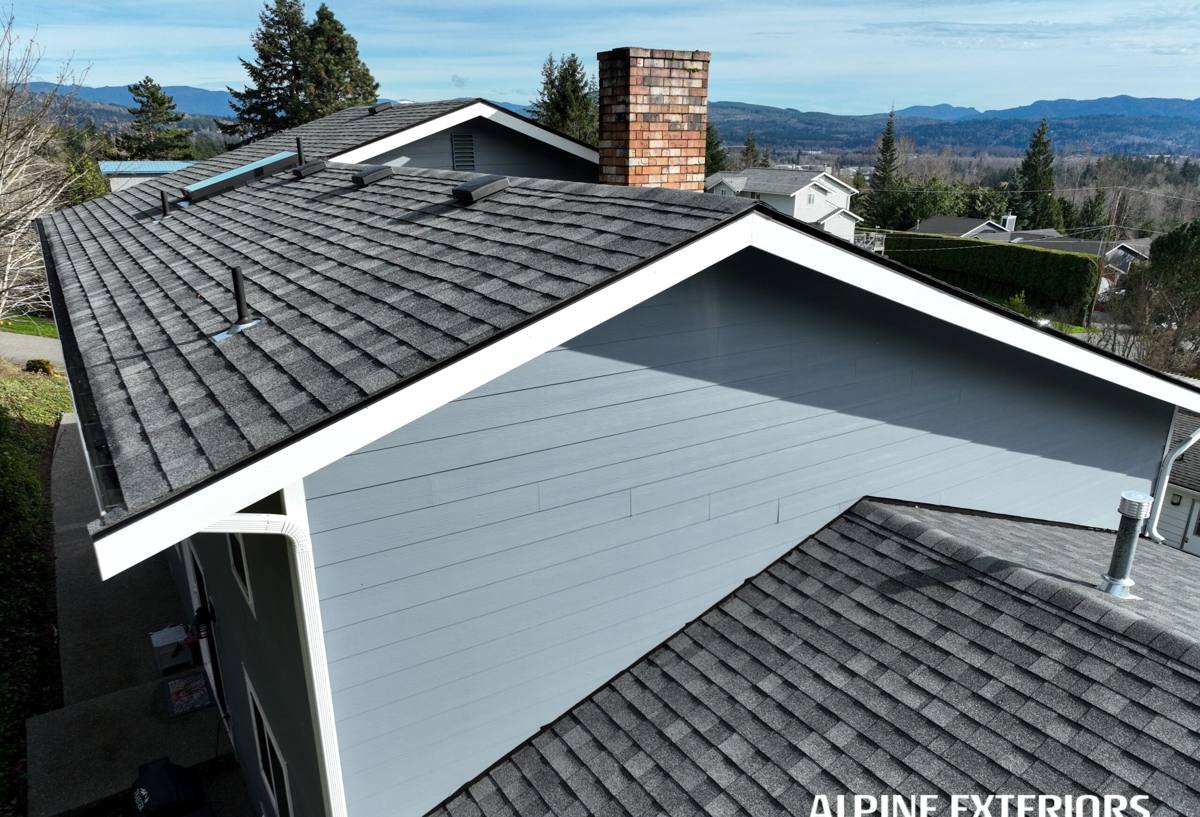
What This Climate Does to a Roof
Driving rain and wind-driven moisture
Rain in this region rarely falls straight down. Wind pushes it sideways and under roof edges, up under shingle tabs, and into any gap in flashing that wasn't sealed with the wind in mind. A roof that only has to shed water falling vertically will fail here faster than the same roof would somewhere drier and calmer. Every seam, penetration, and edge detail has to assume the rain is coming in at an angle.
Salt air and corrosion
Being inland from the immediate coastline doesn't fully protect a roof from salt-laden air moving up the Fraser Valley, especially on homes with more open exposure. Salt air accelerates corrosion on any metal that isn't properly coated — fasteners, flashing, and panel edges are usually the first places it shows up, long before the field of the roof does. This is one of the biggest reasons coating quality and fastener choice matter more here than in a dry inland climate.
Moss and prolonged dampness
Shade, moisture, and mild temperatures are exactly what moss wants, and this area gives it all three for a good part of the year. Moss holds water against roofing material, works into seams, and on some surfaces it actively degrades the material underneath it over time. A roof that's shaded by trees or sits on a north-facing slope needs a plan for moss from day one, not a reaction after it's already established.
Why Metal Roofing Fits This Area
Metal roofing addresses several of these problems directly, which is why it's a common upgrade for homeowners in this region:
- No granules to lose and no organic mat for moss to root into, which cuts down (though doesn't eliminate) moss buildup compared to asphalt shingles
- Continuous panel runs on standing seam systems mean far fewer seams for wind-driven rain to exploit
- Steep water shed on a smooth metal surface, which matters when a roof stays wet for days at a stretch
- Long service life when the coating and fasteners are matched to a coastal-influenced climate
- Better standing up to wind uplift than lighter roofing materials, relevant on more exposed lots
None of that happens automatically just because the roof is metal. The system, the coating, the fasteners, and the flashing details all have to be chosen and installed with this specific weather pattern in mind — a metal roof installed the way you'd install one in a dry, low-humidity region will underperform here.
Getting the System Right
Panel type: standing seam vs. exposed fastener
Standing seam panels use hidden clips and a raised seam, so there are no exposed screw heads for water to work around over time. Exposed-fastener panels are less expensive up front but rely on gasketed screws that can loosen or wear over the life of the roof, and in a climate with this much sustained moisture, that's a maintenance item you don't want to inherit. We'll walk through both honestly with you — exposed-fastener systems have a place on some outbuildings and budgets, but for a primary home roof in this climate, we generally steer people toward standing seam.
Coating and finish
The coating is what actually fights corrosion and UV fading, not just the base metal. Premium PVDF-type coatings hold color and resist chalking far longer than basic paint systems, which matters both for appearance and for protecting the metal underneath from the salt-influenced air common to this valley. Cheaper coatings can look fine for a few years and then fail all at once.
Underlayment and flashing
Given how much wind-driven rain this area sees, we treat underlayment as a real second line of defense, not a formality — self-adhered, high-temp underlayment at eaves, valleys, and penetrations, with the field covered by a synthetic underlayment rated for the exposure. Flashing at chimneys, skylights, walls, and valleys gets formed and sealed for this specific climate, not installed from a generic detail sheet.
Fasteners
On exposed-fastener systems, fastener quality is not a place to save money. Corrosion-resistant fasteners matched to the panel material prevent the streaking and loosening that shows up first in coastal-influenced air. On standing seam, concealed clips remove most of this concern, which is another point in their favor here.
| Factor | Standing Seam | Exposed Fastener |
|---|---|---|
| Upfront cost | Higher | Lower |
| Fastener exposure | Concealed clips, no exposed screws | Screws exposed to weather |
| Long-term maintenance | Minimal | Periodic fastener/gasket checks |
| Wind-driven rain resistance | Stronger, fewer seams | Adequate if installed and maintained well |
| Typical best use | Primary home roofs | Outbuildings, budget-driven projects |
Moss Management on a Metal Roof
Metal roofing resists moss much better than shingles, but it isn't moss-proof, especially in shaded valleys, gutters, and low-slope sections where debris collects. A few practices go a long way in this climate:
- Keep overhanging branches trimmed back to reduce shade and leaf/needle litter on the roof
- Clean gutters and valleys on a regular schedule so debris doesn't hold moisture against panel seams
- Consider zinc or copper strips near the ridge on shaded roofs, which release trace metals that discourage moss growth as rain washes over the surface
- Address moss growth promptly rather than letting it establish, since removal gets harder and riskier to the finish the longer it sits
What Correct Flashing and Edge Detail Actually Looks Like
Most metal roof failures we see on inspection don't start in the field of the roof — they start at an edge, valley, or penetration where water was given a path in. In a climate with this much driving rain, edge detail is not decorative, it's structural to the roof's ability to shed water. That means properly lapped and sealed valley flashing, drip edges that extend far enough to keep wind-driven water off the fascia, and pipe and vent flashing boots rated for long-term UV and moisture exposure rather than the cheapest option on the shelf. When we quote a metal roof, these details are priced in from the start — they're not an upsell added later.
Our Process for Abbotsford Homes
We're based in Lynden, and Abbotsford is close enough that we treat it as regular service territory rather than an occasional out-of-town job. That matters in a few practical ways:
- We're familiar with the housing stock and weather exposure common to Abbotsford neighborhoods, so we're not learning the local climate on your project
- Scheduling and material delivery are straightforward since the distance is short
- We handle the logistics of a cross-border job — coordinating timing, materials, and site access — so it's not a hassle on your end
- Follow-up visits for questions or minor adjustments after installation are easy to arrange given the proximity
Our process on a metal roofing project generally runs like this: an on-site inspection and measurement, a written estimate that breaks out panel type, coating, and flashing detail so you can see exactly what you're paying for, a scheduled install window, and a final walkthrough before we consider the job done. We don't pressure a specific panel style or coating tier — we'll tell you honestly where the cost-to-durability tradeoffs are for your specific roof and exposure.
Signs Your Current Roof Needs Attention
Whether you have an aging asphalt roof or an older metal roof, a few warning signs are worth acting on before they become bigger repairs:
- Visible moss or dark streaking, especially on shaded slopes or in valleys
- Rust spotting or streaking below fastener heads or panel seams
- Loose or lifted flashing at chimneys, skylights, or wall intersections
- Water stains on interior ceilings, particularly near valleys or penetrations
- Fading or chalking on painted metal that suggests the coating is breaking down
Any of these are worth a professional look before the next stretch of wet weather rolls through the valley.
Getting an Estimate
If you're weighing a metal roof for a home in Abbotsford, or want an honest read on whether your current roof is holding up to the driving rain and moss this region throws at it, we're happy to come take a look. There's no pressure and no obligation — just a straightforward assessment and a written estimate you can take your time with. Use the form below to get started.